In This Article

Why trust GlobalHealth Education?
-
Our in-house editorial team and healthcare advisors write and review our content.
-
The information in our content provides clarity and insights to help you compare courses.
-
We list postgraduate courses from 25+ respected and reputable institutions in Australia.
Pursuing a career as a speech pathologist means you’ll be part of an exciting, evolving and in-demand healthcare field. In Australia, there are currently 11,000 speech pathologists employed, with an expected job growth of 34.7 per cent over the next five years.
You’ll have the opportunity to support a diverse range of clients, from young children developing their speech and language skills to adults with neurological speech disorders or swallowing difficulties. The impact these professionals have on people’s lives can be profound, as they help them participate in everyday activities that most of us may take for granted.
As the scope of practice for a speech pathologist can cover people of varying ages, abilities and needs, it can be difficult to get an idea of what a speech pathologist does in their day-to-day role. This article will help illuminate this profession by offering a detailed exploration of a day in the life of a speech pathologist. You’ll gain a clearer picture of what they do for their clients, how they work with other healthcare professionals and the meaningful difference they make in their clients’ lives.
Understanding the dynamic field of speech pathology
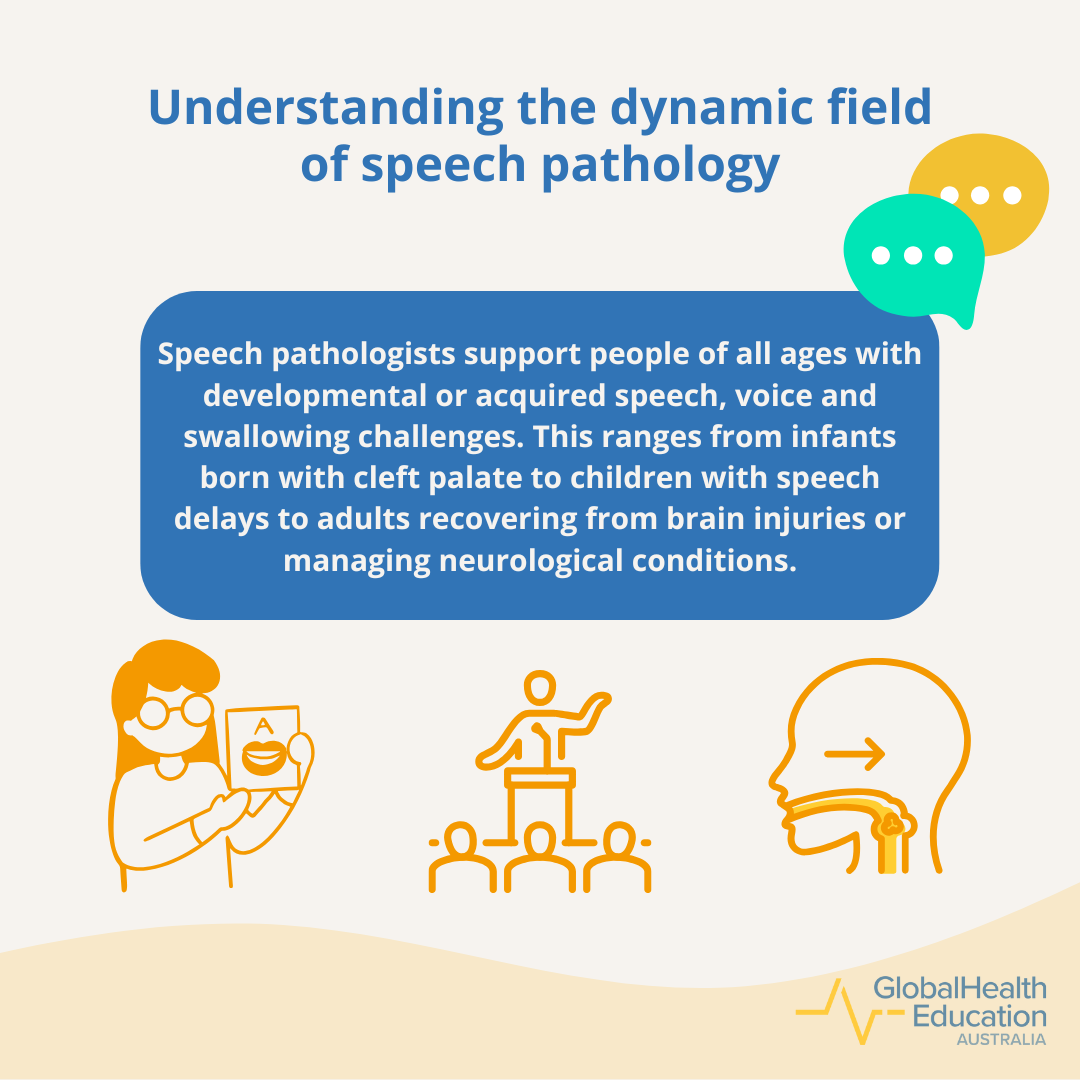
The field of speech pathology offers more variety than people may think. Speech pathologists can help people of any age who experience communication difficulties. They can also help people with problems related to swallowing, which impacts eating and drinking.
In the industry itself, the terms ‘speech pathology’ and ‘speech therapy’ are often used interchangeably. ‘Speech therapy’ may be more commonly used in private paediatric speech therapy clinics to make it easier for children to understand, whereas the term ‘speech pathology’ is often used in hospital settings. Ultimately, these two terms mean the same thing.
To gain a better understanding of the depth and breadth of clients they work with, here is a breakdown of the various conditions and challenges that a speech pathologist can support:
Developmental speech, voice and swallowing conditions
- Babies born with a cleft palate, which may impact feeding, swallowing and communication later in life
- Children and adults of all ages who have trouble communicating, whether due to having developmental speech delays that impact their ability to talk and understand others
- People who have difficulties with reading, spelling, articulating, vocal fluency or stuttering
- Neurodivergent people, including people with autism spectrum disorders or those with neurosensory problems affecting communication
- Children and young clients with social and behavioural challenges who struggle to communicate effectively
- People with speech or hearing loss who require the use of alternative or augmentative communication (AAC), such as a tablet or communication board
- Professional speakers, orators, teachers, singers or anyone who uses their voice for a living, experiencing vocal disorders or difficulties
Acquired speech and swallowing difficulties
- People who have suffered a brain injury due to stroke, motor vehicle accident, sports injury or other cause, which impacts communication and swallowing function
- Those who have had a laryngectomy, which may include total or partial removal of the larynx, throat or tongue, which impacts speech, breathing and swallowing
- People with neurological conditions affecting motor centres of the brain, such as motor neurone disease or Parkinson’s disease
- People who are at risk of choking or who have difficulty eating food or drinking fluids safely
Speech pathologists also frequently collaborate with other allied health professionals, either as part of an in-house multidisciplinary healthcare team or as stand-alone clinicians working with external providers for comprehensive client care.
There are many settings in which a speech pathologist can work, such as schools, non-profit organisations, aged care facilities, hospitals, community health centres, correctional and rehabilitation centres, universities, private practice clinics and providing home visit care.
What does a day in the life of a speech pathologist entail?
If you’re wondering whether speech pathology is a worthwhile career to pursue, here is what a typical day looks like for Emily Cox, a Certified Practising Speech Pathologist (CPSP) working in a community-based allied health organisation.
Emily obtained her qualification in speech pathology in 2015 after first completing a Bachelor of Arts in Music and Psychology. With this undergraduate degree and her previous experience as a music therapy assistant, Emily was able to enrol in and complete a speech pathology graduate entry master’s program at the University of Queensland.
Her career to date has included work in private practice, hospital environments, education, disability support and community outreach. Since graduating, Emily has enjoyed many immersive experiences through various speech pathology roles across Australia, which have helped her to understand what practice areas she enjoys. Currently, Emily works in a multidisciplinary allied health clinic that offers client-centred, tailored care and interventions for clients with a range of functional speech health challenges.
Morning routine
At home, Emily starts her day with some stretching before helping her children get organised for the day. She then enjoys a coffee while checking emails and finalising any outstanding paperwork from the previous day.
From here, she’s ready to start her day with clients. Wherever possible, she’ll aim to see a client for a home visit on her way to the office. Examples of morning clients are often adults with no school or related commitments, such as clients with progressive neurological conditions, cerebral palsy or who have experienced a stroke.
There are a range of ways that Emily supports her clients, as their needs often evolve or are ongoing.
“I could be seeing these clients for a range of reasons, including difficulties swallowing, recurrent chest infections, changes to voice quality, difficulties with word finding, setting up alternative means of communication such as apps on iPad, eye gaze devices or communication books.”
Lunchtime and breaks
Emily takes a one-hour break for lunch and depending on how busy the day is, she’ll either eat while finishing some admin or take a short walk. If time permits, she’ll sometimes read a book to give her some space between clients to clear her head.
Afternoon routine
Her afternoon consists of around two or three school-aged clients seeking help with their language and communication skills. “A lot of the young people I see are focusing on literacy, expressive language (e.g. formulating sentences, telling stories), receptive language (e.g. following directions of increasing length and complexity) and social communication (e.g. starting and maintaining conversations, perspective taking).”
Winding down
At the end of her workday, Emily aims to set aside a minimum of 30 minutes to finish any outstanding work, make phone calls, complete clinical notes and plan ahead for future sessions. Her organisation works closely with National Disability Insurance Scheme (NDIS) clients, which involves a lot of administrative work and follow-up tasks. “Seeing clients on the NDIS means a lot of extra paperwork, such as chasing up service agreements to ensure we have funding for the appointments we do.”
Emily acknowledges that administrative tasks are a time-consuming, yet necessary part of her role as an allied health provider. “I think I always believed that working as a speech pathologist would mean that most of my time was spent in front of a client – I have been surprised, particularly when working with NDIS clients, about how much time I spend preparing resources, writing clinical notes and preparing reports for clients to advocate for more funding.”
This means that on a typical workday, she’ll be able to see between three and four clients per day, plus complete the associated preparation and paperwork for each client. She sees the value in getting as much of this work done during work hours, so that she can enjoy some dedicated family time at home. “I prefer to finish all my work before going to daycare/school pick up so I can focus on the kids in the evenings/weekends.”
Scheduling her work day
In Emily’s current role as a community speech pathologist, she enjoys a regular weekday schedule, with no extra weekend, evening or public holiday work. Her organisation allows each provider to manage their own workday with full autonomy and encourages them to structure their day as they see fit.
Her role encompasses a mix of home visits, in-clinic sessions, school visits and telehealth appointments, which provides variety throughout her week. In the near future, she will also be working with older clients in aged care facilities. Emily keeps some therapy resources at home and at work, which means she is prepared to help her clients whether she is in the office or working remotely.
Emily's calendar is mostly predictable, giving a reasonably accurate idea of how her day will pan out. However, cancellations happen, which can change the flow of the day. Similarly, acute issues for clients may arise during a consultation, which requires adapting to the client’s needs in the moment. For example, “A swallow review turns into a more urgent issue if the client is aspirating and needs support to access medical help.”
Speech pathology client types and session structure
The duration of client sessions is usually 45 to 60 minutes, with initial sessions sometimes taking up to 90 minutes to allow for history taking and assessment. School-aged clients may require additional resources or time to make sure they are comfortable and to help build a strong client-therapist relationship. “For younger clients, time is usually set aside at the beginning of each session to build rapport… This might look like an ice breaker activity, e.g. UNO, conversation cards, Jenga.”
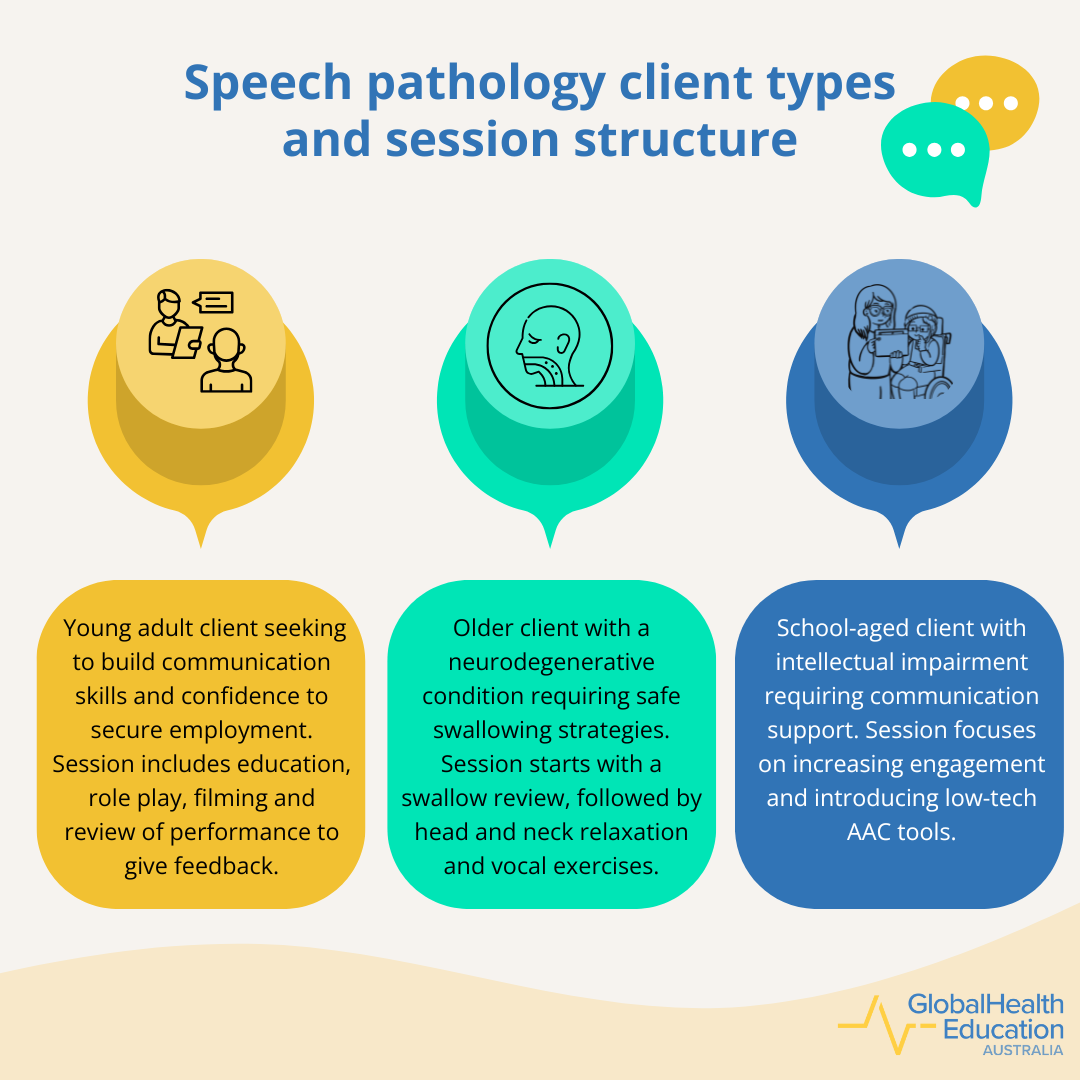
The session structure will vary depending on the type of client and their specific needs. Here are some examples of clients and what Emily will do in a session:
- A 25-year-old client whose goals include building social, public speaking and communication skills in order to obtain employment. The session might include some education, followed by filming a role-play and reviewing the footage to discuss their performance.
- A 42-year-old client with multiple sclerosis. The session might start with a swallow review to assess changes and check for swallowing safety with food and fluids, followed by voice therapy (head and neck relaxation, breathing exercises, vocal function exercises).
- An 11-year-old client with intellectual impairment. The play-based session will focus on increasing the length of engagement in each activity and introducing low-tech AAC (i.e. a communication book) while engaging in activities that are of interest to that child.
Ten minutes are set aside at the end of each appointment to go through homework and expectations around what the client will complete before the next session, along with signing any paperwork and booking in the subsequent appointments.
Progress barriers and overcoming them
Sometimes there’ll be roadblocks for clients, depending on the chronicity and severity of their condition. Emily says that this can indeed be frustrating for both the client and clinician, especially if progress appears slow or doesn’t go as expected.
Fortunately, Emily has identified some ways to navigate these barriers if they occur. Some options include conducting a short intensive block of therapy, such as twice weekly for six weeks, to encourage some more progression. Emily highlights that it’s also important to set attainable goals that keep both the therapist and client on track. She says it helps to have “Frequent check-ins with the client to ensure that goals remain functional for them [and] ensure goals are SMART so that even very small wins are noticeable and can be celebrated.”
Another alternative option is taking a break from therapy and revisiting the client later on. This gives space for both parties to reassess and set new goals. A break could be a pause on therapy for a single school term or for a longer stretch of six months for certain clients.
Finally, Emily acknowledges that sometimes she simply might not be the best fit for her client. In this situation, she says that trying a new clinician, whether it’s another speech pathologist or a different provider, can offer a fresh perspective. “The benefit of working in a larger organisation is that clients can move to new clinicians. It is important to find the right fit, so if the client is willing, trying a new clinician can be a good idea.”
The multidisciplinary team environment
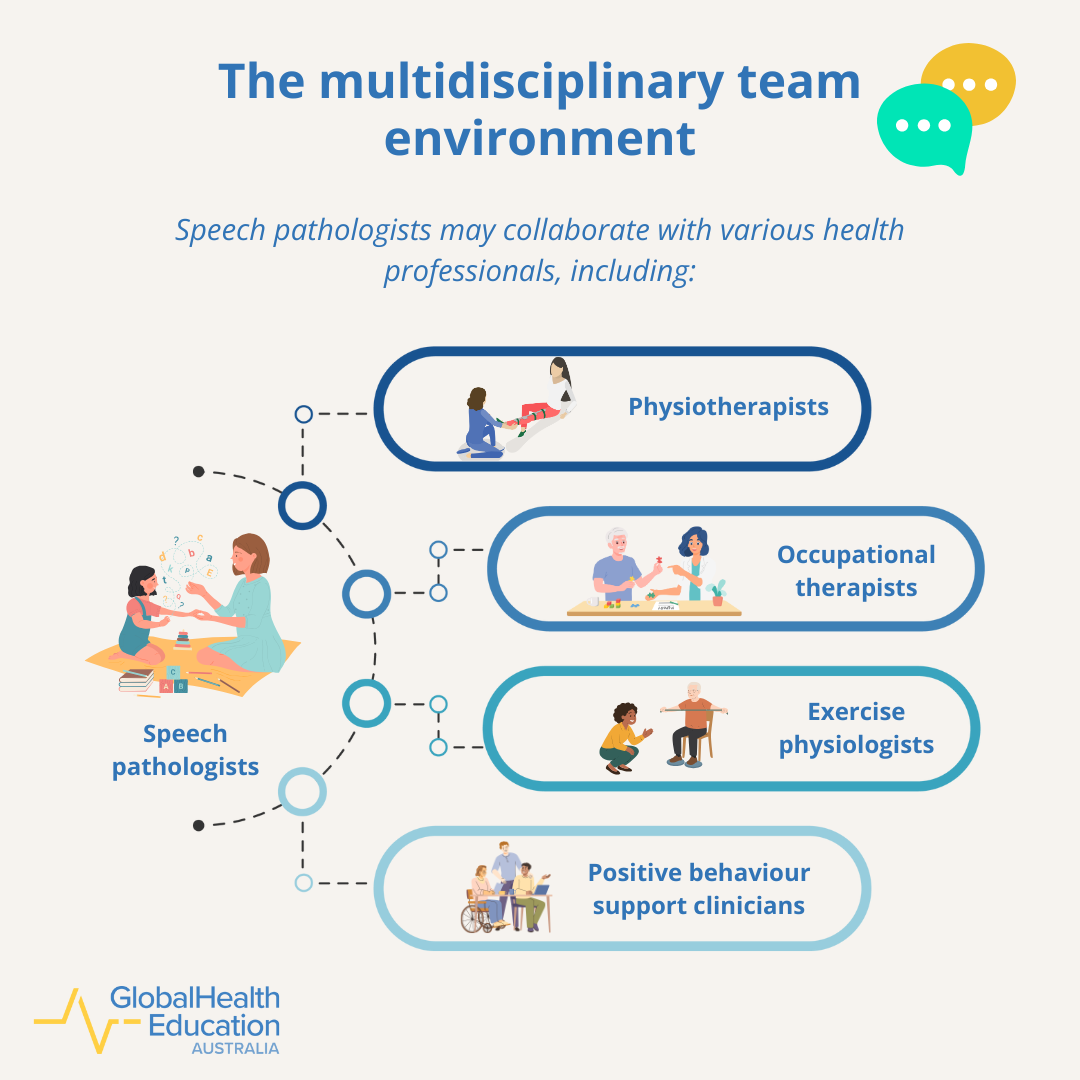
Collaborating with and working alongside other allied health professionals forms a significant part of Emily’s role in speech pathology. This is in part due to her organisation and how they prioritise the comprehensive approach that many professionals can provide to support shared goals for clients.
“Our organisation employs physiotherapists, occupational therapists, speech pathologists, exercise physiologists and positive behaviour support (PBS) practitioners. We often share clients between disciplines, so it is common to informally catch up with colleagues about shared clients while in the office throughout the day.”
The broad impact that speech, swallowing and related issues have on an individual’s life means a multidisciplinary approach is often necessary. Many clients have complex physical, behavioural, social, emotional and practical needs. For example, Emily often works closely with occupational therapists, who can provide tailored support and resources for people with functional limitations to help them live with greater confidence and autonomy. In this way, some clients benefit from having a joint consultation with two practitioners within the organisation who can work directly to provide appropriate support.
The added complexity of NDIS clients means Emily needs to collaborate with support coordinators to discuss funding and resources. Emily may also be in contact with school teachers to discuss her young client’s needs in the classroom. As part of a well-rounded approach to therapy, Emily provides education sessions on swallow safety or communication where necessary to support workers.
She will also actively engage with families and carers to ensure those caring for her clients at home, school or in residential environments are equipped and educated on what the client may need to stay safe and communicate effectively. This commonly involves providing training or education on communication books, apps on an iPad or tablet and swallow safety tips.
Rewards, challenges and finding balance
Big and small triumphs
Emily highlights some of the best parts of her role as a speech pathologist. These commonly arise from witnessing her client’s positive progress, even if it’s a small win. She recounts some memorable moments, such as “Seeing young clients say their first words and watching kids with speech errors figure out how to say words correctly.”
Capabilities that appear easy for the majority of people can sometimes be incredibly tough for those with neurological or developmental challenges that impact speech and swallowing. The ability to say a word that has previously been difficult or to swallow drinks safely can be a life-changing moment for clients. It’s also a deeply rewarding part of being a speech pathologist.
Supporting adults can be equally fulfilling, whether they’ve had a lifelong challenge or an acquired issue that impacts their daily life. Seeing a speech pathologist can help them regain some independence and help improve how they function at home, in interpersonal relationships, at work and in the community. This may include helping adult clients communicate effectively with a voice amplifier or an eye-gaze device. Similarly, providing education or advice on modifying food and fluids so a person with swallowing difficulties can safely enjoy a meal again, sometimes for the first time in years.
Professional pressures and misconceptions
At the same time, speech pathology can bring its share of challenges. In her role, Emily sometimes has to advocate for her client’s needs, especially in the case of children who require play-based interventions for optimal results. She says that sometimes parents or carers may find it difficult to understand these approaches, which can make it challenging when part of the aim is to foster a collaborative and supportive environment for her clients.
She adds that some clinicians feel that their time preparing sessions is undervalued by clients or those paying for speech pathology services. As mentioned, there is an extensive amount of administrative work and session planning involved that goes on behind the scenes. The added pressure of client preparation and staying on top of paperwork requirements can become burdensome in these roles. Emily feels that these tasks are not always reflected in the fee charged for their expertise and time. Moreover, she expresses that it can potentially detract from direct client work, which is where many clinicians feel their impact is strongest.
This underscores another point that Emily believes should be highlighted about the speech pathology field. “We don’t just treat stutters and lisps. We see a really broad range of clients and have a wide range of skills to share.” She says this is one of the biggest misconceptions and that many people think this is all a speech pathologist does. It also fundamentally diminishes how important their role and how significant their impact can be for clients.
Maintaining work-life balance
A key component to maintaining longevity in any healthcare profession is the ability to create a healthy work-life balance. Emily shares her tips on how she keeps the boundaries between work and her personal life intact so she can be effective in her role and still enjoy time with family and friends.
- Try to put my phone/laptop away on the days that I don’t work
- Make use of the “wellbeing days” offered by my organisation (a day off to focus on mental health)
- Utilise our workplace EAP (Employee Assistance Programs) or counselling if needed
- Debrief with a supervisor after any stressful work situations
- Take the pressure off – always do your best, but also know that you can’t help everyone
- Prioritise exercise outside of work to optimise physical and mental health as much as possible
Speech pathology has its pros and cons, and depending on the client type and workplace setting, it may be considered a stressful job. However, Emily’s perspective on her role and overall experience demonstrates exciting variety and opportunities to grow professionally.
Advice for prospective speech pathologists
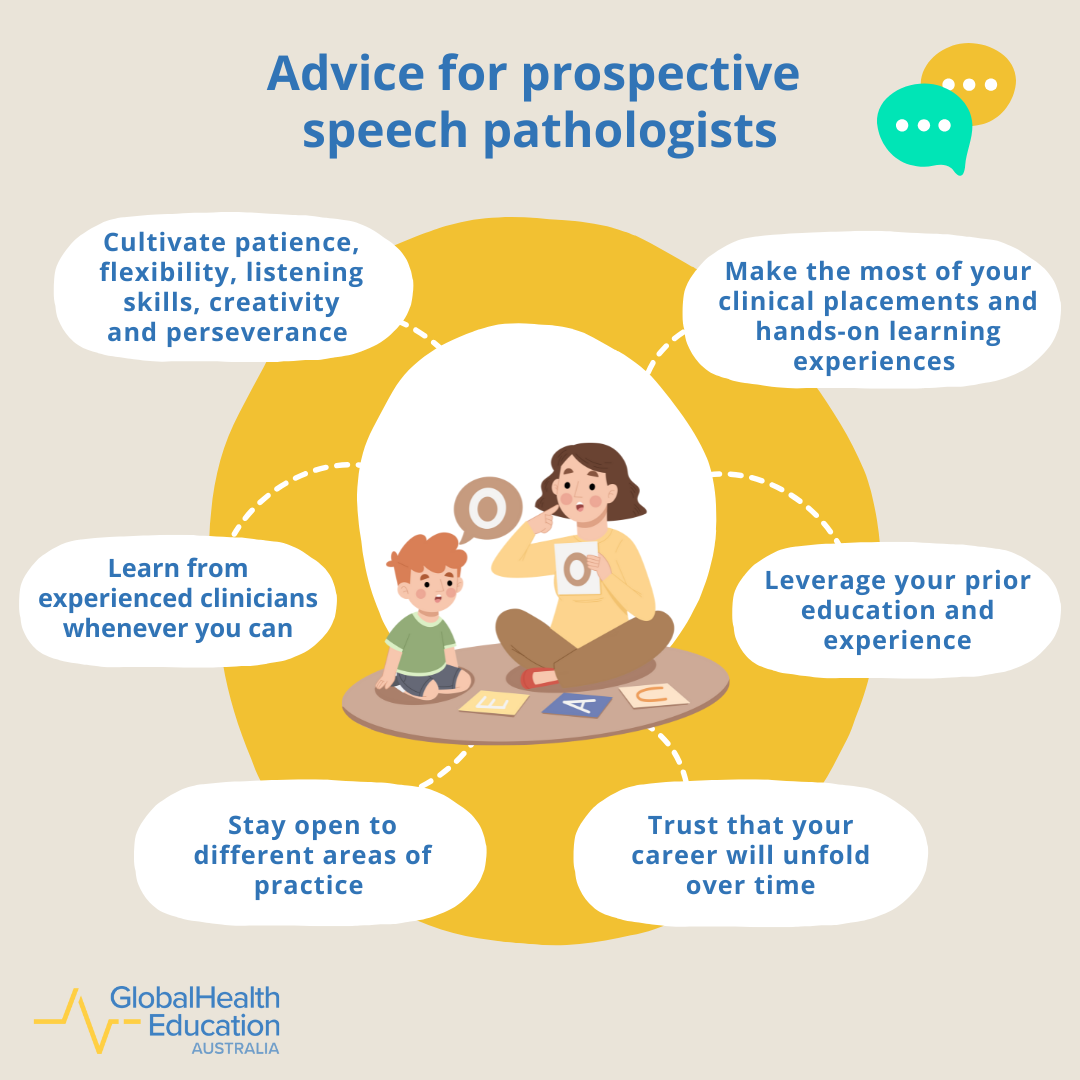
If you’re considering stepping into the field of speech pathology, Emily shares her insights and advice to get the most from your study experience and support your career opportunities.
Utilise your previous skills and experience
Emily’s background in music and psychology has provided a valuable foundation for her work as a speech pathologist. Emily’s love for music and singing has permeated her role, providing a unique depth and warmth to her work that helps create a connection with her clients. “I’ve always looked at things through a musical lens and I think music is such a powerful way to connect with people. So it’s no surprise that music and singing often play a role in how I approach therapy.”
"Because of my background in music, I’ve been able to bring it into sessions from time to time, especially with younger kids. It’s a great way to model language and support communication, whether that’s verbal or non-verbal, like using Key Word Sign.” This tool is a form of AAC that’s used globally, where the most important key words or concepts in a sentence are signed to support comprehension, build confidence and strengthen communication skills.
“Music has been incredibly helpful with my younger clients under five who are just starting to use words. Nursery rhymes are such a great tool for language learning. Singing a song repeatedly and then pausing so the child can fill in a word. It’s the best feeling when they say that word for the first time.”
Emily shares how a musical approach to speech therapy can be effective for older clients as well. “Several years ago, I worked with an older gentleman who was experiencing a loss of vocal volume and quality. He really wanted his voice to sound clearer and feel stronger when speaking with others. We tried some traditional voice therapy, but he struggled to stay motivated. When I suggested incorporating singing, his face beamed. We picked a few songs and used a microphone that lit up as his volume increased, giving him instant feedback. He loved singing Tennessee Waltz, and honestly, we both got a little teary every time he sang it.”
She mentions how her knowledge of psychology theory has supported her role, especially regarding attachment theory and how it helps her understand why a child might be behaving a certain way. She also has a well-rounded understanding of the relationship between emotions, thoughts and behaviour and how these factors can influence the way a client communicates. This may be particularly true for younger clients who are still developing their language and emotional regulation skills, making it challenging to put their feelings into words. They may not yet have the vocabulary to describe what they feel or they may feel overwhelmed and shut down instead of expressing themselves. Emily can use her childhood development knowledge when devising a plan for younger clients to help them achieve their therapy goals.
Emily’s story is a great example of how having a creative arts or music background can add value to the role of a speech pathologist. Music naturally invites playfulness and can help clients feel safe to explore their voice without some of the pressure that may accompany other approaches to speech therapy. It also shows what you can do with a psychology degree and how you can apply your prior knowledge and expertise to a new role in healthcare. If you have an undergraduate degree in a related field, you may already possess a range of transferable skills that can support your pathway into speech pathology.
Enjoy the immersive study process
A helpful first step is to think about what inherent qualities make for a successful speech pathologist. In Emily’s view, “the ability to listen, flexibility, creativity, patience and perseverance” are all qualities that speech pathologists should work towards developing.
Throughout your studies, you’ll complete clinical placements in real-world speech pathology settings. This experience provides a valuable learning opportunity and can help prepare you for a future role as a speech pathologist.
As Emily shares, “The clinical placements were incredibly helpful to prepare us to work in the field. If anything, I would have loved to have more clinical placements in a greater variety of settings.”
Gaining hands-on experience helps put theory into practice and allows you to better understand the challenges your future clients face each day. Emily adds that her experience in an anatomy lab, as well as the dysphagia (swallowing) course, was also very helpful. Trialling modified food and fluids gave her a deeper appreciation of what swallowing disorders are like for people.
She emphasises the importance of being open to different areas of practice within speech pathology, particularly as you progress through your studies. “When you’re at uni, open yourself up to the possibility of falling in love with another area of speech. I always thought I would work in acute care, but I’ve found out it isn’t really for me.”
Keep growing as a skilled clinician
Once you’re qualified, Emily says that there is equal value in specialising in one area versus being a broad practitioner supporting a range of client presentations. “I think there are advantages to both. I like that I’ve had a broad range of experience and I think that has made me a better clinician in some ways, but I think I could be a more senior clinician in my workplace if I had stayed in one area for the past 10 years. It really depends on what you want and what is most important to you.”
Emily reflects on her work experience in a remote part of Australia and how this work helped shape her professionally. “I actually did an outreach stint in 2023-24 where I flew up to Alice Springs every six weeks to see clients. This was an incredible experience because I was getting to see another part of Australia and was able to help clients who wouldn’t otherwise have had speech pathology input due to living remotely.”
When it comes to pursuing speech pathology roles and gaining a competitive edge, Emily suggests that clinicians seek opportunities to shadow other speech pathologists wherever possible. “This will help you to get a better idea of the work you would like to do and it will also look great on a CV or sound great in an interview.”
There are also specific professional development requirements that come with maintaining her CPSP status, which she must maintain annually. To uphold this status with Speech Pathology Australia, speech pathologists need to complete a minimum of two hours of cultural learning, a minimum of two hours of professional support (i.e. supervision) and a minimum of 20 hours of learning for all other categories.
Finally, Emily’s thoughts on the future job demand for aspiring speech pathologists are reassuring. “When I graduated in 2015, finding a speech pathology job was actually really tough. My peers and I were quite stressed about finding a job and starting work. I wish I had known then that within 10 years, there would be many speech pathology jobs. I would have told myself not to stress, to be calm and the right position will come along eventually.”
She says that her skills and experience are highly sought after by employers, which is good news for those looking to enter the field.
“I am constantly getting approached by recruiters and that has been the case for three to four years now. With the changes in the disability sector (i.e. NDIS) and more funding in the aged care sector, there are far more jobs now. It is a great time to be getting into the industry.”
Find your calling with a career in speech pathology
Speech pathology is a vast field with a range of exciting practice areas that give professionals variety in their careers. From paediatric speech therapy to neurogenic communication disorders and work environments that span from private practice, disability support, community health or research, speech pathology is a sector where you can grow professionally and make a meaningful difference to people’s lives.
At GlobalHealth Education, we showcase many healthcare courses from respected Australian universities. We also partner with several universities to offer healthcare courses suited to your specific study and career goals. Discover programs in a range of healthcare fields, including psychology, nursing, public health, health leadership and management, counselling, social work and mental health. Transform your healthcare career and enquire today.
If you’d like to enrol in a postgraduate healthcare degree, book a free professional development strategy call with our Education Consultant, Catriona, who is ready to help you make your next career move.