
Why trust GlobalHealth Education?
-
Our in-house editorial team and healthcare advisors write and review our content.
-
The information in our content provides clarity and insights to help you compare courses.
-
We list postgraduate courses from 25+ respected and reputable institutions in Australia.
Public and private hospitals both play vital roles in the healthcare system and nurses are central to the success of each. Nurses are important in providing essential, compassionate and evidence-based care to patients. While the core elements of nursing remain the same, the working environment, conditions and career opportunities can differ significantly between the public and private sectors.
There are various benefits of working in a private hospital and equally so in a public hospital. If you want a deep dive into the differences between public and private hospitals from a nursing standpoint, this article offers some helpful insights. We compare some key elements that impact nurses’ day-to-day work and longer term career prospects across both settings. Along the way, we highlight perspectives from nurses with real-world experience. We also provide a quiz to help you determine which hospital environment might be the right fit for you.
The most honest answer here is that it depends on what you value most in your nursing career.
In reality, choosing between a public or private hospital is not a one-size-fits-all decision. Generally, public hospitals have structured pay progression, diverse clinical experiences and clear organisational hierarchy, while private hospitals can offer more flexibility, specialised work and sometimes better work-life balance.
Both environments offer rewarding and meaningful work. Which is ‘better’ depends on where you’re at in your career, your preferred patient type, lifestyle needs and long-term professional goals.
Comparing public vs private hospitals for nurses
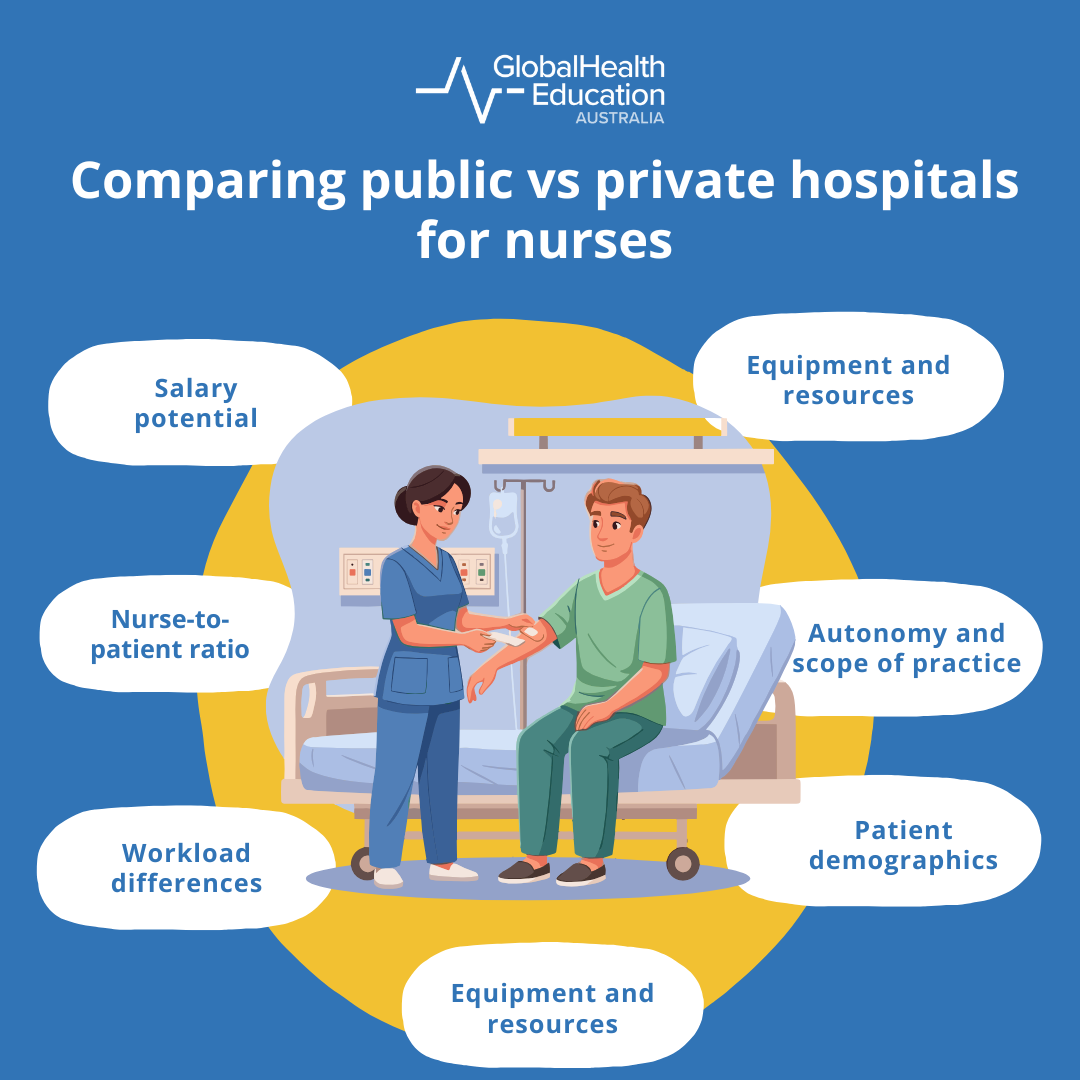
From salary structures to patient demographics, there are many factors that affect career opportunities for nurses. Below is a detailed comparison of the nursing profession in public and private hospitals.
Salary potential
Public hospitals
In public hospitals, salary potential is generally more defined and predictable. Pay rates are guided by state-based awards or enterprise agreements, offering clear and transparent progression as nurses move into higher positions.
Public sector nursing roles typically include strong superannuation contributions and leave entitlements. There are also standard penalty rates that apply to night shifts, weekends and public holidays.
Private hospitals
In contrast, private hospitals may provide greater flexibility and a broader pay range, depending on the role and setting. Salaries are usually guided by facility-specific enterprise bargaining agreements or the minimum requirements established by the Nurses Award 2020.
This can result in more variability across employers where pay is less standardised, meaning pay rates may be higher or lower for nursing roles compared to their public sector equivalent. However, some roles may include additional benefits such as bonuses, salary packaging and performance-based incentives.
Bottom line
Public sector salaries are more stable, making it attractive for nurses seeking financial stability and a clear pathway to earn more as they progress. Private hospitals offer competitive salaries, often at higher hourly rates but lack consistency across employers.
The consensus amongst nurses is that public hospitals are a better overall option regarding salary structure. Registered nurses Madeline Kessler and Michelle Deroubaix agree that while the nurse’s award exists across the board, the public system has better pay, better superannuation packages and other benefits available to nurses. Madeline adds that while public hospital pay is better, there’s always room in private sector roles for nursing pay rates to be negotiated.
Throughout both public and private hospitals, nurse salaries are influenced by factors such as specialisation, location (metropolitan vs rural), years of experience and level of qualification. Advanced practice roles, postgraduate education and working in high-demand areas can significantly increase earning potential in either sector.
For a deeper breakdown of nursing salaries and the factors that impact them, see our detailed article on where nurses get paid the most in Australia.
Nurse-to-patient ratios
Public hospitals
Most public hospitals in Australia operate under mandated minimum nurse-to-patient ratios, largely due to state legislation and strong union advocacy. These ratios are designed to protect staff wellbeing and improve patient safety. For example, in Queensland, ratios are 1:4 on morning and afternoon shifts and 1:7 on night shifts, which is applicable to medical and surgical wards. Victorian public hospitals have the same nurse-to-patient ratios during the day and are 1:8 at night.
Recently, the New South Wales Government implemented new safe staffing levels across public hospitals that target high acuity and complexity areas. The state’s emergency departments, for example, now have a mandated 1:3 ratio in generally occupied beds and 1:1 in resuscitation bays. The remaining Australian states and territories generally align with ratios seen across other jurisdictions in medical and surgical wards primarily.
Private hospitals
In private hospitals, nurse-to-patient ratios vary widely between wards, facilities and organisations. There are no nationwide legislated minimum ratios and staffing levels are determined by the specific hospital, under the guidance of enterprise agreements therein. This may mean that in some private hospitals, fewer nurses are available to care for more patients, which increases workload pressure and can result in poorer patient outcomes.
In Victoria, however, the Safe Patient Care (Nurse to Patient and Midwife to Patient Ratios) Act 2015 outlines specific ratios that are applicable to various private hospitals across the state. These include 1:4 for day shifts and 1:8 for night shifts. Importantly, across level 3 and 4 private hospitals, ratios range from 1:5 to 1:7 and a new 1:4 ratio for night shift maternity wards is due to be implemented in 2026.
Bottom line
Nurse-to-patient ratios appear to adhere to safer rules with better balance across the public sector.
While some private hospitals can safely maintain appropriate staffing levels, others may not be willing or able to do so, depending on their organisational needs. Staffing levels may be dictated by budgetary constraints, patient occupancy and availability. Ultimately, higher nurse-to-patient ratios can contribute to a greater risk of stress, burnout and patient dissatisfaction, negatively impacting staff wellbeing and the quality of patient care. Contrastly, lower ratios support better outcomes, shorter hospital stays and reduced mortality.
As Madeline works in a smaller private day surgery facility that performs endoscopic procedures, her workplace is guided by the Australian College of Perioperative Nurses standards, which specify minimum staffing requirements, including that at least one-third of staff must be registered nurses.
While Madeline has years of experience that help her feel confident managing patients, she feels that as a nurse, having more staff around you to help when things go wrong is important. She feels that for this reason, in the public sector, nurses may feel safer and more supported when making clinical decisions and providing quality care. In reality, with a higher ratio, “the ability to provide a high standard of care is compromised.”
Workload differences
Public hospitals
Public hospitals are open 24 hours a day, seven days a week. This means there is typically a higher patient acuity, more emergency presentations and a greater number of complex and chronic patient cases. The workload can be unpredictable, fluctuating across the day and night and nurses are exposed to a wide range of experiences, such as acute trauma and critical care. It involves a faster pace of work with a high likelihood of overtime and weekend shifts, depending on the role and ward. Public hospital roles can be incredibly demanding but also highly rewarding, where many nurses ‘cut their teeth’ in their profession, honing their skills and building their identity.
Public hospitals often also incur a higher administrative workload due to high patient numbers, the combination of elective and emergency care, the volume of varied health professionals and the need to adhere to government reporting requirements. Despite the potentially chaotic nature of public hospital environments, the regulations around nurse-to-patient ratios across the states and territories may be a protective factor that helps keep the workload more manageable.
Private hospitals
Patient care and the related workload is often lower acuity and more stable in private hospitals. There is a greater focus on elective procedures and planned admissions for patients, and as such, more predictable schedules for nursing and medical staff. In smaller hospitals, such as day surgery or outpatient clinics, there is also more consistency with shifts, as these facilities typically operate during standard business hours. Again, the workload within private hospitals will vary greatly by organisation, specialisation and the specific nursing role.
In relation to the workload, the associated administrative tasks are generally lower in private hospitals, especially in smaller hospitals or clinics. Instead, more focus is placed on a higher turnover of patients, particularly in environments that specialise in minimal or non-invasive procedures. However, the variation across private hospitals regarding nurse-to-patient ratios may contribute to a higher workload, depending on the type of hospital and specific patient presentations.
Bottom line
The overall workload in private settings is more predictable with less paperwork compared to public hospitals. Madeline’s direct experience in a day surgery clinic highlights these workload differences well.
“[There’s] more flexibility in the private sector. Nurses can job-share with other RNs… it’s more of an environment where you can talk to your manager and work something out.”
Madeline’s perspective shows that the smaller private organisations can typically offer more stability, predictability of work and higher patient turnover, yet better work hours overall. Provided patients recover as expected, the work can be generally less stressful. However, in situations that deteriorate or when there is insufficient staffing, the workload could change and increase suddenly.
Equipment and resources
Public hospitals
Public hospitals are government-funded facilities that usually offer patients access to a wide range of wards, units and state-of-the-art medical equipment. The experiences gained in public hospitals can help strengthen clinical skills, as nurses will need to learn how to operate a variety of everyday and advanced equipment. Some public hospitals have dedicated major trauma units and many large public hospitals are also teaching hospitals, supporting education and research, with top national and international professors and experts in the health and medical field.
Advanced imaging technologies such as MRI machines, PET and CT scanning machines, interventional radiology, pathology laboratories and genetic testing facilities are widely available at public hospitals in Australia. There are also specialised units such as neonatal intensive care units, transplant services, oncology, cardiology and neurology, as examples. The broad spectrum of services, equipment and resources available in public hospitals are to cater for the widest of population needs. Services are Medicare-funded, meaning access to public hospitals for the community is typically free. Nurses can work alongside teams of doctors, specialists, other nursing staff and multidisciplinary teams, including allied health professionals.
Private hospitals
Private hospitals may have newer facilities, greater funding and access to specialised or niche equipment. They are often funded by not-for-profit organisations or run as a private business, with patients paying out-of-pocket costs, claimable through their private health insurer with some government subsidies. They have many of the same core medical equipment and resources as public hospitals, such as imaging and pathology services. They may also invest in newer or more specialised equipment with a focus on patient experience. Private rooms with additional comforts are also more common in private hospitals.
These environments provide nurses with the opportunity to develop expertise in using equipment for a niche demographic or health area. For example, in some private hospitals, equipment such as video laryngoscopes can be used by nurses for improved airway management. Enhanced telemetry devices that monitor patients’ heart rate, blood pressure, oxygen and respiratory rates simultaneously are also increasingly used in private settings. Learning how to adapt to new or sophisticated equipment is an important part of the nursing role.
Bottom line
Public hospitals are typically structured to deliver comprehensive, high-acuity services with extensive diagnostic and emergency capabilities, making them more resourced across a wider range of population health needs.
Importantly, both public and private hospitals in Australia maintain a broad range of medical equipment and resources necessary for quality patient care. However, because the availability of equipment may vary between different private facilities, the public sector offers more opportunity for nurses to work with the latest, most comprehensive and widest range of equipment and build their competencies accordingly.
Patient demographics
Public hospitals
As mentioned, public hospitals serve diverse populations, including patients requiring emergency, trauma and critical care. They often manage more complex cases, house patients for longer hospital stays and care for those with multiple comorbidities. Public facilities also tend to provide services for people from lower socioeconomic backgrounds and those in rural or remote areas with limited access to healthcare.
This population diversity means that nurses in public hospitals must be adaptable, culturally responsive and skilled in communication across a wide range of patient needs and circumstances. They are required to work with people who may have varying levels of health literacy, different beliefs about illness and treatment and varied cultural, religious and social values that influence decision-making and engagement with care. Moreover, nurses may need to care for patients who are distressed, afraid or frustrated by long wait times. Patients may also be experiencing mental illness, cognitive impairment or present with aggressive or unpredictable behaviour. These factors place significant demands on nurses’ clinical judgement and interpersonal skills, as well as their ability to maintain professional boundaries and personal safety.
Private hospitals
Private hospitals generally care for patients who hold private health insurance or who are able to pay for their own treatment. As a result, these patients often present with lower-acuity needs or are booked in for elective surgeries rather than receiving emergency or complex care. Private hospital patients are more commonly from higher socioeconomic backgrounds and typically have greater financial capacity to choose their healthcare provider and timing of their treatments. Private facilities are frequently located in metropolitan areas, where there is greater access to specialist services and ancillary health providers.
Those seeking care in private hospitals may also have specific expectations regarding the quality of service they are receiving, continuity of care and personal comfort. This may include expectations of private rooms, shorter waiting times, increased choice of clinician and more personalised care experiences. As an example, the premium suites at the Mater Private Hospital in Brisbane offer a hotel-esque experience for mothers who are giving birth, including restaurant-quality meals, private balconies and of course dedicated nursing care. For private hospital nurses, adopting a stronger emphasis on customer service and meeting the individual needs and preferences of each patient may be required, alongside delivering safe clinical care.
Bottom line
Generally, the patient demographic in private hospitals may be less acute and therefore less distressed and easier to support. However, they may also have high expectations. Those receiving care in the public system are typically in need of more acute support, may be more complex, older or from lower socioeconomic backgrounds.
Rather than one demographic being better or worse, each demographic reflects the purpose of the setting: public hospitals prioritise universal healthcare access and complexity, while private hospitals prioritise choice, timeliness, and in many cases, service experience. In both hospital environments, nurses have an important role to play in delivering high-quality care.
Are you interested in honing your skills to work with a specific patient demographic?
Some rewarding specialisations in nursing include neonatal nursing, critical care nursing and oncology nursing. Explore the courses below to find a niche area that may interest you:
Neonatal care courses
- Graduate Certificate in Advanced Nursing (Neonatal Care) - University of Tasmania
- Graduate Certificate in Neonatal Care - Australian College of Nursing
Critical care courses
- Graduate Certificate in Critical Care - The University of Technology Sydney
- Master of Advanced Practice (Critical Care Nursing) - Curtin University
Oncology care courses
- Graduate Certificate in Advanced Nursing (Oncology Nursing) - University of Tasmania
- Master of Nursing (Cancer Nursing) - Queensland University of Technology
Autonomy and scope of practice
Public hospitals
The autonomy available to nurses in public hospitals will vary depending on their level of experience, team and applicable clinical guidelines. Nurses early in their careers may not have much autonomy at all, however, this is for good reason, as it takes time to develop skills, confidence and capabilities to deliver safe patient care. Working within interdisciplinary teams is an important aspect of working in public hospitals, rather than solo nursing.
In rural or remote public health settings, nurses often work with greater autonomy and a broader scope of practice due to the limited access to medical staff, resources and healthcare services. Nurse practitioners are a key example of this, where they can use their expertise to undertake advanced assessments, initiate treatment plans, manage emergencies and coordinate care across vast distances using telehealth services, working in smaller centres and accessing referral networks to support people in remote and under-resourced communities.
Private hospitals
Private hospitals may offer more autonomy to nurses in some roles, particularly due to the instance of lower patient volumes and less acute, more elective services delivered. There are still guidelines and protocols to follow and will be dictated by the specific organisation’s needs and nursing standards.
While nurses are expected to exercise their usual clinical judgement in patient assessment and monitoring, decision-making may be more collaborative with input still guided by doctors and the medical team. Nurses may develop closer working relationships with staff, specialists and surgeons in private hospitals, allowing for quicker decision-making and increased independence. Again, this may be more true in smaller healthcare facilities with fewer staff.
Bottom line
Registered nurses have the same level of responsibility across both sectors, with slightly more autonomy in the private sector. Differences in autonomy and scope of practice may vary depending on a nurse’s additional qualifications and the organisational needs.
Madeline says that her workplace fosters mutual respect for everyone’s role and that autonomy is a natural by-product of the regard each team member has for the other. “Whoever’s in charge of a particular task – they do it their way.”
Both Madeline and Michelle agree that within certain private settings, nurses hold more responsibility with more capacity to make their own clinical decisions. “You don’t always have doctors around in private [hospitals] and not often after hours,” Michelle says.
Do you want to build your scope of practice as a nurse?
Becoming a nurse practitioner or clinical nurse specialist can open doors to roles that attract higher pay, more autonomy and opportunities in advanced nursing settings.
Nurse practitioner courses
- Master of Nursing (Nurse Practitioner) - Edith Cowan University
- Master of Advanced Nursing Practice (Nurse Practitioner) - University of Melbourne
Clinical nurse specialist courses
- Master of Nursing Majoring in Advanced Practice - James Cook University
- Master of Advanced Nursing - The University of Technology Sydney
Career progression opportunities
Public hospitals
Public hospitals typically offer nurse-structured career progression pathways, with access to in-house education and professional development opportunities. It’s possible for nurses to progress into certain clinical roles such as emergency nursing. Similarly, there are pathways to move into leadership and management positions like a nurse unit manager or director of nursing.
Many public hospitals are affiliated with universities, professional bodies and research institutes, which provides an opportunity for nurses to be involved in teaching, research and the advancement of the nursing profession. Larger base or teaching hospitals allow nurses to rotate through multiple specialisations and try out different areas of nursing to discover what areas they might like to pursue in their future career.
Private hospitals
Career progression in private hospitals may be faster in certain contexts, particularly within smaller teams where leadership opportunities or the need to add new skills may arise more quickly. However, educational pathways may be less formalised and nurses may benefit from independently pursuing postgraduate study to support long-term career advancement.
Opportunities for advancement may require nurses taking initiative and having conversations with their team leader about their career goals and aspirations. This may be gaining expertise in a specialised area or moving into a leadership role within that service or organisation. Being honest about what you want for your career is an important first step to getting where you want to go.
Bottom line
There are clearer pathways for career progression in the public sector as a nurse.
However, both Madeline and Michelle attest to the value of being proactive and seeking out opportunities to upskill and advance your career, especially if the options in front of you don’t necessarily align with your goals. It starts with getting clear and then communicating what you need.
“If you want to branch out and shadow someone, the hospital may fund that training and support you in your upskilling,” Michelle says. “It is up to the nurse to think about what avenue they want to pursue,” she emphasises.
Have you considered moving into a nurse leadership role?
As you move through your career, opportunities to lead and support teams may become available. Positions in nurse leadership or becoming a nurse educator can be rewarding pursuits.
Nurse leadership courses
- Graduate Certificate in Nursing (Leadership and Management in Health) - University of Southern Queensland
- Master of Advanced Practice (Clinical Leadership) - Curtin University
Nurse educator courses
We have a dedicated team of nursing and career coaches who are ready to help you gain clarity and take the next step in your healthcare career. Explore our experts for personalised advice on how to unlock your career potential.
Quiz: public vs private hospitals – which one is right for you?
For each of the following questions, choose the response that best reflects your personal preferences.
1. What type of work environment appeals to you the most?
A) Fast-paced, unpredictable and clinically complex
B) A mix of novelty and stability in my role
C) Structured, predictable and same-same
2. How important is having a clear and structured career pathway?
A) Very important – I want to see where I’m going with support to get there
B) Somewhat important, but I value flexibility in my career too
C) Less important – I’m comfortable navigating my own progression
3. Which patient type do you feel most drawn to?
A) Diverse populations with complex or acute needs to build my nursing skills
B) General nursing is fine, but I may want to pursue a specialisation later
C) Elective, planned procedures and lower-acuity patients
4. What kind of environment helps you make the best decisions and deliver safe, effective care?
A) I thrive with strong team support, clear protocols and guidance from experienced colleagues
B) I work best when I have a blend of collaboration and autonomy, with the ability to consult the team as needed
C) I prefer more independence and to be trusted to make my own clinical decisions and manage my workload
5. How do you feel about shift work, nights and weekends?
A) I’m comfortable with it and expect it as part of the role
B) I ideally would like the option of both shift work and a fixed roster
C) I need more predictable hours to cater for my family and personal life
6. What's your attitude when it comes to your salary?
A) I want a salary that increases as I gain more experience (with strong super benefits)
B) I want freedom and flexibility, so I’m happy with casual work, shifts or agency nursing
C) I want to be able to negotiate my pay according to my needs and experience
7. What best describes your current career focus?
A) Building strong foundations and broad clinical experience
B) Developing my skills while I consider where I want to go long-term
C) Moving into a niche healthcare area that interests me
8. Where do you see yourself in 5 or 10 years?
A) In a senior or management role, such as a nurse unit manager in a busy ward
B) Continuing to grow my nursing skills in both large and smaller hospitals
C) In a nursing role with predictable hours, such as a smaller practice in the suburbs
Quiz results
Mostly A’s: Public hospitals may be the right fit for you
If you answered mostly A’s, you’re likely well-suited to a public hospital setting. You may be drawn to fast-paced, complex environments where you enjoy the challenge of novelty and high acuity. You’ll learn fast and grow your skills with the support of mentors and colleagues. You’ll also benefit from learning alongside interdisciplinary and multidisciplinary teams. You’re comfortable with shift work, high workloads and variety in exchange for clinical depth and long-term career security. No two days are the same in public hospitals, which provide a strong foundation to hone your knowledge and learn valuable skills – all within a well-established public health system environment.
You’re likely someone who:
- Enjoys being able to stretch yourself, learn new things and build confidence
- Wants diverse patient experiences, including chronic and complex care
- Sees the benefit in learning from those around you in a structured way
- Needs the safety of clear clinical protocols and strong teamwork
You’re the kind of nurse who grows through experiences (even challenging ones) and public hospitals give you plenty of room to rise.
Mostly B’s: You may suit either public or private hospitals
If you answered mostly B’s, you may do well in either environment – public or private.
You value flexibility with a degree of predictability. You like a bit of variety in your role balanced by some ‘same-same’ nursing. If you fall into this category, it’s possible that you’ll do well moving between sectors at different points in your life. Perhaps you’re looking for a change, going from one type of hospital to another and you want to see what next adventure awaits. Your professional path may be fluid, as you move back and forth many times. You might try your hand at casual or agency nursing in either a public or a private hospital for a different experience. Exploring both environments can help you clarify what matters most before settling long term.
You’re likely someone who:
- Wants a role that provides a mix of teamwork and autonomy
- Doesn’t align with the idea of a fixed career path
- Appreciates the value of exploring different nursing roles to see what energises you
- Keeps career growth on your radar but also wants some work-life balance
You don’t need to have it all figured out, your strength lies in your ability to adapt as a nurse and grow as your life changes.
Mostly C’s: Private hospitals may be the better fit for you
If you answered mostly C’s, a role in a private hospital could be ideal for you.
You may have worked in private hospitals and now want a different pace. Perhaps you’re a later-career nurse or are returning to work after taking a break. Private hospitals provide a level of regularity that public settings often may not. Depending on the size and location, a private hospital may operate at a lower patient load and within business hours, offering a greater sense of work-life balance. You enjoy work environments that have a clear rhythm, with a single patient demographic or more predictable presentations. In smaller settings, you also have a greater opportunity to build relationships with colleagues who are there more consistently.
You’re likely someone who:
- Needs a predictable roster that fits in with your life, family and other commitments
- Wants an opportunity to develop expertise in a niche area that you love
- Enjoys more autonomy and being trusted to make critical decisions
- Knows your value and is comfortable having conversations around pay and work arrangements
A well-defined, steady environment helps you shine, where you can confidently provide specialised nursing care.
Choose the nursing environment that works for you
Determining whether a private or public hospital is better for you depends much on your current circumstances and your future goals. The career opportunities in hospitals are broad and rewarding, with ample room to grow.
Michelle says that a common and useful path for nurses is to start out in the public system, establish skills and build confidence before moving into other roles, commonly into private care afterwards. However, she says that not all new nurses are afforded this opportunity. “30 per cent of nurses who graduate don’t get a grad program in a public hospital. They have to go into prison systems, community, aged care or the private sector.”
This concern is also highlighted by the Australian Nursing and Midwifery Federation Victorian Branch, who revealed that around 2400 Victorian nursing and midwifery students did not receive a public graduate position for 2026. While this may be the current reality for this new cohort of nurses in Victoria, it’s not necessarily representative of the situation nationwide and there are other opportunities available for new graduates to pursue. Importantly, it demonstrates that there is no single, right way to gain nursing experience and a better approach may be to remain open and take things as they come.
Comparing the two, Michelle says there are a lot more rules in public hospitals and it can take a while to settle in. The vast number of staff and rotating doctors can make it difficult to build rapport and professional relationships. In public hospitals, doctors switch over every three or six months. Whereas in private hospitals, she believes the career progression can seem faster, partly because there’s not as much hierarchy and there's often more of a close-knit team within which to build connections.
Madeline reflects on public vs private hospitals.
“Public hospitals are generally more supportive for new nurses; they are a working, teaching environment for all health professionals. They’re a great place to learn and develop skills. Private hospitals are good for nurses who have a foundational set of skills and a level of confidence.”
She says that having strong boundaries is also helpful as a nurse in private settings.
Madeline shares that there are many things that can change the trajectory of your career as a nurse. For example, when she had young children, she primarily worked weekends to fit her career in with parenting. She says that there is always a way to find the right mix of work and life. “There are roles you can get that are more 9 to 5, [such as] pathology, radiology, day procedures.” Madeline’s overall advice to nurses is to try new things to keep fresh.
Where you work matters – but upskilling helps shape your future
While your specific work environment is important, what ultimately determines how far your nursing career can progress is how you continue to develop your skills. Postgraduate study can open doors to advanced clinical roles, leadership positions and new nursing areas across both public and private sectors. Consider the courses above to see if there’s one that aligns with your career goals.
There are a range of healthcare courses available from various reputable Australian universities, including our university partners. Within the extensive range of nursing courses featured in our GlobalHealth Education catalogue, there are various specialisations to explore, including mental health nursing, geriatric and aged care nursing, perioperative nursing and midwifery, to name a few.
You’ll find graduate certificates, graduate diplomas and master’s degrees delivered both online and on-campus to suit your career goals, study needs and lifestyle. Plus, there are also many postgraduate nursing courses offered as a Commonwealth Supported Place (CSP), meaning they are government-subsidised and significantly cheaper than full-fee programs. Explore CSP nursing courses here.
Deciding on the right course can feel overwhelming. That’s why we have Catriona, our Education Consultant. She can provide expert advice that’s tailored to your needs. She’ll help you weigh up your options and find the best study path forward to suit your career. Book a free professional development strategy call with Catriona today to get started.