In This Article
- What is value-based healthcare?
- Pillars of a value-based healthcare model
- Value-based care in Australia: current landscape of this evolving model
- Key capabilities for health professionals in a value-based healthcare model
- Why postgraduate study is necessary to be equipped for value-based care
- Postgraduate courses that support a value-based approach to care
- Build your expertise to excel in value-based healthcare

Why trust GlobalHealth Education?
-
Our in-house editorial team and healthcare advisors write and review our content.
-
The information in our content provides clarity and insights to help you compare courses.
-
We list postgraduate courses from 25+ respected and reputable institutions in Australia.
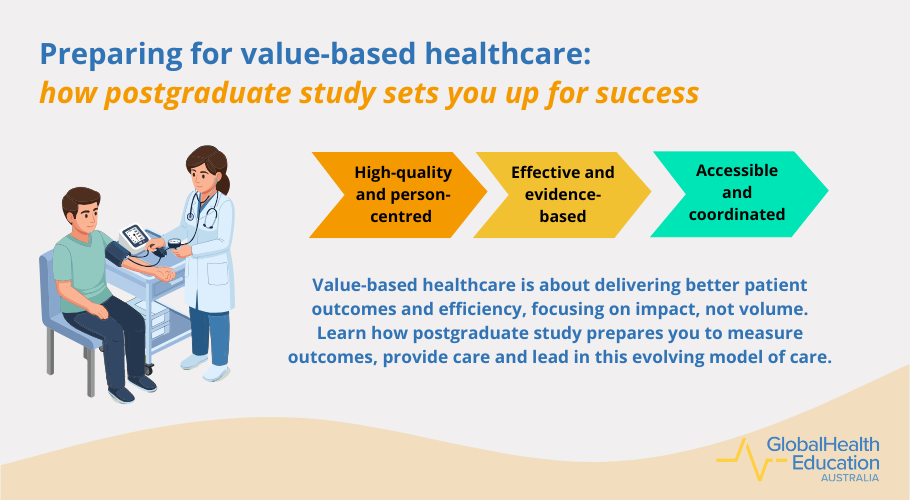
The Australian healthcare landscape is changing across many sectors, indicating a move away from systems designed primarily to treat illness toward one focused on prevention and long-term health management. As a result of the country’s chronic disease burden and ageing population, a value-based healthcare model has been introduced in certain regions over recent years to help address these challenges.
Healthcare professionals need to expand their skill set in order to succeed in a system that prioritises patient experiences and health outcomes relative to the costs involved, rather than the sole output of patients treated. This means honing clinical skills, understanding holistic patient needs and working out how systems and organisations can support these results in a financially sound way.
Read on to understand what a value-based healthcare system is and current examples of this model in the Australian healthcare context. We explore some important skills and expertise you need to build and how postgraduate study is an effective way to bridge this knowledge gap, equipping you with the tools to navigate value-based care in healthcare.
What is value-based healthcare?
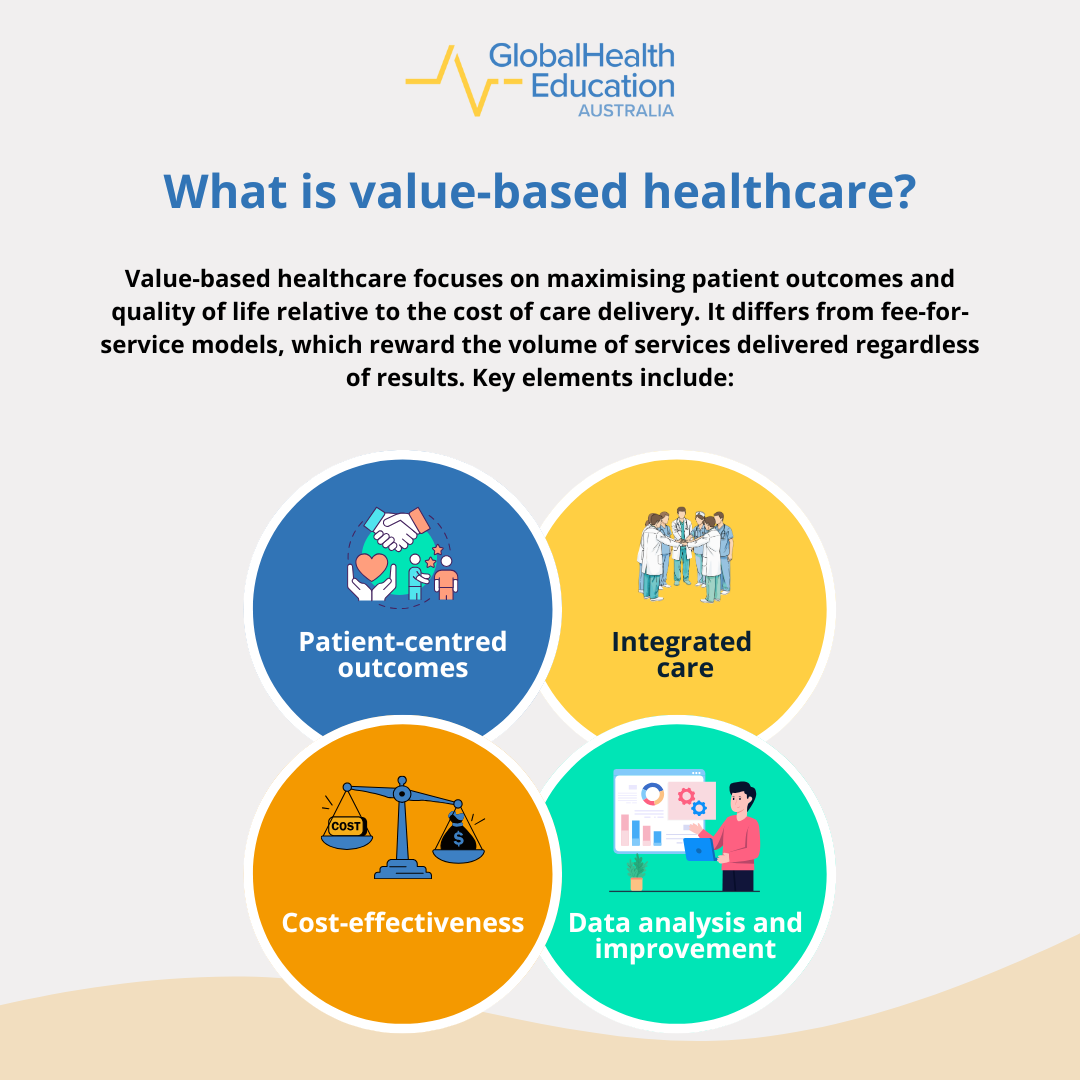
Value-based healthcare is a healthcare model based on maximising the outcomes that matter to patients relative to the cost of delivering that care. In this model, the metric for success is how many patients achieve improved health and a better quality of life following their treatment or service experience. This model first emerged as a strategy to ease pressure on overburdened health systems worldwide by reducing the estimated 20 per cent of global healthcare spending that is ineffective or unnecessary.
Value-based care is inherently different from the more traditional fee-for-service model, which currently exists as the primary model of healthcare in many parts of the developed world, including Australia. A fee-for-service model remunerates healthcare providers based on the volume of services, whether it is a healthcare visit, tests conducted or procedures carried out, irrespective of the results they deliver to patients. In contrast, a value-based healthcare model is patient-focused with an emphasis on delivering the right care, at the right time, with better results for patients and lower costs overall.
Pillars of a value-based healthcare model
Some key pillars of a value-based healthcare model include:
- Patient-centred outcomes: Care is structured around what the patient values, not just clinical indicators that drive testing and treatment. This involves a level of cultural and socioeconomic awareness toward patients and a quality-over-quantity approach.
- Integrated care: Breaking down silos between general practitioners, hospitals and allied health providers to ensure a seamless and well-integrated patient journey. This requires strong multidisciplinary teamwork skills and perspective sharing.
- Cost-effectiveness: Utilising resources where they have the most impact, as well as reducing unnecessary spending. This framework encourages providers to focus on delivering high-value, meaningful care rather than more services, ultimately lowering costs over time.
- Data analysis and improvement: Robust, transparent data that analyses outcomes, safety, quality and equity help underpin value-based care. This enables providers to track performance, benchmark against peers, improve over time and make informed decisions about the most effective care delivery.
Value-based care in Australia: current landscape of this evolving model
Australia is in the early stages of implementing a value-based healthcare system, and while there is no unified approach in place yet, many regions are already adopting this model across various initiatives. These initiatives may be installed independently or in partnership with organisations such as the Australian Centre of Value-Based Healthcare. Below are some state-run value-based healthcare examples:
New South Wales has established the Leading Better Value Care program in collaboration with the NSW Ministry of Health and other local health networks. This broader healthcare program encompasses a range of clinical initiatives, including the osteoarthritis chronic care program, which supports patients in improving their readiness for surgery through effective management of comorbidities and providing targeted exercise and lifestyle interventions.
Similarly, the Lumos program links data from general practices with other NSW health research to map patient journeys, helping policy makers and health providers within the state government understand where gaps in care exist. This program uses de-identified patient data to help determine the services needed for optimal care, as well as to assess the benefits and drawbacks of the services currently accessed by patients.
The Victorian Government, through Dental Health Services Victoria, developed and implemented Australia’s first value-based healthcare framework for public dental services to shift the system from volume-driven care to one focused on patient outcomes, early prevention, intervention and value.
Queensland is in the midst of an allied healthcare reform with the 10-year allied healthcare strategy. This initiative is in operation until 2029 and aims to optimise the allied healthcare workforce for the best care and value. A primary goal of this strategy is to increase access to high-value, personalised allied health services across all of Queensland in a timely, appropriate and effective manner.
These state-based initiatives have played a significant role in setting the direction and expectations for value-based healthcare in Australia. The programs to date have demonstrated how outcomes-focused and cost-effective funding, data analysis, prevention strategies and accessible services can be embedded into real-world practice. These initiatives may help pave the way for a more cohesive national model of care in the near future.
Key capabilities for health professionals in a value-based healthcare model
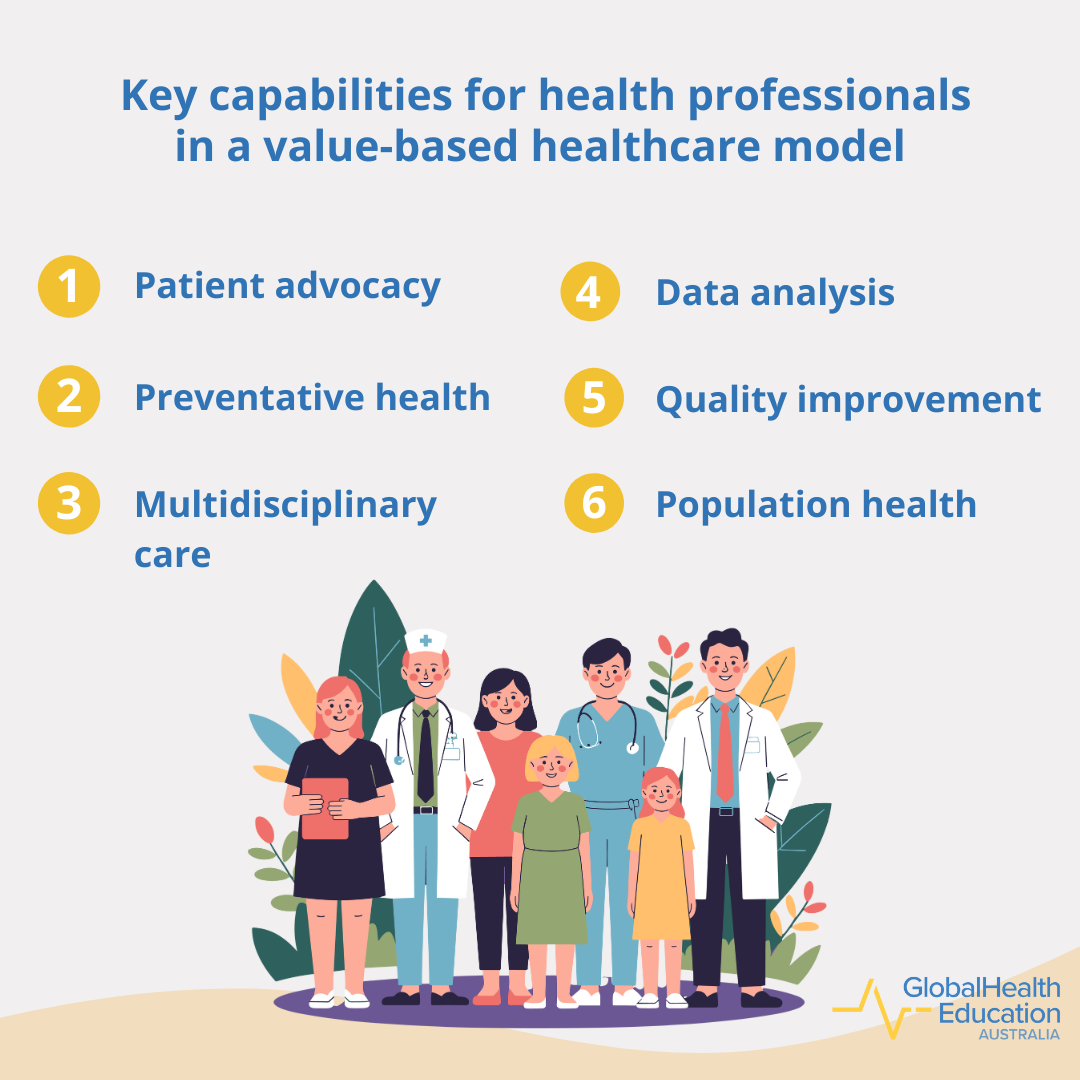
In order to meet the dual demands of both patients and organisations, you’ll need to develop a mix of technical and interpersonal skills, also known as hard and soft skills. To work well in a value-based healthcare model, you’ll need skills in:
-
Patient advocacy
In a value-based model, it’s essential that patients are heard and respected by the healthcare system and the professionals taking care of them. This means you need to work with patients to meet their health goals, acknowledge their cultural influences, educate and empower them and help them make informed decisions about the care they receive. When you help patients have a voice, especially in complex circumstances, you can support their overall health and recovery. -
Preventative health
Taking a proactive, preventative health approach can help significantly reduce the strain on the healthcare system, resources and the healthcare workforce in both acute and chronic care. Professionals such as dietitians, epidemiologists or community health nurses play a valuable role in preventive health. Knowledge of health promotion, early detection and intervention forms part of a well-developed, sustainable and efficient value-based system. -
Multidisciplinary care
Value-based care thrives on collaborative efforts within integrated, multidisciplinary teams. Professionals involved in coordinated care for an individual patient could include a general practitioner, physiotherapist, surgeon and specialist. Together, they can work towards a shared treatment plan where each professional brings a unique perspective and specialised knowledge to the team. This can lead to better health outcomes for the patient while reducing overall healthcare expenditure. -
Data analysis
The collection and interpretation of data related to patient experiences, outcomes and the health system as a whole is a significant component of a functional value-based care model. The insights gained from patient-reported outcome measures, which highlight quality of life, function and overall wellbeing, can help identify service delivery gaps. Analysing data over time can also help professionals develop more targeted interventions for certain demographics. -
Quality improvement
Identifying what’s not working and taking steps to change it is an important element of a value-based system. You’ll need to understand methodologies for assessing safety and quality, identifying risks and implementing systematic changes to improve care delivery. Health professionals should also help champion these changes and inspire their colleagues to embrace new ways of operating, with a focus on long-term outcomes rather than short-term outputs. -
Population health
It’s also important to develop skills in epidemiology and look at trends in population health. This includes assessing and interpreting the socioeconomic determinants of health, disease patterns and identifying vulnerable groups who may be at a higher risk of poor health outcomes. Taking a broader view of potential health trajectories helps facilitate more effective resource allocation, supports the development of community-based prevention initiatives and addresses existing health inequities.
Why postgraduate study is necessary to be equipped for value-based care
If you’re an established healthcare professional, you may be familiar with some of the skills mentioned above. They are an important foundation for success in a value-based care model. You may have previously worked in roles where you needed to practice patient advocacy or collaborated with other healthcare providers to deliver the best care possible, especially if your background is in clinical work. Perhaps your undergraduate degree may have covered core units on health data analysis or population health, which are widely applicable to public health professions.
However, postgraduate study offers an important opportunity to consolidate and expand on these skills, as value-based care calls for a deeper, system-wide perspective shift and a need for the ability to translate these skills into measurable outcomes at scale.
Postgraduate education strengthens strategic thinking, advanced use of data, health economics literacy and leadership in complex care environments. These are becoming increasingly essential for designing, evaluating and leading value-based models of care. There is also a greater need for providers to offer more cohesive, holistic patient care rather than support with one complaint at a time.
The future of healthcare is constantly changing and as professionals in this space, it’s important to stay relevant. Rather than arriving at the tail end of a major system change, postgraduate study positions you to move with the shift toward value-based care as it happens. Having the skills to lead and sustain this change helps ensure the next generation of healthcare workers is prepared for what lies ahead and that individuals and populations continue to benefit from better health outcomes well into the future.
Postgraduate courses that support a value-based approach to care
Postgraduate study is an ideal way to gain the strategic, analytical and clinical capabilities required for effective value-based healthcare. Below are some courses you should consider that align with the skills needed for this new era of healthcare.
Counselling and mental health
Master of Counselling at the University of Canberra
Who is this course for?
This course is ideal for those looking to develop professional counselling skills to support individuals and communities. It is particularly suited for professionals aiming to work in private practice, youth work and community services or in specialised counselling roles, like family, adolescent or relationship counselling.
What will I gain from completing this course?
This Master of Counselling includes 10 core units, including subjects such as Principles of Ethical Conduct in Counselling, Diversity Inclusion Respect and Loss, Grief and Trauma in Counselling to help you build a holistic, person-centred practice. You’ll also undertake two placement units where you can put your theoretical learning into practice. This course is also ACA-accredited, making it a suitable choice for those seeking professional recognition as a counsellor in Australia.
How does this course support a value-based approach to care?
The course supports a value-based approach to care by equipping students with evidence-informed, client-centred counselling skills. You’ll learn how to deliver compassionate, culturally sensitive care that helps empower people to prioritise their mental health as part of a holistic care plan. You’ll advocate for your client’s needs and educate them on preventative mental health strategies to better manage life’s challenges for long-term emotional and mental wellbeing.


Develop advanced counselling knowledge and practical skills through online study, supervised placement and experiential learning, with a focus on ethical practice, diversity, mental health and inclusive counselling.
Master of Mental Health at Southern Cross University
Who is this course for?
This course is aimed at any health professional with a background in health, psychology or a social science-related discipline. It provides graduates with a comprehensive understanding of mental health and psychology, enhancing their current practice and preparing them for future roles across a variety of mental health settings.
What will I gain from completing this course?
The Master of Mental Health includes 11 core units and one elective unit. You’ll complete subjects such as Mental Health Across the Lifespan, Physical Healthcare in Mental Health and Applied Leadership in Mental Health Clinical Practice. During the course, you’ll gain valuable skills to support the holistic needs of patients, providing much-needed support and helping to reduce the broader mental health burden on the healthcare system. A selection of elective subjects allows you to customise your learning experience and build the skills to match your career goals. For example, Contemporary Health Leadership, The Positive Leader and Leading Change in Healthcare can help you establish yourself as a sought-after leader for advanced mental health roles.
How does this course support a value-based approach to care?
This program integrates value-based care by building skills for recovery-oriented care that enhances patient outcomes, ensures respectful engagement and responds effectively to the diverse needs of those struggling with mental health challenges. At a community or government level, you can pursue roles that could be influential in improving the quality of mental health services in primary healthcare. This can help make spending more efficient by shifting resources toward early intervention and prevention, which improves long-term outcomes.


Delivered part-time and online, this course is designed to prepare graduates to work within a wide range of health settings and disciplines.
Master of Mental Health Nursing at Victoria University
Who is this course for?
This program is designed for registered nurses or midwives who want to specialise in and take on leadership roles in mental health nursing, with a focus on building a trauma-informed, culturally-aware and recovery-oriented practice.
What will I gain from completing this course?
This master’s degree includes 11 core units, including Recovery-Oriented Mental Health, Biopsychosocial and Cultural Perspectives in Mental Health, Promoting Cultural Competence and Community Health, Care Coordination in Practice, and one elective unit focusing either on addictive behaviours or older person care to tailor your course. You’ll learn how to build an evidence-based mental health practice with multidisciplinary care skills that help promote optimised outcomes for patients struggling with mental health conditions.
How does this course support a value-based approach to care?
Through this master’s degree, you’ll be effective in providing safe, recovery-focused patient care that centres around their needs and experiences. You’ll gain the skills to work effectively in teams, where you’ll collaborate and develop personalised care plans that address patients’ holistic needs. This could be as a coordinator or across disciplines, including allied health, primary care and specialist health professionals.


Advance specialist practice. Strengthen your ability to deliver safe, evidence-based mental health nursing care through flexible online study in recovery-oriented practice, trauma-informed care, advanced assessment, psychopharmacology and coordinated support across diverse populations.
Want to learn more about the differences between a Master of Mental Health and a Master of Mental Health Nursing? Read our comprehensive article here.
Healthcare data, quality and safety
Master of Health Services Management (Quality and Safety) at the University of Technology Sydney
Who is this course for?
This master’s degree is designed for professionals in health and social care who aspire to lead change and improve quality, safety and equity in healthcare systems. It is ideal for those seeking leadership roles in healthcare management, quality improvement or risk and safety management.
What will I gain from completing this course?
This course comprises six core units, four units to make up the Quality and Safety Major and your choice of two elective units to tailor your degree. You’ll gain critical skills for a value-based healthcare environment, with subjects such as Foundations of the Australian Healthcare System, Managing Quality, Risk and Cost in Health Care, and Quality and Safety Improvement Methods. You’ll develop leadership and analytical skills to manage healthcare services and drive innovative change.
How does this course support a value-based approach to care?
This course aligns with the principles of value-based care as it equips you with the necessary capabilities to drive change and transform healthcare services across various sectors. The expertise you gain from understanding how to implement change across health services coupled with policy and politics knowledge enables you to make a positive impact on healthcare in communities. You’ll have the tools to make important decisions at a systemic level, with downstream financial benefits for organisations, providers and patients alike.


Delivered 100% online, this course provides a deep understanding of the complexities of the Australian health and social care systems and the skills to navigate its unique politics, policy and data.
Master of Public Health (Data Analytics) at the University of Technology Sydney
Who is this course for?
This course is aimed at health professionals who are passionate about public health and the implementation of data to improve population health. It may be suitable for nurses, psychologists or other healthcare professionals who are interested in addressing local and national health challenges through epidemiological studies and evidence-based research.
What will I gain from completing this course?
The Master of Public Health (Data Analytics) provides comprehensive knowledge of healthcare systems, biostatistics and population health trends to help you thrive in a value-based model of care. Specific subjects such as Systems and Service Innovation, Implementing and Evaluating Change, Using Health Care Data for Decision Making and Managing for Value-Based Care are uniquely able to support your capabilities in assessing and applying necessary change in a value-based healthcare system.
As an entry point option, UTS also offers a Graduate Certificate in Health Analytics, which is a shorter course providing the fundamentals of epidemiology, biostatistics and data visualisation. This course could be ideal to gain and apply health data skills rapidly or it can be used as a stepping stone toward the comprehensive master’s degree above.
How does this course support a value-based approach to care?
With a focus on data-driven decision-making, this course supports a value-based care approach by equipping professionals with the skills to measure what matters, including health outcomes, equity and efficiency. You’ll be able to apply this insight to design better health programs at a community, national or global scale. You’ll also be able to assess the cost-effectiveness of interventions and provide guidance for continuous improvement as new data emerges.

Uniquely blends advanced data science with real-world public health challenges, empowering professionals to drive evidence-based policy and innovation from anywhere in the world.
Strategic healthcare management and leadership
Master of Public Health at the University of Melbourne
Who is this course for?
This course is designed for professionals interested in building advanced skills in public health theory and practice. It suits those with a background in health, science or related fields, including nursing, allied health or biomedicine. It may be ideal for individuals seeking leadership, research or policy development roles in the government and private sectors.
What will I gain from completing this course?
This postgraduate degree delivers comprehensive knowledge of public health, biostatistics and policy planning to make an impact at the local, state and federal levels. You’ll gain essential skills to be influential in value-based healthcare systems through subjects such as Public Health Leadership and Management, Health System Transformation and Advancing Health Equity. You’ll be eligible to pursue a range of roles, including health director, public health researcher and policy advisor.
How does this course support a value-based approach to care?
Upon completion of this course, you’ll understand the foundational aspects of public health, including the social determinants of health, disease prevention and community-level education. You’ll be able to develop evidence-informed policies that directly impact population health with the expertise to transform health systems for maximum effectiveness and value.


Learn from leaders in public health at Australia's #1 University.
Master of Health Leadership and Management and Master of Public Health at the University of New South Wales
Who is this course for?
This dual degree is designed for professionals aiming to lead and manage health services while addressing public health challenges. Those with an educational background and work experience in a health-related field such as medicine, health sciences, nursing, social sciences, psychology or environmental health are suitable for this double master’s degree. It is ideal for those seeking leadership roles in population health, clinical settings or health systems management.
What will I gain from completing this course?
This unique course equips graduates with expert skills to lead healthcare organisations through transitional change and address public health challenges with evidence-based strategies. You’ll complete a variety of core units and electives that are highly relevant to a value-based healthcare context. Examples of core subjects include Systems, Strategy, Policy and Change and Clinical Governance and Risk Management. You can also optionally choose to specialise in a range of areas to help shape the direction of your career, such as Aboriginal Health & Wellbeing, Epidemiology, Health Economic Evaluation, Primary Health Care or Social Research.
How does this course support a value-based approach to care?
The leadership and systems thinking skills you gain from this combined degree supports value-based care by equipping you with the tools to improve the effectiveness, quality and equity of services for specific demographics and larger populations. You can be influential in your own practice with patients or guide the development of innovative healthcare policies at a government level.


Combine public health expertise with health leadership and management through online study, building the evidence-informed, strategic and organisational capabilities to address population health challenges and improve health services and systems.
Build your expertise to excel in value-based healthcare
Moving from volume to value requires advanced skills in several areas, including data analysis, healthcare improvement, clinical care and collaboration. Explore the courses above to equip yourself for future value-based healthcare environments.
At GlobalHealth Education, we partner with universities to offer postgraduate healthcare courses across a range of fields, including health leadership, psychology, nursing, public health, counselling, social work, mental health and more. We also showcase healthcare courses from many respected Australian universities. You’ll find courses delivered online, face-to-face or a blend of both to help you advance your career.
If you’re ready to take the next step in your career but aren't sure which course aligns best with your goals, book a free professional development strategy call with Catriona, our Education Consultant. She can help you navigate your options and find a postgraduate course to suit you.