
In This Guide
- Counsellor data at a glance
- Why study counselling?
- Top Australian universities for postgraduate counselling courses in 2025
- Things to consider before studying postgraduate counselling courses
- Career outcomes for postgraduate counselling courses
- Salaries for counselling careers
- Frequently asked questions about postgraduate counselling courses
- Jumpstart your career in counselling

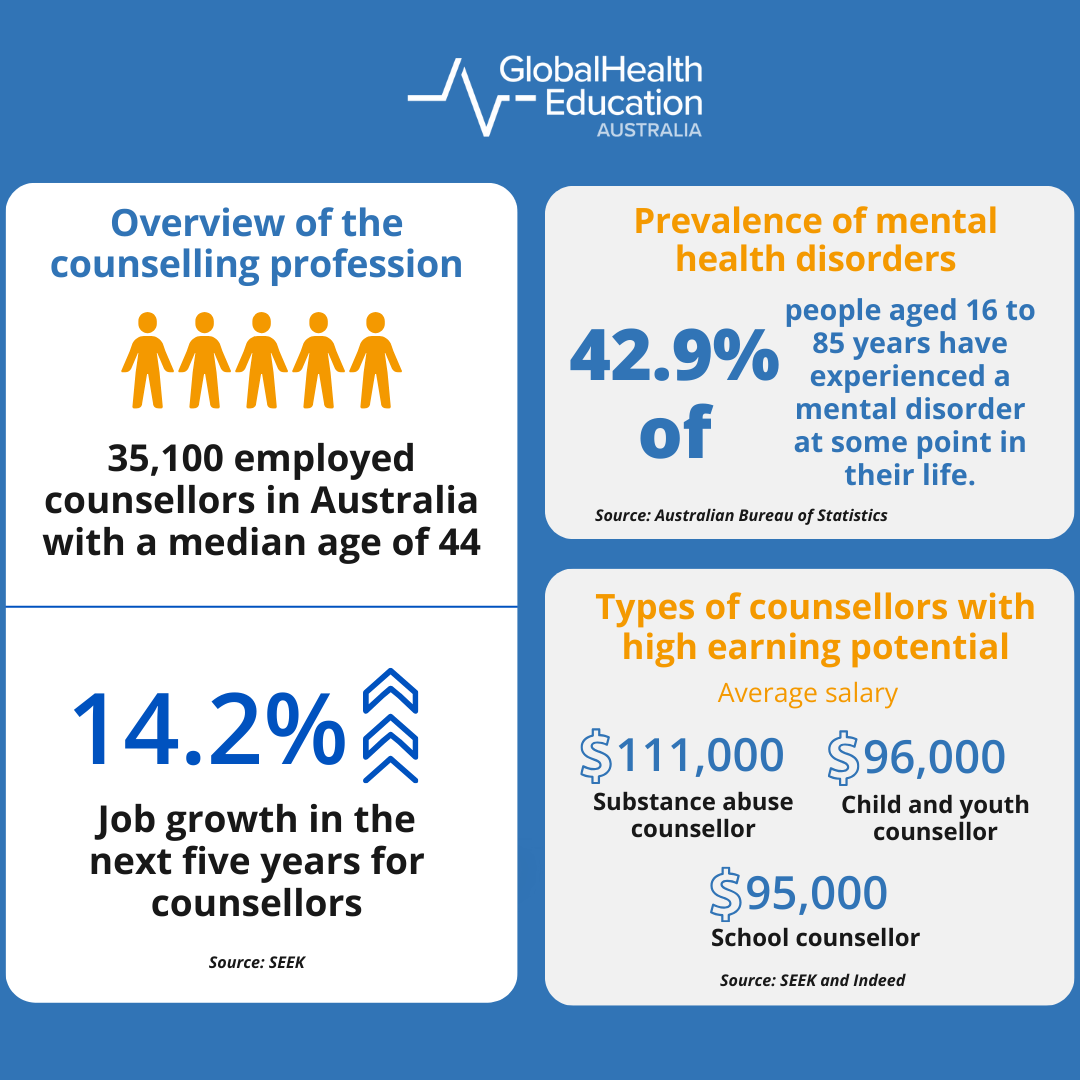
With 42 per cent of people aged 16 to 85 having experienced a mental disorder at some point in their life, the demand for mental health professionals such as counsellors has never been greater.
Obtaining a postgraduate counselling degree prepares you for a successful counselling career as you’ll learn the essential skills and strategies needed to provide compassionate, evidence-based care and support individuals effectively.
You’ll also have the opportunity to build industry connections, learn from experienced professionals in the field and network with like-minded individuals.
Counsellor data at a glance
Why study counselling?
Engage in meaningful work
If you’re looking for a rewarding profession that’s fulfilling, counselling provides the opportunity to genuinely impact people’s lives in meaningful ways.
In this career, you’ll have the opportunity to make a significant difference, guiding individuals as they navigate difficulties and equipping them with practical strategies to build resilience and overcome adversity.
Develop the skills needed to succeed in a counselling career
Counselling courses in Australia are designed to prepare you for the real world as the curriculum has a strong focus on teaching students a wide range of counselling skills that can be applied across a variety of work settings and client types.
Many counselling courses are also accredited by recognised professional bodies such as the Australian Counselling Association (ACA) or the Psychotherapy and Counselling Federation of Australia (PACFA), meeting registration requirements and enabling you to apply to become a registered counsellor upon graduation.
Additionally, courses are often developed in consultation with industry experts and taught by experienced practitioners, ensuring that what you learn is relevant and aligned with current and emerging mental health needs.
Strong job growth
As awareness and understanding of mental health continue to grow, so too does the demand for qualified counselling professionals. According to SEEK, counsellors are projected to experience an employment growth of 14.2 per cent over the next five years.
By getting a qualification such as a postgraduate counselling degree, you’ll benefit from a career that has both strong long-term job security along with the opportunity to make a meaningful impact on the lives of others.
Transferable skills for a variety of careers
While many study counselling with the goal of becoming registered counsellors, the versatile skill set developed during your studies can also be used across a wide range of professions. Whether you work in education, nursing or social work, the skills you learn from a counselling course may strengthen your ability to engage effectively with others and navigate complex human behaviours.
For example, if you enrol in the Graduate Certificate of Counselling at Edith Cowan University, you’ll complete a unit called The Role of the Counsellor, where you’ll learn therapeutic skills and verbal communication techniques, skills that are highly applicable in other fields.
An accessible pathway into healthcare
While many postgraduate healthcare courses often require applicants to have a bachelor’s degree in a health-related field, counselling is one of the few professions with postgraduate courses that often accept applicants with a bachelor’s degree in any discipline.
In some cases, relevant professional experience may also be considered in place of formal academic qualifications, making counselling a more accessible pathway for those interested in pursuing a career in healthcare.
Obtain a globally-recognised qualification
For international students, studying counselling in Australia provides a world-class education that equips you with the skills and credentials to practise counselling locally and potentially overseas.
With most courses accredited by professional bodies such as the ACA or PACFA, Australian counselling courses provide comprehensive, industry-aligned training that meets strict professional standards, ensuring you possess the competencies for a successful counselling career.
Top Australian universities for postgraduate counselling courses in 2025
While the QS World University Rankings do not specifically rank counselling, the closest relevant category is life sciences and medicine. According to the QS World University Rankings 2025, the following Australian universities are highly ranked in that subject area.
| Rankings | |
| #15 | University of Melbourne |
|
#24 |
The University of Sydney |
|
#34 |
Monash University |
|
#37 |
The University of Queensland |
|
#54 |
The University of New South Wales |
|
#99 |
The University of Adelaide |
|
#114 |
The University of Western Australia |
|
#140 |
Australian National University |
|
#193 |
The University of Newcastle, Australia |
|
#253 |
La Trobe University |
|
#253 |
Queensland University of Technology |
|
#261 |
Deakin University |
|
#261 |
University of Technology Sydney |
|
#282 |
Curtin University |
|
#289 |
Griffith University |
|
#305 |
Macquarie University (Sydney, Australia) |
|
#309 |
Flinders University |
|
#323 |
University of Tasmania |
|
#352 |
University of South Australia |
|
#352 |
University of Wollongong |
|
#359 |
Western Sydney University |
|
#401 – 450 |
James Cook University |
|
#451 – 500 |
RMIT University |
Things to consider before studying postgraduate counselling courses
Choosing to study a counselling course is an important decision, offering advantages alongside challenges. To help you make an informed choice, here are some key factors to consider.
-
- Advantages
- Diverse career opportunities
A postgraduate counselling qualification allows you to pursue a career across a variety of settings, including private practice, schools and rehabilitation centres.
With experience, you also have the option to specialise in specific areas such as grief and trauma counselling or addiction, further broadening your career prospects. - Develop skills that are applicable to your personal and professional life
When you study counselling, you’ll enhance your skills in active listening, empathy, communication and conflict resolution. While these skills will help you become a proficient counsellor, they’re also highly valuable in personal and professional settings and may help in areas such as building stronger relationships and navigating difficult conversations. - Practical learning opportunities
Many postgraduate counselling courses, particularly at the master’s level, incorporate practical placements. These placements provide a valuable opportunity to apply your theoretical knowledge in real-world settings.
For example, the Master of Counselling at the University of Canberra includes a compulsory placement of 200 hours in an appropriate setting. - Networking opportunities
You’ll have the opportunity to connect with peers, build a support network and engage with experienced professionals teaching your course. Many institutions also have strong industry partnerships, providing further opportunities to network through placements or collaborative projects.
-
- Challenges
- Financial commitment
Postgraduate counselling courses can be a significant financial investment, particularly as Commonwealth supported places (CSPs) are less common in this field. It’s important to assess your financial situation and explore financial support options such as FEE-HELP to manage the costs of study. - Time commitment
Counselling courses demand considerable time, effort and commitment. In addition to coursework, certain courses require practical placements while others may require periodic in-person attendance. If you’re managing studies alongside work and other commitments, these course demands could be challenging. - Confronting content
Studying a counselling course involves engaging with sensitive and potentially distressing subject matter such as trauma and abuse which can be difficult for some. As such, it’s essential to prioritise your own wellbeing, practise self-care and seek additional support when necessary. - Embracing vulnerability
Postgraduate counselling courses often require deep self-reflection as understanding your own values, biases and emotional responses is key to becoming an effective counsellor. While this introspective process can be rewarding, it can also be challenging for some students as it requires vulnerability and a willingness to reflect on your own experiences and behaviours.
Career outcomes for postgraduate counselling courses
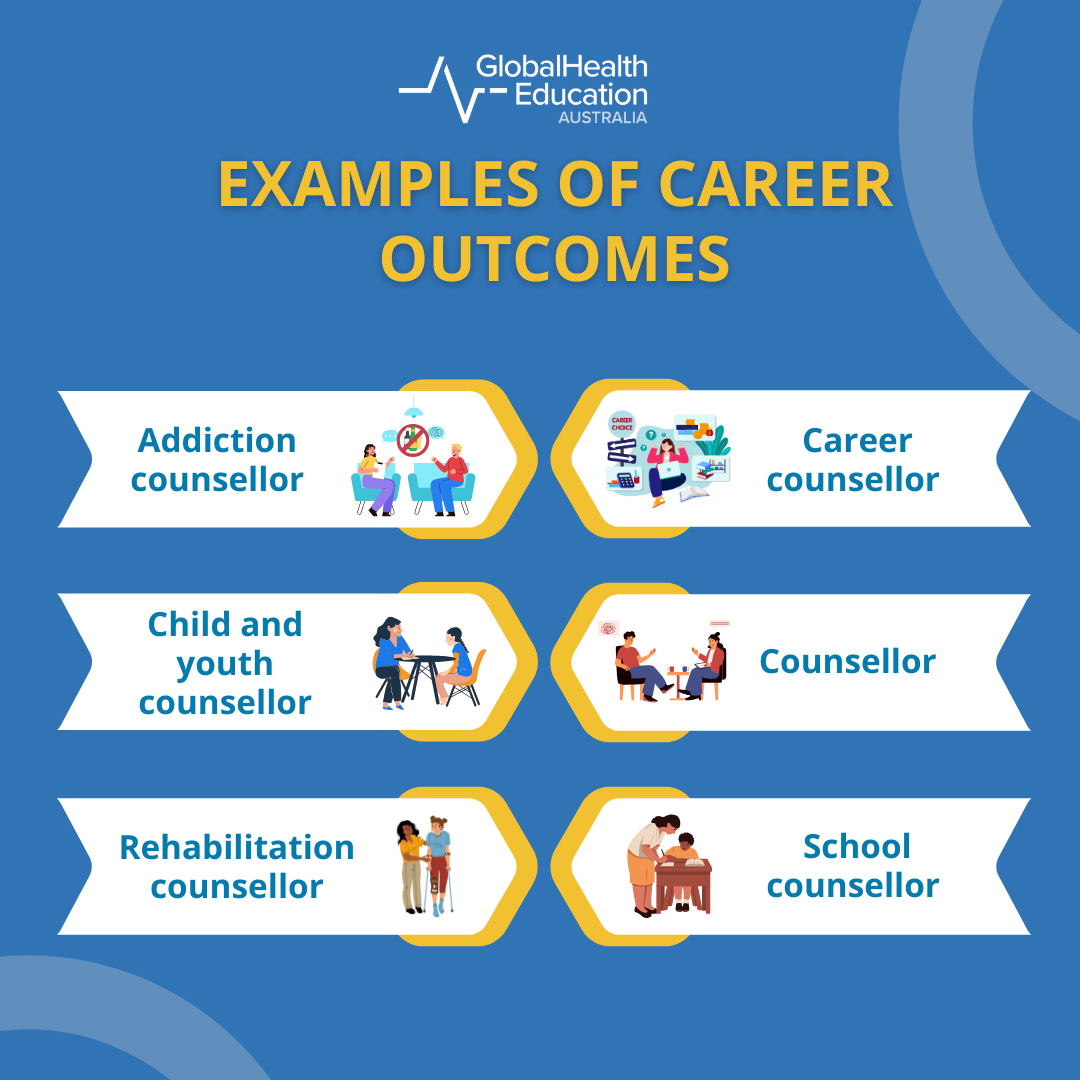
Counselling is a diverse and dynamic field, offering a wide range of career paths depending on your interests. While there are many different types of counsellors, here are some common career outcomes for those with a counselling qualification:
Career counsellor
Helps individuals explore career options, set professional goals and develop strategies to achieve them. Often works with students, job seekers or professionals seeking a career change.
Child and youth counsellor
Supports children and adolescents dealing with emotional, behavioural or social challenges. Often works in schools, community organisations or specialised youth services.
Counsellor
Provides general support to individuals, couples or groups facing a range of issues including anxiety, grief and relationship challenges.
Rehabilitation counsellor
Supports individuals living with physical, mental or emotional disabilities with the goal of improving their independence and quality of life.
School counsellor
Helps students manage issues such as anxiety, peer relationships and academic pressure by offering guidance.
Substance abuse counsellor
Specialises in supporting individuals struggling with substance use or behavioural addictions. They help clients understand the root causes of their addiction and develop coping strategies.
Sectors
Counsellors have the flexibility to work across a diverse range of sectors, reflecting the broad and adaptable nature of the profession. Examples of sectors include:
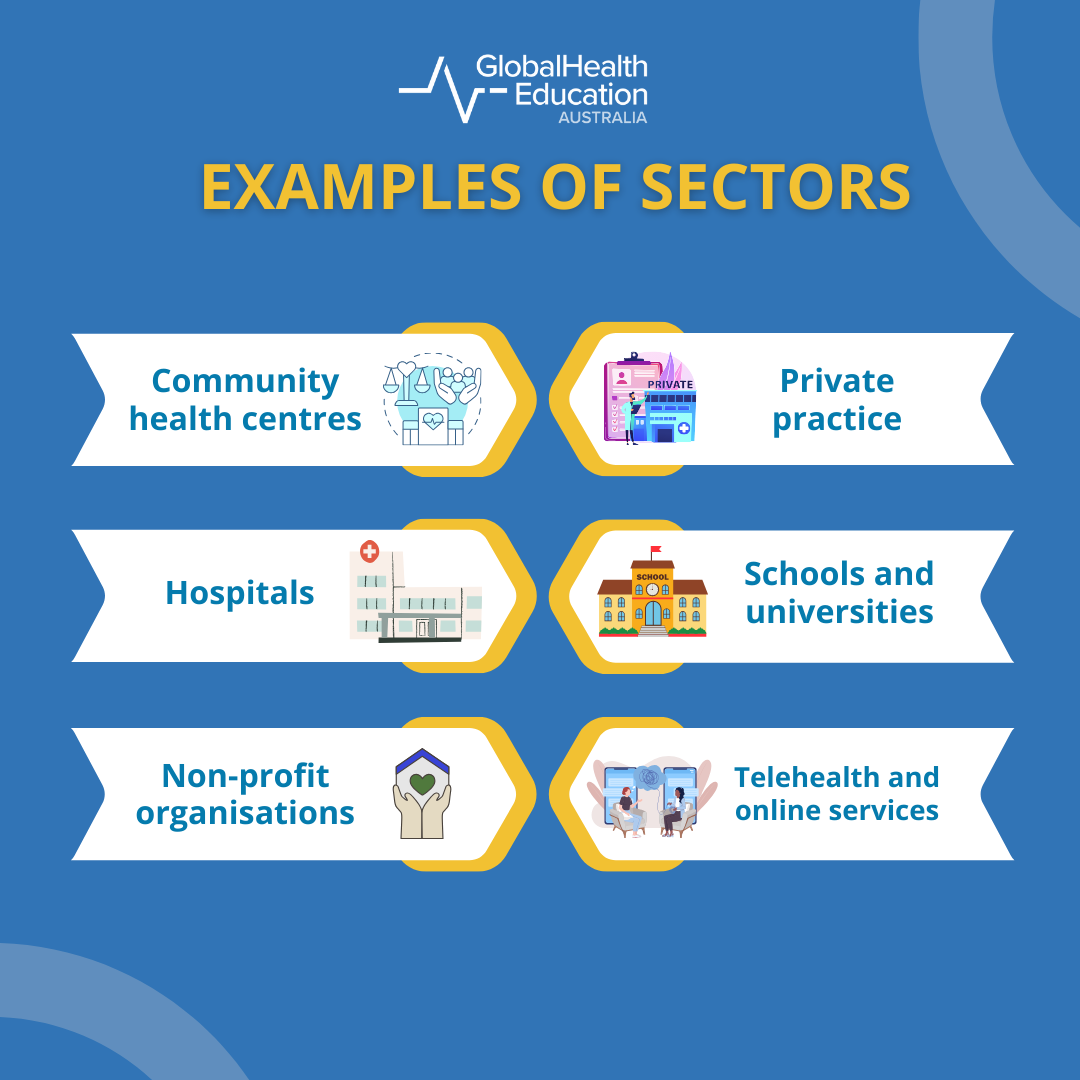
Community health centres
Offering accessible counselling services to local communities, often focusing on mental health and family support.
Hospitals
Assisting patients and their families in managing emotional responses to illness or trauma.
Non-profit organisations
Supporting individuals and communities through advocacy, crisis intervention and outreach programs.
Private practice
Provide one-on-one or group counselling in an independent setting with the flexibility to tailor services to specific client needs.
Schools and universities
Helping students manage emotional, social and academic challenges by providing guidance.
Telehealth and online services
Offering flexible, accessible counselling through virtual platforms, making it easier for clients to receive support from their own home or in remote areas where in-person services may not be available.
Salaries for counselling careers
A counsellor’s salary can vary depending on factors such as location, experience and industry. Below are the average salaries for some of the career outcomes for postgraduate counselling courses based on data from SEEK, Indeed and Talent.com.
Career counsellor
Average annual salary: $85,000
Entry-level positions start at $82,000, while experienced workers can make up to $88,000 a year.
Child and youth counsellor
Average annual salary: $96,000
Entry-level positions start at $86,000, while experienced workers can make up to $105,000 a year.
Counsellor
Average annual salary: $100,000
Entry-level positions start at $95,000, while experienced workers can make up to $105,000 a year.
Projected job growth: 14.2 per cent over the next five years.
Rehabilitation counsellor
Average annual salary: $93,000
Entry-level positions start at $95,000, while experienced workers can make up to $105,000 a year.
School counsellor
Average annual salary: $95,000
Entry-level positions start at $85,000, while experienced workers can make up to $105,000 a year.
Frequently asked questions about postgraduate counselling courses
How long is a postgraduate counselling course?
The duration of a postgraduate counselling course depends on the qualification and whether you’re studying part-time or full-time. Here’s a general guide:
Graduate certificate
Typically the shortest option and usually takes around six months full-time or six months to one year part-time to complete.
Graduate diploma
A more in-depth qualification that takes around one year full-time or between 16 months to two years part-time to complete.
Master’s degree
The most comprehensive qualification that often includes supervised placements. Usually takes anywhere between one to two years full-time or three years part-time to complete.
What are the differences between studying counselling online and on campus?
The main difference between studying counselling online and on campus lies in how the course is delivered rather than what you learn. Both delivery formats typically have similar course content and requirements, ensuring consistent learning outcomes across delivery modes.
Choosing between online vs on-campus study often comes down to personal preferences and lifestyle needs. If you’re working full-time while studying, online postgraduate study offers more flexibility and may suit you better.
On the other hand, if you value face-to-face interaction and prefer learning in a classroom setting, studying on-campus might be a better fit. Many counselling courses give students the option to study online, on campus, or in a blended (hybrid) format that combines both.
While some students may feel that on-campus learning better supports the interpersonal nature of counselling, many online counselling courses can be just as engaging. For example, Edith Cowan University ensures that their online courses have an intuitive learning environment with virtual lectures, interactive workshops and discussion forums that are designed to meet best practice online learning standards using the latest learning technology.
What are the prerequisites for a postgraduate counselling course?
The entry requirements for a postgraduate counselling course varies depending on the institution. Generally, most courses require a recognised bachelor’s degree or equivalent qualification in any discipline. In some cases, courses may also require applicants to have both a bachelor’s degree and relevant work experience.
Some institutions may also consider applicants who don’t have formal academic qualifications but have at least three years of significant and relevant professional experience.
How much does a counselling course cost?
The cost of a postgraduate counselling course ranges significantly depending on the institution and level of study. As CSPs are generally not offered for counselling, most courses are full fee-paying.
Graduate certificate
Costs range from approximately $8,500 for a Graduate Certificate in Counselling at Western Sydney University to around $17,440 for the same course at Swinburne University.
Graduate diploma
Fees typically range from $22,000 for a Graduate Diploma of Counselling at Excelsia College to approximately $34,880 for the same course at Swinburne University.
Master’s degree
Costs can range from around $34,200 for a Master of Counselling at Torrens University to approximately $67,600 for the same course at Monash University.
What are the payment options for postgraduate counselling course fees?
The most common payment option for postgraduate counselling course fees is FEE-HELP as CSPs are uncommon for postgraduate counselling courses.
FEE-HELP is an Australian Government loan scheme that allows eligible students to defer all or part of their tuition fees until they earn above a certain income threshold with repayments made through the tax system.
A CSP is a subsidised university place where the Australian Government covers a portion of the tuition fees and students are responsible for paying back the student contribution amount. CSPs are less commonly available for postgraduate counselling courses. To help manage costs, some institutions may offer scholarships or alumni discounts to reduce the financial burden. It’s best to check with your chosen institution for the most accurate and up-to-date financial support options.
What skills do graduates gain by studying a postgraduate counselling course?
While specific skills gained can vary depending on the course and institution, here’s a general guide to the type of counselling skills that you may gain.
Graduate certificate
Graduate certificates provide a solid foundation in counselling theory. Skills you may develop include:
- Foundational interviewing and counselling techniques
- An understanding of fundamental counselling theories and intervention models
- Insight into human development across the lifespan through theories of attachment and cognitive and social development
- Ethical decision-making skills applicable to diverse counselling presentations
Some graduate certificates also offer elective units, allowing you to tailor your learning to specific areas of interest.
Graduate diploma
Graduate diplomas are often more in-depth and some courses also offer a practical component and the option to specialise in areas such as couples counselling or human services counselling. Skills that you may gain include:
- Cultural competence and an understanding of best practices for working with diverse populations
- Advanced therapeutic communication and relationship building skills
- Application of advanced counselling theories such as Cognitive Behavioural Therapy (CBT) and Acceptance and Commitment Therapy (ACT)
- Clinical practice skills to prepare for supervised placements and group casework discussions
Master’s degree
Master’s courses are often the most comprehensive and typically include compulsory placements which allow students to gain hands-on experience. Skills that you may develop include:
- Research skills to critically evaluate and conduct academic work in counselling and mental health
- Advanced knowledge and skills in specialised areas such as trauma, grief and relationship counselling
- The ability to deliver counselling services in various settings
- The ability to execute advanced counselling skills including assessment and implementing appropriate interventions
What specialties are available for postgraduate counselling courses?
Postgraduate counselling courses typically offer a diverse range of specialisations allowing you to focus on a specific area of counselling.
Some areas of specialties include:
Addiction counselling
Explore the theories behind substance use and behavioural addictions. Students will develop the skills needed to support individuals using trauma-informed and culturally sensitive approaches to addiction counselling.
Child, youth and family therapy
Gain the expertise to assist children, adolescents and families in navigating complex emotional, behavioural and relational challenges.
Forensic counselling
Develop core competencies in forensic mental health practice, including understanding the criminal justice system, risk assessment and working with individuals involved in legal proceedings.
Human services counselling
Focus on counselling skills applicable to broader human services fields including addiction support, group facilitation and evidence-based therapeutic approaches for diverse populations.
Mental health counselling
Specialise in supporting clients with a range of mental health conditions using evidence-based therapies.
Relationship counselling
Gain practical skills and knowledge to work with couples and individuals facing challenges in their relationships.
How hard is a postgraduate counselling course?
The difficulty of a postgraduate counselling course can vary depending on the level of study, how well you’re able to balance your studies and how you manage the demands of placements.
Level of study
Graduate certificates are generally more manageable than other postgraduate course levels as they are shorter in duration and focus on foundational counselling concepts. They are ideal for those new to the field or returning to study after a break. Master’s degrees on the other hand, are more intensive, requiring a larger time commitment due to the greater academic demands.
Balancing study
If you’re juggling work, family or other responsibilities, managing your time effectively can influence how challenging the course feels. Those who haven’t studied in a while may find it takes time to adjust to learning in an academic setting, while recent graduates or those with fewer personal commitments may find it easier to stay on track.
Managing placements
While placements offer a valuable opportunity to apply theory in a supervised, real-world setting, they can also be demanding. For many students, it’s the first time putting counselling skills into practice with direct client interaction, which can be intense and require emotional resilience.
Additionally, placements can take up a good amount of time. For example, the Master of Counselling at Edith Cowan University requires 220 hours of professional placement, which can be challenging for some to manage alongside other responsibilities.
Jumpstart your career in counselling
Getting a degree in counselling is an important step towards developing the skills and knowledge needed to become a well-rounded counsellor.
At GlobalHealth Education, our university partners offer a range of postgraduate counselling courses at different levels to help you begin or advance your counselling career. Explore our available courses and submit an enquiry to connect with a Student Enrolment Advisor who can guide you through the application process.
Still deciding if counselling is the right path for you? Book a professional development strategy call with our Education Consultant to receive personalised advice and support tailored to your goals.