In This Article
- What is a Commonwealth supported place and how does it work?
- Is CSP available to postgraduate students?
- How much tuition does a Commonwealth supported place cover?
- How hard is it to get a Commonwealth supported place as a postgraduate healthcare student?
- Commonwealth supported place eligibility for postgraduate healthcare students
- How do I know if the course I want to study offers CSP?
- Pursue a postgraduate CSP course in healthcare

Why trust GlobalHealth Education?
-
Our in-house editorial team and healthcare advisors write and review our content.
-
The information in our content provides clarity and insights to help you compare courses.
-
We list postgraduate courses from 25+ respected and reputable institutions in Australia.

If you’re looking to enrol in a postgraduate healthcare course but are concerned about the cost, a Commonwealth supported place (CSP) may significantly reduce your tuition fees and make further education more accessible.
In this article, we’ll cover various aspects pertaining to postgraduate Commonwealth supported places in healthcare, answering questions about how much tuition a CSP covers, how hard it is to get a place, eligibility criteria and more.
What is a Commonwealth supported place and how does it work?
A Commonwealth supported place (CSP) is a government-subsidised place at an Australian public university or an approved private higher education provider.
With a CSP, the Australian Government subsidises a portion of your tuition fees, thereby lowering the overall cost of your course.
This government subsidy is not a loan so you won’t need to repay the subsidised amount. You will, however, need to pay for the remaining portion, also known as the student contribution amount.
How to get a Commonwealth supported place
- Check CSP availability and eligibility
• Check the higher education provider’s website to see if CSPs are offered for your course. Contact the institution directly if you’re unsure.
• Ensure that you meet the eligibility criteria, including citizenship and residency requirements. - Apply for your chosen course
• Before submitting a CSP application, you must first apply for, receive and accept an offer for your chosen course. - Submit a CSP application
• Submit the electronic Commonwealth Assistance Form (eCAF) before the census date. - Application assessment
• CSP applications are assessed by the higher education provider and allocated based on factors such as academic merit and whether eligibility requirements are met. Payment and loan options
• If you are awarded a CSP, you only need to pay the student contribution amount, while the government covers the rest through a subsidy.
• You can choose to either pay the student contribution amount upfront or defer the payment through HECS-HELP.
CSP vs HECS-HELP vs FEE-HELP
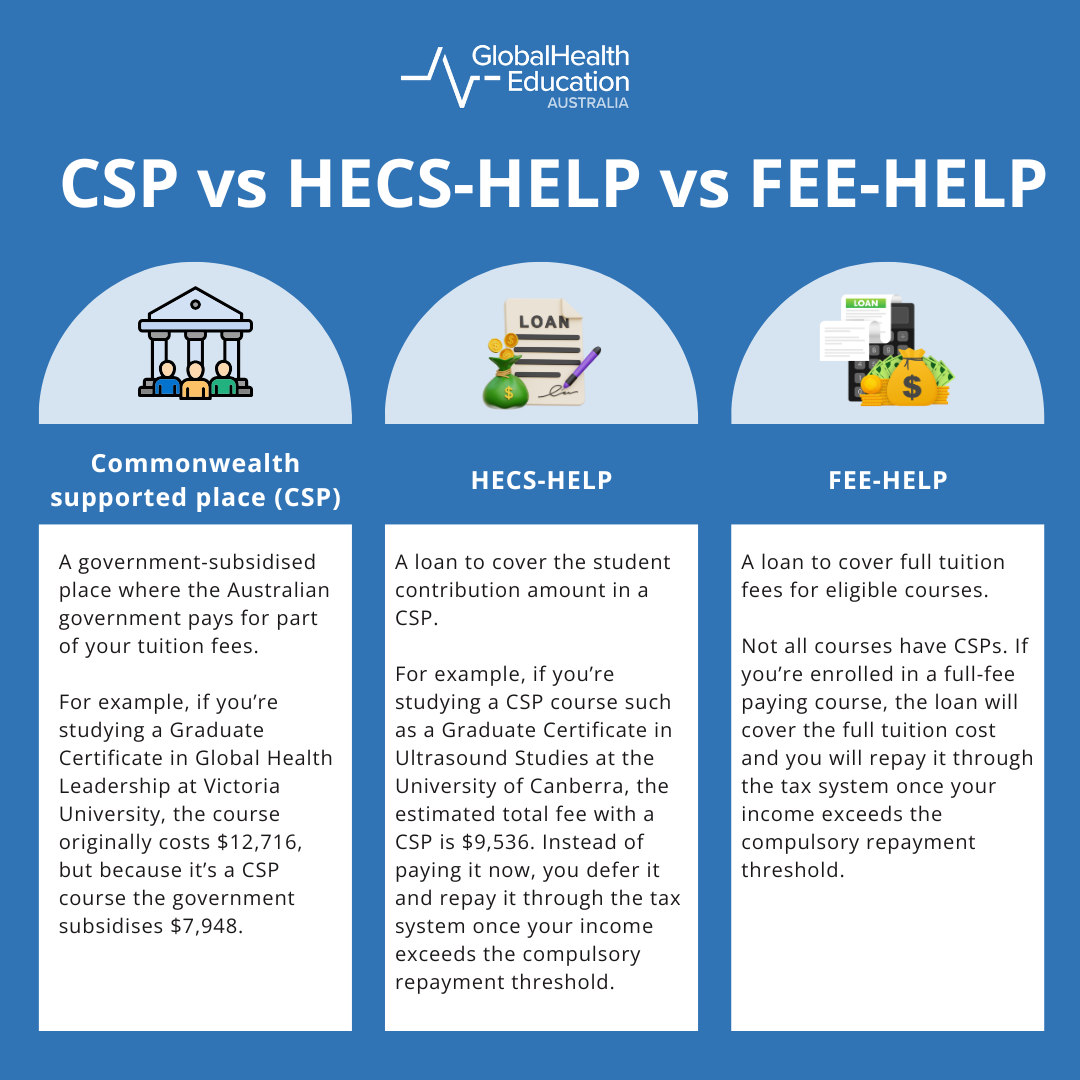
When it comes to higher education loan schemes, CSP, HECS-HELP and FEE-HELP are the three most common funding arrangements. While a CSP reduces tuition fees through a government subsidy, HECS-HELP and FEE-HELP are loan programs designed to help students defer their fees.
The table below breaks down the key differences between these options:
| Commonwealth supported place (CSP) | HECS-HELP | FEE-HELP | |
|---|---|---|---|
| What is it? | A government-subsidised place where the Australian government pays for part of your tuition fees. | A loan to cover the student contribution amount in a CSP. | A loan to cover full tuition fees for eligible courses. |
| Who uses this scheme? | Mostly undergraduate students as CSPs are more readily available for undergraduate courses. Some postgraduate students also use this scheme as CSPs are available for some postgraduate courses. | Students who need to defer their student contribution amount. | Students who are enrolled in a full-fee paying course. |
| How does it work? | The government subsidises part of your tuition fees and you pay the remaining student contribution amount. | You defer your student contribution amount through a government loan. | You can borrow the full tuition cost for eligible courses through a government loan. |
| What will I need to pay? | The student contribution amount. The government covers the rest. | Nothing upfront but you will eventually need to repay the loaned amount through the tax system once your income exceeds the compulsory repayment threshold.
The threshold for the 2025-2026 income year is $67,000. | Nothing upfront but you will eventually need to repay the loaned amount through the tax system once your income exceeds the compulsory repayment threshold.
The threshold for the 2025-2026 income year is $67,000. |
| What is the borrowing limit? | There is no borrowing limit as the student contribution amount is pre-determined based on government subsidies for the course. | As of 2026, the HELP loan limit is $129,883 for most students but can vary depending on the course. | As of 2026, the HELP loan limit is $129,883 for most students but can vary depending on the course. |
Is CSP available to postgraduate students?
Yes, CSPs are available for postgraduate courses but they are much more limited compared to undergraduate courses.
The majority of government funding for CSPs is directed towards undergraduate programs, meaning fewer subsidised places exist at the postgraduate level.
For example, in 2022, the Department of Education announced 20,000 additional CSPs for 2023 and 2024 but these were only for sub-bachelor's and bachelor's-level courses, not postgraduate courses.
Unlike undergraduate CSPs which are more widely available, postgraduate CSPs are harder to come by and their availability depends on several key factors:
- Government funding allocation
Higher education providers are allocated funding from the government for CSPs, however, as funding priorities change each year, some courses may offer CSPs one year but not the next.
- Field of study
Field of study CSPs are typically offered to courses which meet areas of national priority, skills needs and workforce shortage. Some examples of these areas include teaching, information technology, nursing, psychology and social work.
- Course type
CSPs are typically only offered for select postgraduate coursework degrees. There are no CSPs offered for research master’s degrees.
How much tuition does a Commonwealth supported place cover?
The amount of tuition covered by a CSP depends on what you study. Each unit of study in your course falls into a funding cluster, which determines:
- How much the government subsidises
- How much you need to pay (your student contribution amount)
Since courses are made up of multiple units, you may have different student contribution amounts depending on the subjects you take.
Here’s a breakdown of the 2026 maximum student contribution amounts for each funding cluster:
| Funding cluster | Fields | 2026 maximum student contribution amount (per equivalent full-time student load (EFTSL) |
|---|---|---|
| Cluster 1 | Law, accounting, administration, economics, commerce, communications, society and culture | $17,399 |
| Cluster 2 | Education, postgraduate clinical psychology, English, mathematics or statistics | $4,738 |
| Allied health, other health, built environment, computing, visual and performing arts, professional pathway psychology or professional pathway social work | $9,537 | |
| Cluster 3 | Nursing, Indigenous and foreign languages | $4,738 |
| Engineering, surveying, environmental studies or science | $9,537 | |
| Cluster 4 | Agriculture | $4,738 |
| Pathology | $9,537 | |
| Medicine, dentistry or veterinary science | $13,558 |
How hard is it to get a Commonwealth supported place as a postgraduate healthcare student?
Securing a CSP as a postgraduate healthcare student can be challenging due to limited availability and strong competition. Here are some factors that may influence whether you get a CSP and what you can do to strengthen your application:
-
Academic merit
CSPs for postgraduate students are not automatically granted and are often awarded based on academic performance. Higher education providers tend to prioritise applicants with a high grade point average (GPA) or weighted average mark (WAM) in their undergraduate degree and in some instances, relevant professional experience in the field.If you’re still completing your undergraduate degree, focus on maintaining strong grades. If you’ve completed your undergraduate degree and are applying for a CSP, make sure you’re highlighting any work experience, internships or research that may be relevant to the course.
-
Competitiveness
Postgraduate CSPs are quota-based, meaning only a set number of places are available each year. Higher education providers receive a specific amount of funding from the government and must decide how to distribute this across different courses.To circumvent this, you can try applying as early as possible as CSPs may be allocated on a first-come, first-served basis. You can also boost your chances of securing a CSP by applying to multiple higher education providers that offer CSPs in your field.
- Course and field of study
CSPs are more likely to be available in postgraduate healthcare courses that are considered workforce priorities, so you may have a higher chance of getting a CSP if you apply to a course that offers CSPs in these fields. In healthcare, these may include areas such as nursing and clinical psychology.
Commonwealth supported place eligibility for postgraduate healthcare students
To be eligible for a CSP in a healthcare course, you must meet certain citizenship, residency and course-related requirements, which include:
-
Citizenship and residency requirements
To qualify for a CSP you must be:
• An Australian citizen who will study at least one unit of your course while living in Australia
• A New Zealand citizen who will study the entire course while living in Australia
• An Australian permanent visa holder who will study the entire course while living in Australia
• An eligible former permanent humanitarian visa holder or a Pacific engagement visa (PEV) holder who will study the entire course while living in Australia - Enrolled in an eligible postgraduate healthcare course
CSPs for postgraduate students are not available for all courses, so it’s important that you’re enrolled in a postgraduate healthcare course that offers CSP. - Meeting selection criteria
Postgraduate CSPs are not automatically granted and higher education providers typically assess students based on course entry requirements and academic performance. These course entry requirements may include conditions such as:
•Having a Unique Student Identifier (USI) prior to the first census date of your course
•Having sufficient Student Learning Entitlement (SLE) available
•Not undertaking more than two years worth of higher education study within 12 months unless your higher education provider has approved you to take on more
How do I know if the course I want to study offers CSP?
Not all postgraduate healthcare courses offer CSPs, so it’s important to check before applying. Higher education providers usually indicate whether a CSP is available for a course on their website but the information may not always be obvious. Here’s how you can determine whether your course offers CSP.
-
Check the higher education provider’s website
The easiest way to check if the course you want to study offers CSP is to visit the higher education provider’s website, search for your chosen course and look for a section titled “fees”. Once you’ve toggled to this section, you will be able to see if it offers CSPs or if it’s a full-fee paying course.Some websites also have a dedicated page for information on postgraduate CSPs which may be titled “postgraduate CSP courses”, “CSPs for postgraduate study” or “course fees and CSP availability.”
-
Download a course guide
Some higher education providers have detailed course guides that outline whether CSPs are offered and how they are allocated. These guides may also explain the selection criteria for CSPs in further detail.If CSP availability isn’t clearly listed online, you can:
- Contact the higher education provider directly
If CSP availability isn’t clearly stated, you can contact the higher education provider directly via phone or email. -
Speak to an advisor
Some higher education providers have course advisors who can provide personalised guidance on CSP eligibility and availability. Depending on the institution, these advisors may also be referred to as student advisors or learning advisors.At GlobalHealth Education, for example, you can speak with our Education Consultant, Catriona, who can help you with information on CSP availability, application requirements and eligibility criteria for courses in our course catalogue.
Pursue a postgraduate CSP course in healthcare
A CSP can significantly reduce fee costs, making further study more accessible. While securing one can be tricky, maintaining strong grades, showcasing relevant work experience, applying early and for courses in high-demand healthcare fields may improve your chances.
Take a look at the full list of CSP courses offered by various reputable universities in Australia. Courses are available in a range of disciplines, including counselling, mental health, nursing, psychology, social work, public health and more.
If you’re interested in exploring your options or have questions about a specific course, book a free professional development strategy call with our Education Consultant, Catriona.