In This Article
- Which state or territory pays nurses the most in Australia?
- Average salary for nurses in Australia
- What factors influence pay for nurses?
- Why is there a pay discrepancy for nurses across Australia?
- Which state or territory offers the best quality of life for nurses?
- Increase your nursing salary with a postgraduate nursing course

Why trust GlobalHealth Education?
-
Our in-house editorial team and healthcare advisors write and review our content.
-
The information in our content provides clarity and insights to help you compare courses.
-
We list postgraduate courses from 25+ respected and reputable institutions in Australia.
Nurses are the heart of Australia’s healthcare system. With over 450,000 nurses and midwives nationwide, they represent the country’s largest sector in the health workforce, delivering essential care across hospitals, aged care facilities and community health services.
If you’re a nurse contemplating a move to a different state or territory, understanding how much you’ll get paid is essential. This article highlights where nurses are paid the most in Australia, looks at factors that influence pay and explores which state or territory offers the best quality of life for nurses.
Which state or territory pays nurses the most in Australia?
The Australian Capital Territory (ACT) currently pays registered nurses the most, with an average annual salary of $115,000.
ACT nurses earn approximately 21 per cent higher than the national average registered nurse salary of $93,000. They also earn 26.6 per cent more than South Australian nurses, who sit at the lowest end of the pay scale with an average salary of $88,000 per year.
Queensland comes in second, with registered nurses earning an average of $95,000, which is 2.15 per cent higher than the national average.
While nurses in the ACT receive a higher base salary, nurses in Queensland have stronger earning potential once benefits are factored in. In comparison to nurses in the ACT, Queensland nurses benefit from a higher employer superannuation contribution, along with access to higher bonuses and incentive rates.
How do other nursing roles compare?
When it comes to more senior or specialised roles such as clinical nurse specialists, nurse unit managers and mental health nurses, the Northern Territory consistently ranks as the highest-paying location.
| Role | Average Northern Territory salary | National average | Difference |
|---|---|---|---|
| Clinical nurse specialist | $151,000 | $120,000 | 25.83 per cent higher |
| Nurse unit manager | $175,000 | $135,000 | 29.63 per cent higher |
| Mental health nurse | $121,000 | $90,000 | 34.44 per cent higher |
Average salary for nurses in Australia
Based on SEEK data, the average salary for registered nurses in Australia ranges from $90,000 to $95,000 a year. The figures below provide a snapshot of the average salary of registered nurses across Australia:
- Australian Capital Territory: $115,000
- Northern Territory: $112,000
- Western Australia: $100,000
- Tasmania: $97,000
- Queensland: $95,000
- Victoria: $92,000
- New South Wales: $89,000
- South Australia: $88,000
Why does the same role pay so differently depending on where in Australia you work? Read on to discover the key factors driving these variations in nursing salaries across Australia.
What factors influence pay for nurses?
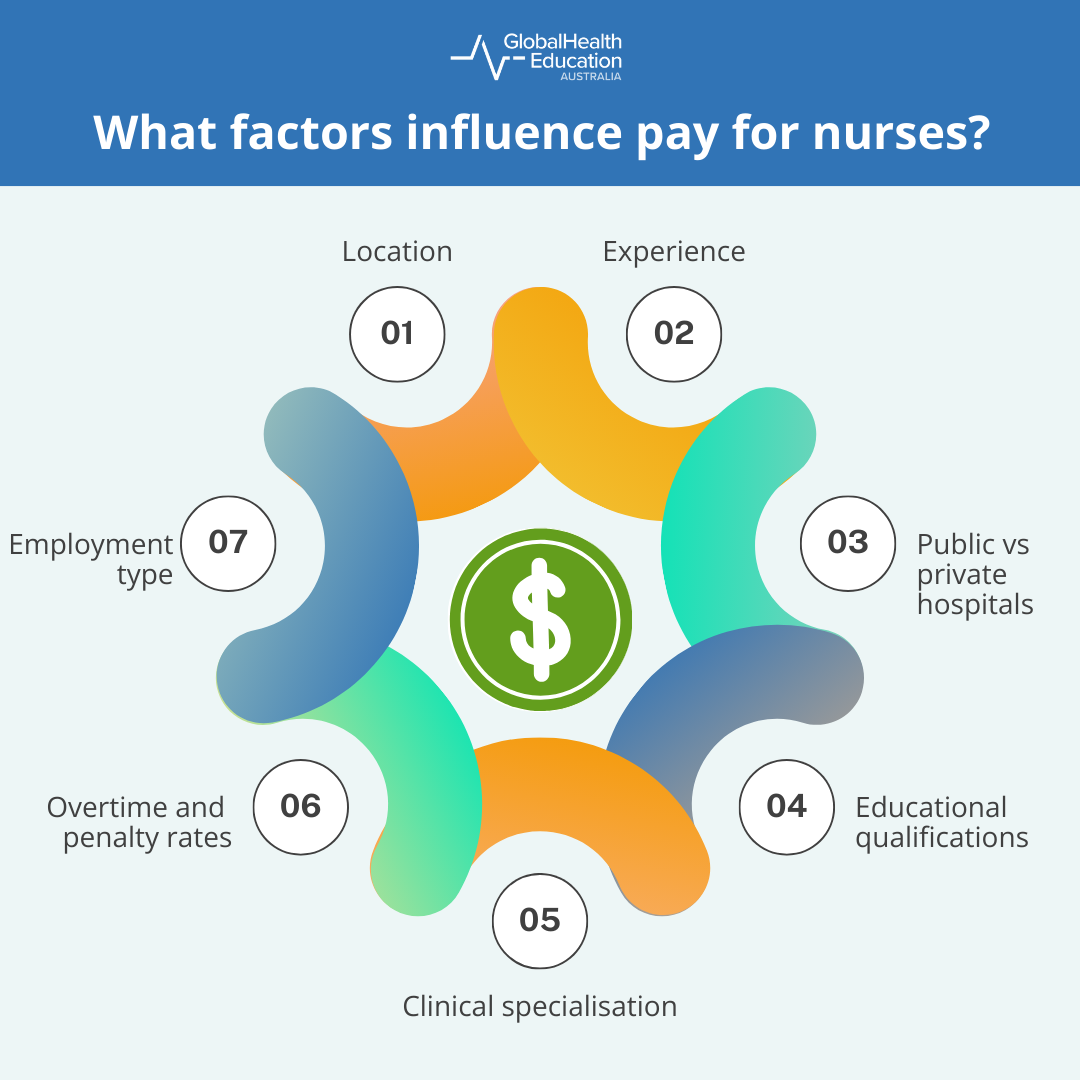
Location
Where you work can significantly impact your earnings. Rural and remote area nurses, for example, typically earn more than nurses working in metropolitan areas due to workforce shortages and higher demand.
According to SEEK, the highest-paying cities and regions for registered nurses are all in rural and remote areas, such as:
- Katherine and Northern Australia in the Northern Territory (Average salary: $112,500)
- Kalgoorlie, Goldfields and Esperance in Western Australia (Average salary: $110,000)
- Bairnsdale and Gippsland in Victoria (Average salary: $105,000)
Beyond higher average salaries, nurses working in rural and remote areas also receive additional incentives. Examples include:
Queensland
Queensland Health offers rural and remote nurses benefits such as:
- Free or subsidised accommodation
- Retention bonuses of $3,500 after one year, $10,500 after two years and $7,000 annually after three years
- Annual professional development allowance of up to $3,500
Northern Territory
Nurses working in rural and remote areas in the Northern Territory are eligible for benefits such as:
- Up to $40,000 in combined allowances including postgraduate allowance, professional development allowance and shift responsibility allowance
- Rental and electricity concessions
- Salary packaging of up to $27,500 per annum
New South Wales
The Rural Health Workforce Incentive Scheme offers:
- Up to $20,000 sign-on bonus plus additional incentives
- Accommodation and meal allowances
- Additional leave entitlements
Experience
The years of experience you have can also influence your overall salary. Under the Nurses Award 2020, which incorporates all amendments up to and including 1 October 2025, a registered nurse’s salary increases as they accumulate experience.
For example, a level 3 registered nurse with one year of experience starts out receiving a minimum hourly rate of $40.98. However, after three years of service, they progress to pay point 4, where their minimum hourly rate increases to $43.21.
Public vs private hospitals
Public hospitals follow state government enterprise agreements with structured pay scales, making your expected salary clear from the outset.
Private hospitals, on the other hand, operate either under their own facility-specific enterprise bargaining agreements (EBA) or the minimum Nurses Award 2020 requirements. This results in greater salary variability across the private sector, depending on the employer, facility size and location.
Generally, however, public hospitals tend to offer higher salaries and more benefits compared to private hospitals, though this can vary by state and employer.
Example: Victorian public vs private hospital wages
According to the 2024 EBA wages outcome in Victoria, grade 2 registered nurses in public hospitals earn between $81,734 and $104,380, depending on experience. In comparison, nurses working in a private hospital such as St Vincent’s Hospital Melbourne are paid $69,253 to $92,601 for an equivalent role.
Educational qualifications
Completing a relevant postgraduate qualification can increase your salary through qualification allowances. Qualification allowances are calculated differently across states, with some offering percentage-based increases and others paying fixed annual amounts.
In Tasmania, for instance, if you’re a grade 3 registered nurse with three years of experience in acute care and you complete:
- A graduate certificate such as the Graduate Certificate in Acute Care Nursing from Curtin University, you’ll receive an additional $3,368 per year (4 per cent of your salary)
- A graduate diploma such as the Graduate Diploma of Advanced Nursing (Acute Care Nursing) from the University of Tasmania, you’ll receive an additional $5,472 per year (6.5 per cent of your salary)
- A master’s degree such as the Master of Advanced Nursing (Acute Care) from the University of Technology Sydney, you’ll receive an additional $6,314 per year (7.5 per cent of your salary)
- A PhD or doctorate, you’ll receive an additional $8,419 per year (10 per cent of your salary)
Clinical specialisation
Specialising in a specific area of nursing can also influence your salary. Nurses who pursue clinical specialisations typically advance their skills through postgraduate nursing courses, which not only increases their salary through a qualification allowance, but also opens pathways to higher-paid specialist roles.
While registered nurses in Australia typically earn an average of $88,000 per year, specialised nurses generally earn more due to their advanced expertise. The table below illustrates average salaries across different specialisations in Australia:
| Nursing role | Average annual salary |
|---|---|
| PACU nurse | $92,000 |
| Aged care nurse | $100,000 |
| Paediatric nurse | $115,000 |
| Clinical nurse specialist | $115,000 |
| Critical care nurse | $172,000 |
Overtime and penalty rates
Penalty rates and overtime can significantly boost a nurse’s income. Penalty rates are additional payments for working weekends, nights and public holidays, while overtime is extra pay for working beyond your ordinary rostered hours.
As an example, under the Nurses Award 2020, a level 3 registered nurse at pay point 1 who is earning $40.98 per hour would receive the below:
| Penalty rates (Nurses Award 2020 | ||
|---|---|---|
| Shift type | Percentage | Rate per hour |
| Afternoon shift (Monday to Friday) | 12.5 per cent loading | $46.10 |
| Night shift (Monday to Friday) | 15 per cent loading | $47.13 |
| Saturday | 150 per cent | $61.47 |
| Sunday | 175 per cent | $71.72 |
| Public holiday | 200 per cent | $81.96 |
| Overtime rates (Nurses Award 2020) | ||
|---|---|---|
| Day | Percentage | Rate per hour |
| Monday to Saturday | 150 per cent for the first two hours and 200 per cent thereafter | $61.47 for the first two hours and $81.96 thereafter |
| Sunday | 200 per cent | $81.96 |
| Public holiday | 250 per cent | $102.45 |
While these are the minimum rates set by the Nurses Award 2020, some public and private hospital enterprise agreements may offer higher penalty rates and better overtime conditions.
For example, nurses working in Queensland public hospitals under the Nurses and Midwives (Queensland Health) Award receive 20 per cent loading for night shifts between Monday and Friday instead of the 15 per cent stipulated in the Nurses Award 2020.
Employment type
Employment type also impacts your overall earnings. Casual nurses don’t receive certain benefits, such as paid leave or sick leave. To compensate for this, they receive a casual loading of 25 per cent on top of their minimum hourly rate.
As an example, under the Nurses Award 2020, a level 3 registered nurse at pay point one earning $40.98 per hour would earn $51.23 per hour as a casual employee. While this higher hourly rate can be attractive, casual nurses trade job security and leave entitlements for increased pay.
Why is there a pay discrepancy for nurses across Australia?
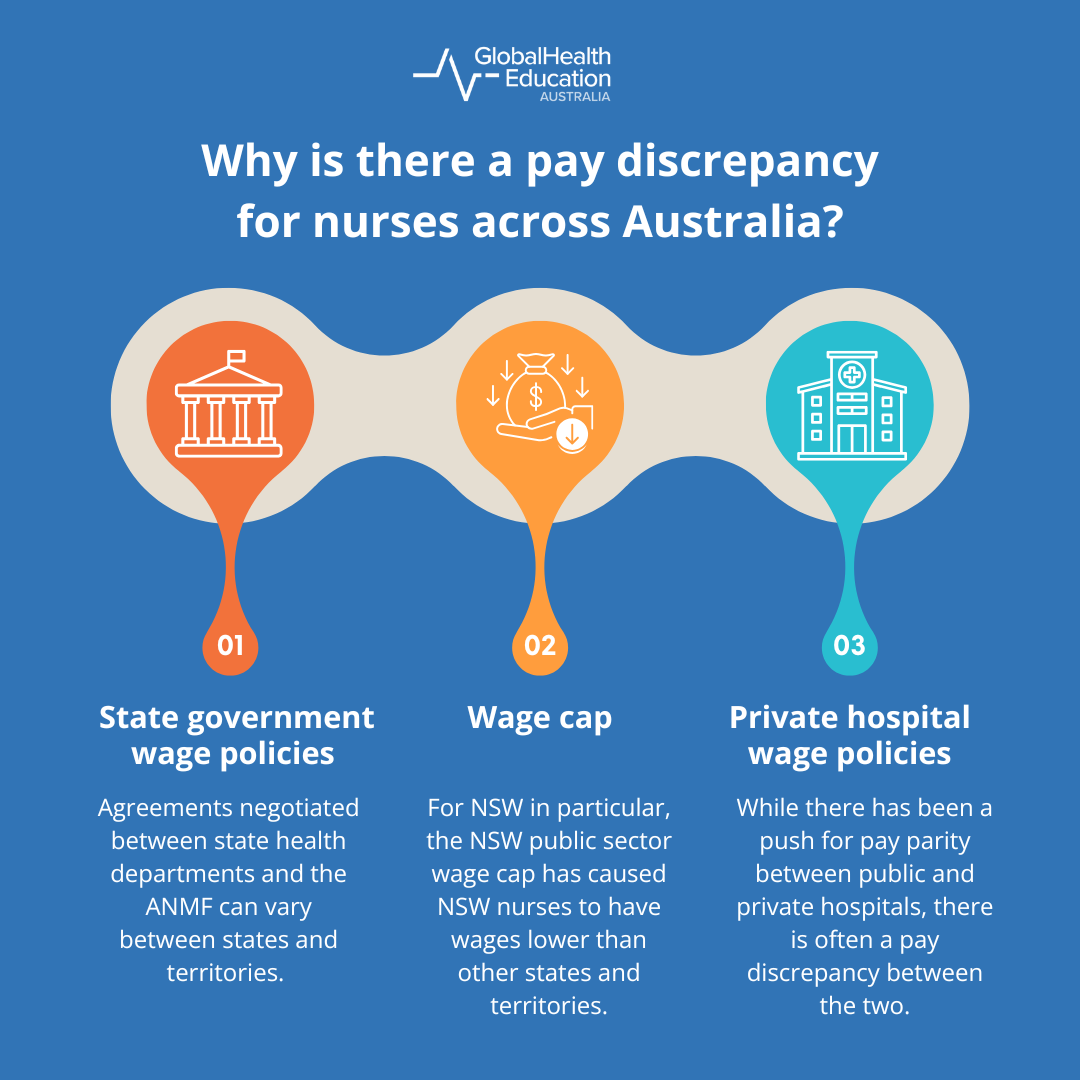
Nursing salaries vary significantly across Australian states and territories. While factors such as experience and specialisation can influence salary, there are several other factors that contribute to the pay discrepancy for nurses across Australia.
State government wage policies
State government wage policies in Australia are primarily determined through enterprise agreements negotiated between state health departments and the Australian Nursing and Midwifery Federation (ANMF). These agreements outline specific wage rates, allowances, penalties and conditions which can vary between states and territories.
As an example, a NSW registered nurse working in a public hospital earns an hourly rate of $36.39 in their first year, while a registered nurse working in a public hospital in Queensland earns an hourly rate of approximately $41.74 in their first year.
Union influence and bargaining power
While ANMF branches across Australia use their collective voice to fight for the professional, industrial and political rights of members, certain branches have had more success than others.
ANMF Victoria, for instance, has over 100,000 members and is the largest branch in the country. Other than previous achievements such as securing a historic 15 per cent private aged care pay rise in 2023, the union also recently secured a 28.4 per cent (compounded) wage increase by November 2027 and more than 70 improvements to aspects such as allowances and penalties.
On the other hand, the NSW Nurses and Midwives’ Association (NSWNMA) has encountered significant challenges in securing competitive wage increases. After rejecting the state government’s offer of a nine per cent increase in wages over three years, highlighting it as inadequate, the union is now campaigning for a 35 per cent pay increase over three years, with a six-week hearing that commenced in late 2025.
Negative workforce sentiment
Over the years, strikes and rallies have occurred across Australia due to dissatisfaction with wages determined through negotiations between nursing unions and state governments.
In 2024, for instance, NSW nurses and midwives went on strike for 24 hours after talks between the NSWNMA and the state government failed to reach an agreement. NSW public sector nurses and midwives were seeking a 15 per cent pay increase, but there was no progress after a four-week intensive negotiation period.
Most recently, nurses and midwives in South Australia also rallied outside Parliament House to express their dissatisfaction with the government’s latest pay offer of a 13 per cent pay rise over four years.
Wage cap
Another factor that affects the pay discrepancy for nurses is the NSW public sector wage cap.
While it was abolished in 2023, for over a decade, the NSW state government imposed an annual cap or maximum allowable wage increase for workers in state-funded public service. As a result, by the 2021 to 2022 financial year, wages for an experienced nurse were $335 lower per week (or about $17,500 for the year).
Even though NSW nurses received a 4.5 per cent pay increase after the wage cap was abolished, they still haven’t reached wage parity with other states. According to a University of Sydney Business School report, NSW continues to be one of the lowest-paid states in Australia for entry-level nurses and midwives.
Private hospital wage policies
Unlike public hospitals and facilities, private hospitals either follow the minimum rates set by the Nurses Award 2020 or operate under their own facility-specific EBAs. Even though there has been a push by the ANMF for pay parity between the public and private sectors, there has been more volatility and variation when it comes to private hospital wages.
This pay discrepancy often leads to reduced job satisfaction, which can culminate in strikes or rallies. In November 2024, more than 1,000 nurses and midwives at Ramsay Health Care’s 17 hospitals across NSW went on strike.
Protesting at the company’s annual meeting, the nurses were demanding a 20 per cent wage increase over three years. After more than 250 days of historic industrial action, the nurses eventually secured a 16 per cent pay increase over three years.
Similarly, in November 2025, nurses at John Fawkner Private Hospital in Coburg, Victoria went on strike after owner Healthscope collapsed under a $1.6 billion debt burden. Nurses were urged to accept a pay cut and a controversial salary packaging proposal in a new EBA.
Which state or territory offers the best quality of life for nurses?
While salary is an important factor to take into consideration when choosing which state or territory to work in, so are other factors such as cost of living, work conditions and benefits.
Taking all of these factors into consideration, Queensland ranks as the state that offers the best quality of life for nurses.
Queensland
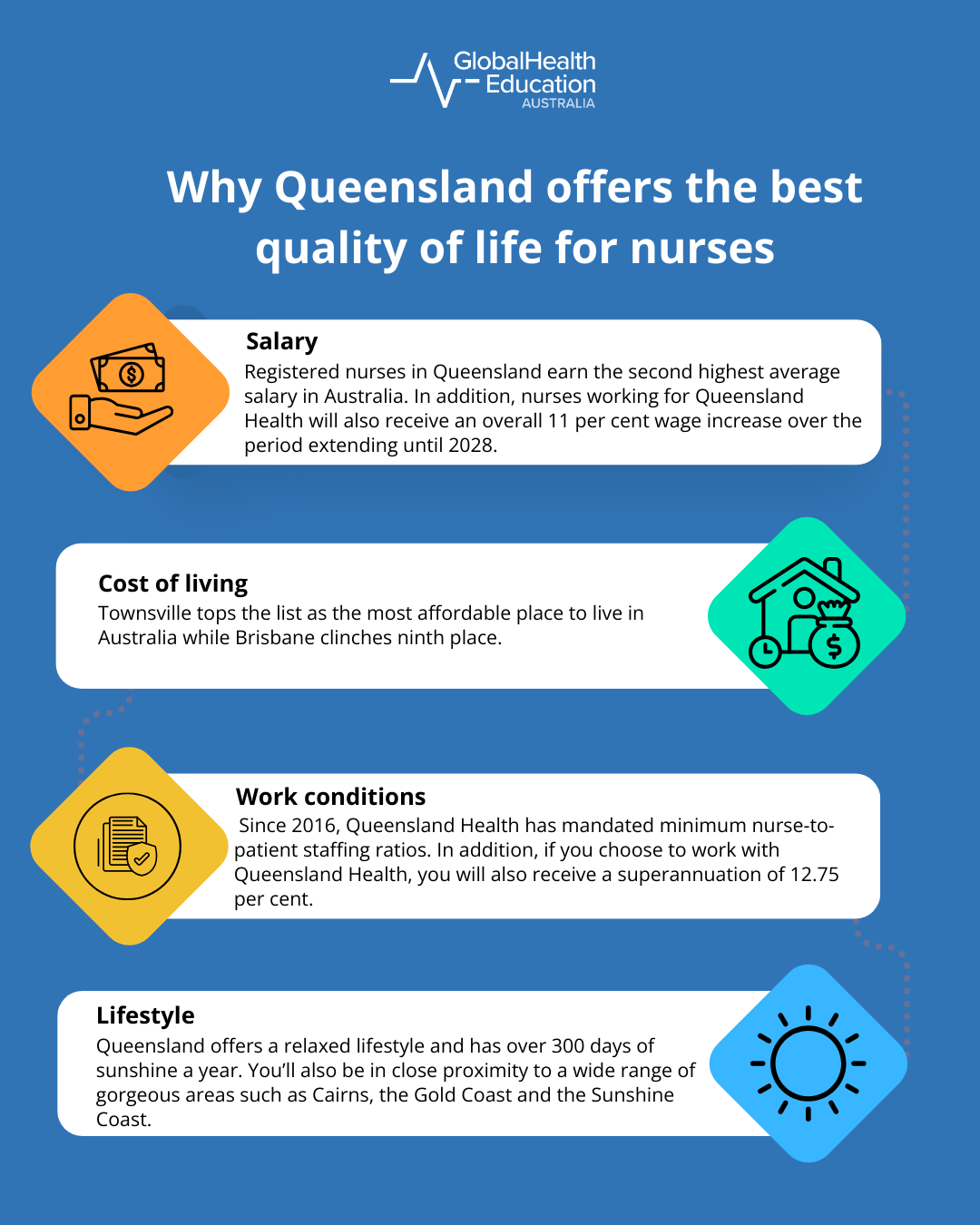
Salary
In terms of salary, Queensland pays relatively high rates, ranking second after the ACT with an average of $94,000.
Under the recent Nurses and Midwives (Queensland Health and Department of Education) Certified Agreement, nurses will also receive an overall 11 per cent wage increase over the period extending until 2028. The agreement also includes other key improvements, such as a new allowance for nurse unit managers and double the rates for overtime for all nurses grades 2 to 9 who work shift work.
Cost of living
According to a recent cost of living study, Townsville tops the list as Australia’s most affordable city while Brisbane comes in at ninth place.
Work conditions
Since 2016, Queensland Health has mandated minimum nurse-to-patient staffing ratios. In adult acute care medical and surgical wards, for example, the minimum ratios are 1:4 on morning and afternoon shifts and 1:7 on night shifts.
If you’re relocating to start a job with Queensland Health, they may also assist with flights, airport transfers and relocation of personal belongings. Additional benefits also include 12.75 per cent employer superannuation contributions and the ability to salary package part of your income.
Lifestyle
Queensland offers a relaxed lifestyle with access to some of Australia’s most iconic natural attractions. You’ll also be within reach of destinations such as Cairns, Brisbane, the Gold Coast and the Sunshine Coast. The state also enjoys lower population density compared to bustling cities like Sydney and Melbourne and receives around 300 sunny days per year. H3: Comparison table Here is a comparison table that provides an overview of quality of life across all the different states and territories in Australia.
Comparison of nursing across Australia’s states and territories
Here is a comparison table that provides an overview of quality of life across all the different states and territories in Australia.
| State/territory | Average registered nurse salary | Cost of living (Information taken from this study) | Work conditions | Lifestyle |
|---|---|---|---|---|
| Queensland | $95,000 | Townsville takes the top ranking as the most affordable city in Australia, while Brisbane is ranked ninth. Gold Coast is ranked the least affordable city in Australia, while Cairns, Logan City and Toowoomba come in fourth, seventh and tenth, respectively | Mandated minimum nurse-to-patient staffing ratios with benefits such as 12.75 per cent superannuation and salary packaging | Relaxed lifestyle with abundant sunshine and lower population density. Generally more affordable with warm weather and access to iconic Australian hotspots |
| Victoria | $92,000 | Melbourne, Ballarat and Bendigo are ranked fifth, seventh and tenth in the most affordable cities in Australia. Geelong, on the other hand, is ranked third in the least affordable cities in Australia | Minimum nurse-to-patient ratios with additional amendments being incorporated. Victoria also has a strong union presence that has secured significant improvements over the years | World-class arts, culture and dining scene, but also has a higher cost of living and a competitive job market |
| ACT | $115,000 | Canberra ranks as the second least affordable city after the Gold Coast | Patient ratios are still being rolled out. Phase one began in 2022 and phase two commenced in 2024. Benefits that Canberra Health Services provide include salary packaging and no fringe benefits tax on numerous ordinarily taxable items | Family-friendly with high quality of life and easy access to the outdoors, but is a smaller, quieter city with a high cost of living |
| NSW | $89,000 | Both Sydney and Newcastle fall under the least affordable cities (ranked eighth and ninth), however, Wollongong was ranked fourth in the most affordable cities in Australia | Currently introducing safe staffing levels in NSW public hospitals. Other benefits that NSW Health provides include access to a fitness passport and an employee assistance program | Sydney offers beaches, fantastic weather and is one of Australia’s most multicultural cities. However, it is also more populous and has a high cost of living |
| Western Australia | $100,000 | Rockingham and Perth are among the more affordable cities in Australia, ranking second and sixth respectively | Currently rolling out nurse-to-patient ratios, most recently implemented in metropolitan medical and surgical areas such as Child and Adolescent Health Service and East Metropolitan Health Service | Beautiful beaches and natural environment with warm weather, but is geographically isolated from the rest of Australia |
| South Australia | $88,000 | Adelaide was listed number six among the least affordable cities in Australia | Legislation introduced for nurse-to-patient ratios, but not yet rolled out. Benefits can include relocation support of up to $15,000 for eligible roles with SA Health | Relaxed lifestyle with access to wine regions and pleasant Mediterranean climate. However, South Australia also has a smaller job market and less going on in comparison to cities like Melbourne and Sydney |
| Tasmania | $97,000 | More affordable, with both Launceston and Hobart ranking third and eighth on the list for the most affordable cities in Australia | Minimum nurse-to-patient ratios are not in place, but ANMF Tasmania is pushing for legislated ratios | Stunning scenery and relaxed lifestyle with general affordability, but limited job opportunities and more isolated than larger cities like Melbourne or Sydney |
| Northern Territory | $112,000 | Darwin was ranked fifth among the least affordable cities in Australia | Currently has no mandated ratios in place. Good benefits such as attraction and retention allowance and relocation assistance due to the remote nature of the location | Stunning landscapes and a laidback lifestyle with generally lower cost of living, but more isolated and remote with limited entertainment options |
Increase your nursing salary with a postgraduate nursing course
While factors such as location, cost of living and employment type can affect your nursing salary, pursuing a postgraduate nursing qualification remains one of the most effective ways to increase your earning potential and open doors to specialised roles and leadership positions.
If you’re interested in pursuing a postgraduate nursing course, GlobalHealth Education has a variety of graduate certificate, graduate diploma and master’s nursing courses from numerous reputable universities such as Edith Cowan University, James Cook University, University of Canberra, Victoria University and more.
Our Education Consultant, Catriona, can help you with choosing the right course and university. Book a free professional development strategy call with her to receive personalised guidance and support.