In This Article
- About Catriona Kaminski
- What is a career development plan?
- How to create a career development plan
- Common obstacles faced when creating a career development plan
- Benefits of creating a career development plan
- Get started with a free professional development strategy call with Catriona
- Ready to figure out the next steps in your healthcare career?

Why trust GlobalHealth Education?
-
Our in-house editorial team and healthcare advisors write and review our content.
-
The information in our content provides clarity and insights to help you compare courses.
-
We list postgraduate courses from 25+ respected and reputable institutions in Australia.
Whether you’re an early-career healthcare professional still figuring out your next steps or an experienced clinician considering your next move, having a career development plan can be what you need to propel your career forward.
Drawing on insights from experienced career coach, Catriona Kaminski, this article provides a detailed six-step framework for creating a career development plan. You’ll find actionable strategies and tips that will help you work towards achieving your career goals.
About Catriona Kaminski

Catriona is an education and careers consultant and positive psychology practitioner with extensive experience in career coaching, corporate wellbeing and education consulting. She holds a Graduate Certificate in Career Development from James Cook University and a Graduate Diploma in Positive Psychology from CQUniversity.
Her work blends evidence-based wellbeing strategies with practical career development tools, empowering individuals to navigate change with confidence and resilience.
What is a career development plan?
A career development plan is a strategic roadmap that Catriona describes as “more than just a wish list.” She explains that a career development plan is future-oriented, where “instead of just watching opportunities pass you by or fall into your lap, you identify what you want and how to take small and consistent steps towards [achieving] it.”
In terms of what it constitutes, Catriona shares that a career development plan should “connect three things – where you are now, where you’d like to be and what needs to happen in between.”
“A career development plan is a good way to future-proof your career. Rather than feeling like you’re at the mercy of the system or that job that pops up, it gives you a clear sense of direction and agency.”
The bowerbird analogy
With a career development plan, Catriona states that you’re not wishing for change, you’re actively creating it and “it involves your agency, essentially your belief in your own ability to achieve those goals.”
To illustrate this intentional approach, Catriona uses the analogy of a male bowerbird that slowly collects items over time to create an impressive structure called a bower. “All these little bits might seem like they’re insignificant, but they end up creating something beautiful.” She shares that just like the bowerbird, career development involves intentionally gathering skills, experiences and qualifications that may seem minor in the moment but collectively build towards your career goals.
Why having a career development plan matters
A career development plan shifts you from reactive to proactive career management. Instead of scrambling to tailor your resume each time you’re applying for a job, you’re strategically building towards your goals over time, making you a stronger and more prepared candidate when opportunities arise.
To demonstrate this, Catriona shares an example of a nurse looking to become a nurse educator. Without a plan, they’re simply responding to job advertisements as they appear, tweaking their resume to match each role’s requirements.
With a career development plan, however, the nurse takes a proactive approach by taking the initiative to “build their teaching skills on the ward, collect evidence for recognition of prior learning (RPL) and explore their postgraduate options,” Catriona explains. “That way, when they’re job hunting, they’re not someone who’s just tweaking their resume at the last minute, instead, they’re presenting themselves as a strong and aligned candidate.”
Early career professionals vs more experienced professionals
No matter what stage of their career, Catriona highlights that healthcare professionals can benefit from a career development plan. What the plan focuses on, however, can differ depending on where you are in your journey.
For those starting out, Catriona explains that, “It’s more about exploration and exposure.” She recommends early career professionals to:
- Try working in different settings
- Work on building their core skills and confidence
- Learn to identify what energises and drains them
- Develop their professional network
For more experienced professionals, Catriona states that, “It’s about intention and refinement.” At this stage, you’re:
- Deciding whether to move into a specialty or leadership role
- Deciding if you want to pivot your career
- Thinking about your legacy and the impact you want to leave behind
- Aligning your career decisions with aspects such as life priorities and family
How to create a career development plan
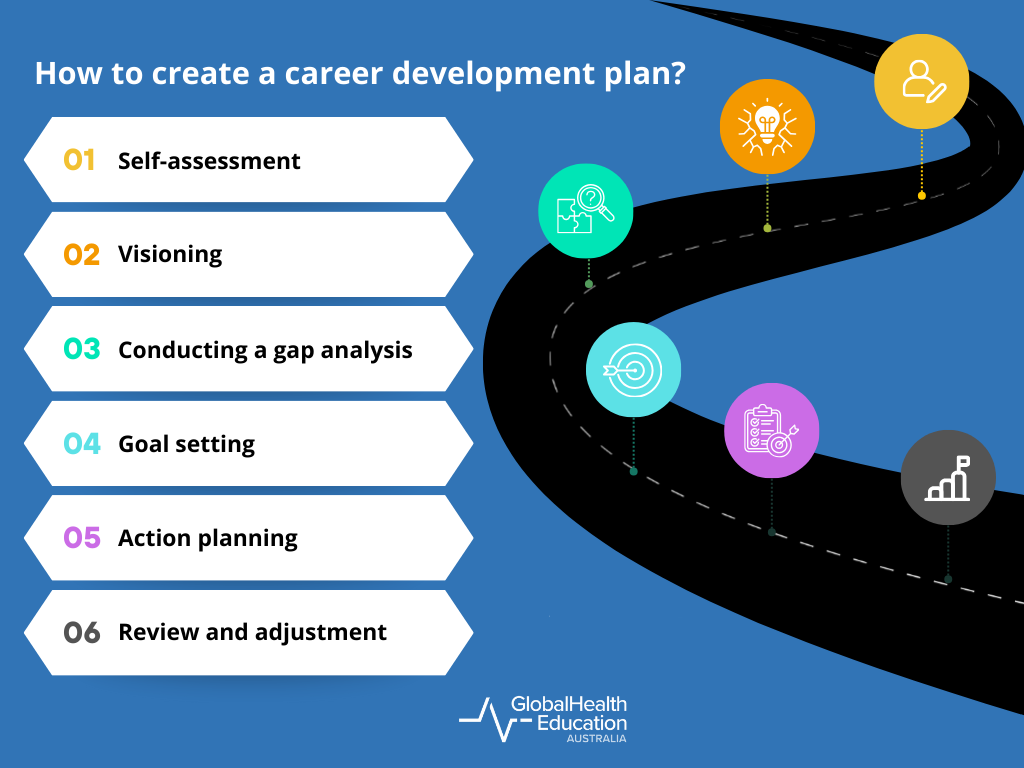
When it comes to creating a career development plan, Catriona shares that there are six steps involved:
Step one: self-assessment
Catriona states that creating a career development plan begins with clarifying your interests, values and strengths as “there’s no point designing a pathway that looks impressive on paper but fights against who you are.”
While there are a plethora of different assessment tools available, she highlights three specific tools she uses that each focus on different areas but when used together, provide a holistic picture.
RIASEC (or Holland Codes)
This particular test was invented by John Holland and is a type of personality assessment used to help with career planning. Catriona shares that this assessment “aligns people not only with their values and interests, but also with the environment where they would work best.”
The RIASEC model is structured around six personality factors, which consist of realistic, investigative, artistic, social, enterprising and conventional. Upon completion of the test, the results highlight your top three RIASEC codes, which are referred to as your Holland Code. “Depending on your code, you might say, ‘Okay, I’m really social and artistic and I’ve got an investigative element, so I might work well as a counsellor,’” Catriona explains.
VIA character strengths
The values in action (VIA) character strengths framework originated in the early 2000s through a three-year project which involved 55 scientists. How it works is that “there are 24 different character strengths and we have all of these, but when you work through the questionnaire, the first three to five are called your signature strengths,” Catriona shares.
You can use this particular assessment to help you feel more fulfilled both personally and professionally. Catriona also states that “it can help you really understand where you would work best and what motivates you.”
Myers-Briggs Type Indicator (MBTI)
A popular assessment, the MBTI is a self-report questionnaire that categorises individuals into 16 distinct personality types using different letters such as E and I for extraversion and introversion and T and F for thinking and feeling.
Catriona shares that “it’s a lot of fun to do” and is a great way for individuals to learn more about themselves, as it provides a fair amount of insight. The assessment can help you better understand your strengths, weaknesses, how you perceive information and how you make decisions. By gaining greater self-understanding, you can identify suitable roles and work environments where you’re likely to thrive.
Critical assessment questions
After completing all three assessments, Catriona suggests reflecting on the results and asking yourself questions such as:
- When have you felt most energised at work?
- What environments bring out your best?
- How can I best apply my strengths to support the advancement of my career?
Understanding what energises you is important, as Catriona states, “If you ignore that, no matter what you do, you’re not going to be fulfilled.”
Step two: visioning
The next step, according to Catriona, involves “picturing where you want to be in the next three, five or ten years. You could do so through experiential vision boards or narrative exercises.”
Experiential vision boards
Catriona explains that with an experiential vision board, “you’ll create a collage of images, words and symbols that represent your core values. For example, it could be growth, contribution, creativity and connection. In a healthcare context, it could be patient advocacy, flexible work, leadership or making time for family.”
When it comes to the difference between a traditional vision board and an experiential vision board, Catriona shares that “while traditional vision boards focus on a specific outcome, so the job title, for example, experiential vision boards are more about how you want your life and work to feel.”
Catriona states that an experiential vision board can help ensure that you’re on the right track. “For example, when you’re talking about study options or promotions later, you can go back and look at that board and ask, ‘Does this pathway move me closer to this or further away?’” She also emphasises that an experiential vision board helps keep you grounded in what truly matters to you. Rather than chasing status or salary, it helps anchor you to your values because, as she notes, “it’s so easy to steer away from that.”
There are many ways to create your experiential vision board, whether that’s a Pinterest board, a piece of paper on your wall or a corkboard in your room where you can move things around. The main thing Catriona stresses is that “it’s got to be adaptable” as you need to be able to move things around as life evolves.
Narrative exercises
Beyond an experiential vision board, Catriona also recommends narrative exercises. “There are some workbooks and things you can work through that really get you to sit down and think about your story.”
Catriona states that there’s a free resource called My Career Story, an autobiographical workbook that “helps identify the values that you appreciate in people or characters, allowing you to gain further insight into yourself.” The workbook consists of three parts:
- Telling your story where you’ll answer several questions about yourself
- Hearing your story where you will use your answers from the first part to tell your career story with greater clarity and comprehension
- Enacting your story where you’ll make a realistic plan to put your story into action
Step three: conducting a gap analysis
The third step involves conducting a gap analysis, which consists of “comparing role requirements to your current profile,” Catriona explains. To start, she recommends collecting two or three descriptions of each job that you’d love to move into. It should ideally be roles that aren’t within reach right now, but represent your long-term goals.
For instance, you could collect job descriptions for a mental health social worker or midwife to understand what’s required to apply for each position.
Once you’ve gathered them, Catriona recommends “highlighting the recurring requirements the job descriptions are looking for. This includes the specific qualifications or registrations, the years of experience, critical skills, leadership responsibilities, etc.”
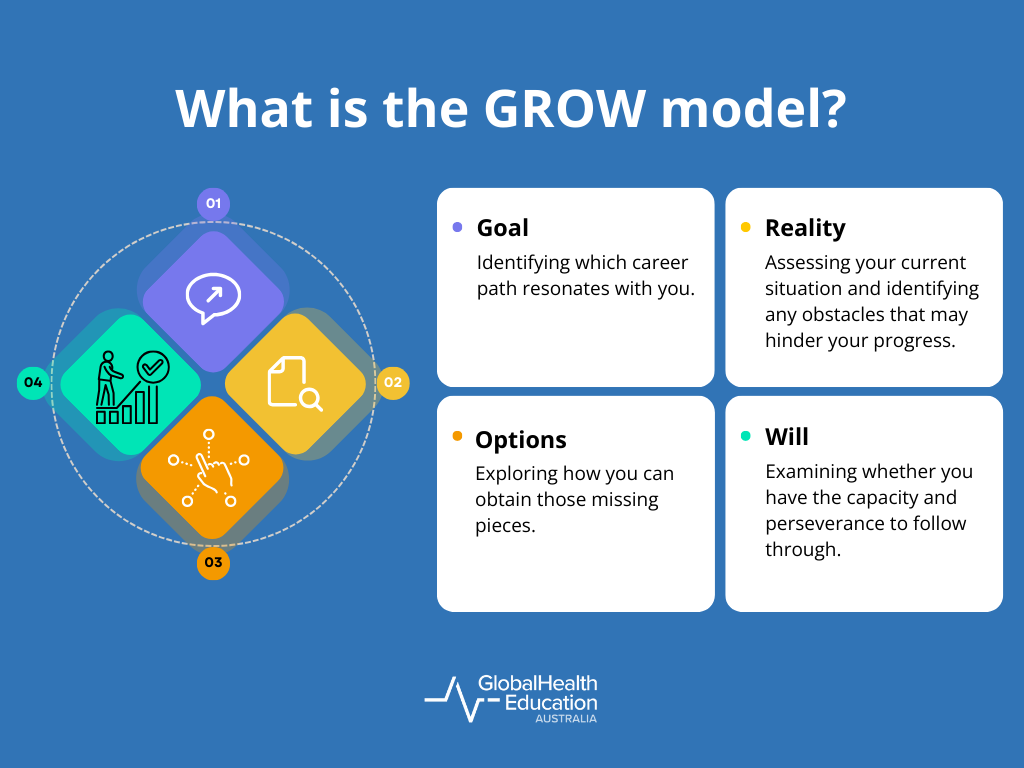
From there, Catriona recommends following the GROW model:
G (Goal)
After reviewing the requirements of your target roles, you’ll need to establish your overall career direction. At this stage, it isn’t about setting specific deadlines yet. It’s more so about identifying which career path resonates with you.
Catriona shares that some questions you can ask yourself include, “Where do you want to be? What is the goal?” She also highlights looking beyond current vacancies and taking a look at resources such as to myfuture and Jobs and Skills Australia to see where growth is projected and where your skills can make the biggest difference.
When it comes to setting goals, Catriona cautions that while there’s “nothing wrong with shooting towards the stratosphere, you’ve also got to maintain a realistic expectation of what you can actually achieve.”
R (Reality)
Once you’ve clarified your goals, it’s time to assess your current reality. This involves examining your current situation and identifying any obstacles that may hinder your progress.
Catriona categorises this into four buckets:
- Qualifications and registrations
- Skills and competencies
- Experience and exposure
- Networks and reputation
For example, if you’re looking at skills and competencies, Catriona shares that you can ask yourself questions such as, “What skills do you already have? What do you need? How long might acquiring these skills take?” and for qualifications and registrations, you might ask yourself, “How much will it cost? Is a Commonwealth supported place (CSP) available? Can I realistically manage study on top of work?”
O (Options)
With options, Catriona shares that it’s about exploring how you can obtain those missing pieces, whether that’s through on-the-job training, continuing professional development (CPD), postgraduate study or volunteering.
For example, if you’re looking to become a specialised physiotherapist such as a musculoskeletal physiotherapist, you would need to become a registered physiotherapist and complete an approved coursework physiotherapy master’s degree before undertaking a specialist training program.
Catriona notes that, at this stage, it’s also important to consider who you can rely on for support, what funding you might have and whether you could possibly transition to part-time work while studying.
W (Will)
The final component of GROW examines whether you have the “willingness and capacity to pursue this path,” Catriona explains. It isn’t about limiting your ambitions. Instead, it’s about ensuring your plan is sustainable given your current reality.
“For example, if becoming a psychologist from the point where you are now requires six years or more of study, is that realistically a workable option for you? Or would a two-year counselling or mental health course work better for you?”
Working with the GROW model
With the GROW model, Catriona emphasises that you’ll constantly be moving backwards and forwards between the steps rather than working through them linearly. “That’s why it’s called the GROW model, because you’re always growing,” she shares.
This iterative process is intentional. As you explore your options, you might realise your goals need adjusting, or as you assess your reality, new possibilities might emerge.
She also stresses that a gap analysis doesn’t make decisions for you. “It’s meant to give you a clear map of the distance between where you are and where you need to go so you can make those informed decisions,” she explains. “When you’ve got that in place, that’s when you’re ready to take action.”
Step four: goal setting
Once you’ve completed your gap analysis, the next step is setting SMART goals. This involves making your goals:
S (Specific)
Well-defined and clear.
M (Measurable)
Quantifiable so you can track progress.
A (Achievable)
Attainable and realistic given your circumstances.
R (Relevant)
Aligned with your values and long-term objectives.
T (Time-bound)
With a clearly defined timeline including both a start date and a target date.
Example: Instead of saying, “I want to work in mental health one day,” a SMART goal would be, “In order to hone my mental health skills (specific), I will enrol in Victoria University’s Graduate Certificate in Mental Health in March 2026 (relevant) and complete the course by December 2026 (time-bound). I will then use the skills acquired from the course (achievable) to apply for a role as a mental health support worker (measurable).”
Pairing long-term and short-term goals
Catriona recommends pairing one long-term goal with one to three shorter goals. She adds that “with a career development plan, you’ll typically have a goal to work towards within 12 to 18 months and have your little quarterly milestones along the way.”
Using the example above, for instance, while you might not secure a mental health support worker role for another 12 months, there are incremental steps you can take in the meantime, such as:
- Volunteering with mental health organisations such as Beyond Blue or Lifeline
- Completing short courses in mental health first aid or trauma-informed care
- Booking a career development session
Catriona states that while having goals is important, it’s equally important to keep things flexible, especially if you’re feeling overwhelmed. “If you’re already a bit burnt out, adjust the dial because career development should support your wellbeing, not erode it,” she shares.
Step five: action planning
While step four establishes what you want to achieve through SMART goals, this step involves “mapping out concrete steps with timelines and support,” Catriona explains.
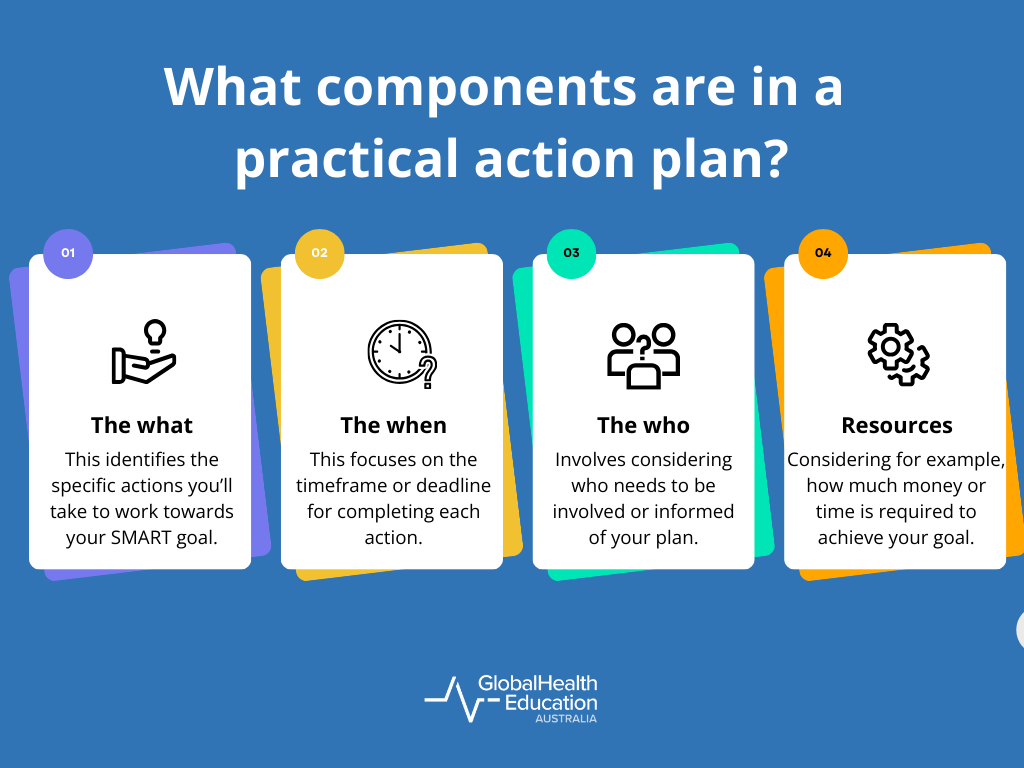
Catriona shares that a practical action plan typically includes four key components:
What
This identifies the specific actions you’ll take to work towards your SMART goal. For example, if your goal is to complete a Graduate Certificate in Public Health, your actions might include enrolling in the course, speaking with your manager about study leave or booking a career consultation to discuss your course options.
When
This focuses on your timeframe or deadline for completing each action. For instance, stating that you’ll enrol in the course by March 2026.
Who
This considers who needs to be involved or informed of your plan.
Catriona stresses that this component is especially important as “career development is really hard to do on your own and shouldn’t be a solo project.” She explains that bringing people such as your manager, colleague or a trusted friend into your plan can help you “reality check your goals and identify strengths that you might be underusing.”
She suggests a practical approach where you can “share a simple one-page version of your plan and ask questions such as, ‘Given what you see of me at work, do you think this direction makes sense?’ Getting that feedback from a few trusted advisors can help with confirming your plans.”
“Having people to cheer you on, reality check the wobble moments and remind you of why you’re doing what you do makes it easier to stick to your plan.”
Resources
This involves considering practical components such as money and time, childcare and study support.
Creating an action plan
With regards to creating an action plan, Catriona explains that there’s no one correct way as it really depends on each individual’s preference and what works for them. “Some people like a detailed month-to-month roadmap, others like to gamify it,” she shares.
She particularly recommends the gamification strategy as a way to keep things engaging. “You can think of each milestone or your pathway through all of this as a bit of a quest instead of a checklist. Each quest has a purpose and you might give yourself a small reward at each checkpoint..”
Step six: review and adjustment
The final step of creating a career development plan involves “setting up regular check-ins, particularly as life and the labour market continue to evolve,” Catriona explains.
She recommends conducting two types of reviews, a quarterly review and an annual review.
Quarterly review
During your quarterly review, Catriona suggests asking yourself:
- What have I done in the last three months?
- What’s changed in my life or the labour market?
- Do my goals still align with my values, wellbeing and family situation?
Catriona emphasises the importance of regular reflection, “It changes much more than you think and if you take the time to think about it quarterly instead of waiting for an annual check-in, you’ll be much more productive.”
After reviewing your plan, adjustments may be needed. "Sometimes your plan is going to need a small tweak. It could be shifting the timeline of a course, changing a course, changing which skills you’ve got to prioritise or even pausing a goal for a season,” Catriona notes.
Catriona also emphasises that careers are no longer linear and it’s important to “give yourself permission to adjust the plan without labelling it as a failure. Your aim is to stay intentionally responsive and not rigid as your career and circumstances evolve.”
Annual review
The annual review is a more in-depth check-in where Catriona explains that you assess what you’ve ticked off in the last 12 months in relation to your goals and what you can put into that plan for the next 12 months.
The more consistently you review your plan, the more you’ll see yourself progressing towards your goals. As Catriona emphasises, “The more you do these sorts of exercises, the more you’ll learn to align yourself with your goals. Instead of that goal being something external to you, it actually becomes something that’s aligned with your everyday life.”
Common obstacles faced when creating a career development plan

Creating a career development plan isn’t without its challenges. Catriona identifies several key obstacles that healthcare professionals commonly face:
Time and energy
Between clinical responsibilities, family commitments and the day-to-day demands of life, finding time and energy to plan your career can be challenging. As Catriona acknowledges, “Taking on any sort of new change in your life is a heavy shift. There’s going to be emotional challenges and needing to ensure that you’ve got bandwidth to move forward.”
To tackle this, Catriona suggests being realistic about your own emotional bandwidth, “whether that means slowing your plan down or adjusting things.” She also emphasises that slowing down doesn’t mean failure, as careers are messy and non-linear by nature.
Feeling overwhelmed
When researching career options, the sheer number of pathways available in healthcare can be confusing. “You might feel that there are too many options and you’re not sure of where to start,” Catriona notes.
In this instance, she suggests working with a career coach, as they can help you narrow down options, provide guidance and keep you accountable throughout the process.
Imposter feelings
Many healthcare professionals struggle with self-doubt, also known as imposter syndrome. Catriona describes this as “that nasty inner critic where you’re doubting your ability to step into something more senior or pivot to something different, something new.”
Catriona highlights that having a career development plan can help with combating these feelings. “Having that plan really helps to reduce those imposter feelings because you can see evidence of progress,” she explains.
Life events
Unexpected circumstances, whether it’s family responsibilities, health issues or changes at work can derail even the most detailed plans. To deal with these changes, Catriona emphasises the importance of flexibility and regularly reviewing your career development plan to make adjustments where necessary.
Benefits of creating a career development plan
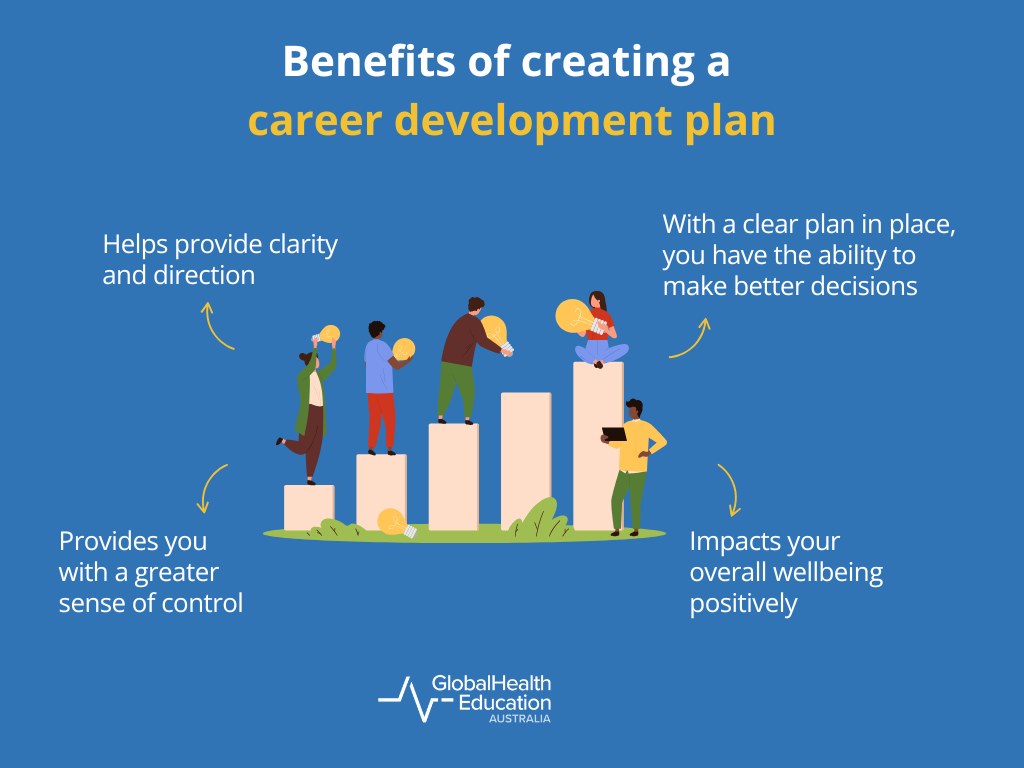
While creating a career development plan is no easy feat, Catriona shares that she’s seen significant benefits in those who have crafted a career development plan. These benefits include:
Clarity and direction
One of the most immediate benefits is moving from a state of uncertainty to having a clear path forward. “A career development plan helps you move from ‘I’m stuck’ or ‘I’ve got no idea what I’m doing’ to ‘I know my next few steps,’” Catriona shares.
The ability to make better decisions
With a clear plan in place, you’re able to evaluate opportunities strategically rather than simply jumping into something. “You might be offered a role that may not be the right job for you and instead of just saying yes to gain the experience, you can assess whether it genuinely moves you closer to your goals,” Catriona explains.
Catriona shares an example of a newly graduated nurse she guided who was keen on jumping straight into a master’s course. Through their work using assessment tools and looking into labour market research, however, Catriona stated that “it became quite clear that gaining a couple of years of targeted clinical experience would accelerate her long-term goals.”
From there, Catriona states that they “developed a plan that focused first on securing roles in preferred specialty areas, building mentoring relationships and completing shorter CPD courses before revisiting postgraduate study. The idea was that within 18 to 24 months, she’d move into her ideal specialty, feel more confident clinically and have a much clearer sense of which postgraduate pathway would genuinely serve her.”
Greater sense of control
Healthcare is an ever-changing field with constant policy updates, technological advances and workforce shifts. This can leave healthcare professionals feeling like they’re at the mercy of the system.
While change is inevitable, Catriona shares that “when you have a roadmap in place, you’ll feel more like the driver than a passenger.” You’re still navigating change, but you’re doing so with purpose and direction rather than feeling swept along by circumstances.
Improved wellbeing
Perhaps one of the most important benefits is the positive impact on your overall wellbeing. Catriona emphasises that “intentional planning helps you avoid overloading, sets healthy boundaries and integrates work with the rest of your life.”
Summing up the cumulative effect of these benefits, Catriona states, “over time, it’s not necessarily about having a perfect career, but it’s having one that’s more sustainable, meaningful and aligned with your values.”
Get started with a free professional development strategy call with Catriona

Creating a career development plan is a great way to clarify your next steps and work towards your professional goals. If you’re not sure where to start or need guidance navigating your options, book a complimentary professional development strategy call with Catriona.
What to expect during your call:
- Understand your circumstances
Catriona will ask questions to learn more about your current role, life circumstances and what’s prompted you to reach out for a conversation.
- Build clarity
Together, you’ll identify one to three key questions or areas to focus on within the session.
- Create actionable next steps
You’ll walk away with concrete actions to take, whether that’s completing career assessments, reviewing job descriptions or mapping out the initial stages of your career development plan.
Ready to figure out the next steps in your healthcare career?
GlobalHealth Education offers a wide array of postgraduate courses from renowned universities in Australia. Whether you’re looking to specialise, move into a leadership role or pivot into a new area of healthcare, there are courses available in disciplines such as counselling, mental health, nursing, psychology, public health and social work.
If you need help with selecting a course or figuring out the next steps in your career, Catriona can help guide you towards study options that align with both your career development goals and personal circumstances.