
Why trust GlobalHealth Education?
-
Our in-house editorial team and healthcare advisors write and review our content.
-
The information in our content provides clarity and insights to help you compare courses.
-
We list postgraduate courses from 25+ respected and reputable institutions in Australia.
The new year often brings a fresh wave of reflection, prompting many healthcare professionals to think about their next career move. If a master’s degree is something you’ve been considering, you may be wondering if it’s worth the investment and whether it will help you achieve your career goals.
In this article, we’ll break down the latest data and help you determine if a master’s degree in healthcare is worth it in 2026.
The verdict: is a master’s degree in healthcare worth it in 2026?
For many healthcare professionals, the answer is yes, but with important caveats that depend on your individual circumstances.
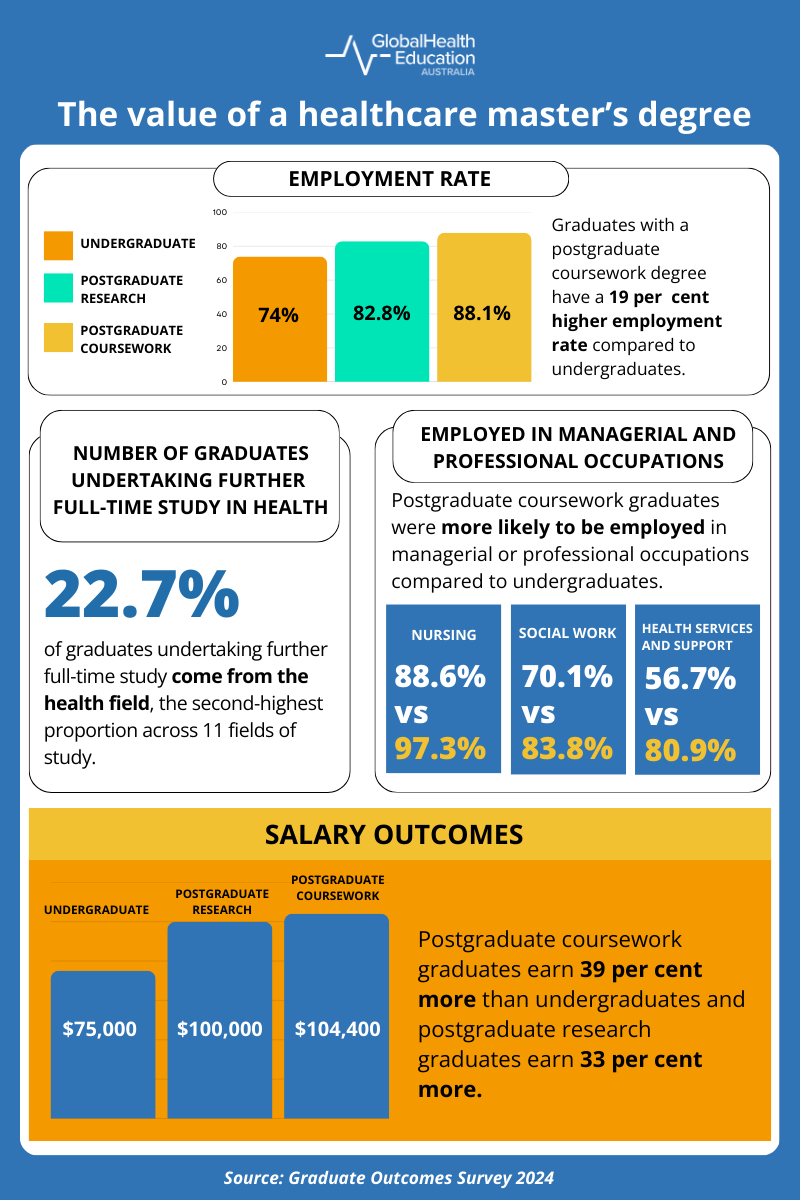
According to the 2024 Graduate Outcomes Survey, there are clear advantages to pursuing postgraduate study. Not only do postgraduates have the potential to earn more (around 39 per cent more than undergraduates, to be exact), there’s also a significantly higher chance of being employed.
Healthcare professionals in fields such as nursing, social work or health services and support are also more likely to be employed in managerial or professional roles if they’ve completed a postgraduate coursework degree.
Even with these advantages, however, a master’s degree may not be the right move for everyone. Pursuing a master’s degree requires a significant investment of time, energy and money and is not a decision that should be taken lightly. Whether it’s the right choice can depend on factors such as your career goals, financial situation and where you are in your career journey.
For some healthcare professionals, the returns can be substantial. For others, alternative pathways may deliver better outcomes.
When a healthcare master’s is worth it

For some healthcare professionals, the long-term rewards can outweigh the challenges. Here are some situations where a healthcare master’s degree may be worth the investment.
If the role you’re after requires a master’s qualification
There are certain roles in healthcare where a master’s degree isn’t optional, instead, it’s essential for registration or career advancement.
For example, if you’re a registered nurse looking to become a nurse practitioner, you’ll need to complete a Nursing and Midwifery Board-approved master’s course, such as a Master of Nursing (Nurse Practitioner) at Edith Cowan University.
Similarly, if your goal is to become a clinical psychologist, you’ll need to complete either a two-year master’s degree, such as the Master of Clinical Psychology at Macquarie University or pursue a four-year doctorate as part of the pathway to registration.
If you’re looking to move into a new career
Already in healthcare but eyeing a different role? Or maybe you’re in another industry and are looking to pivot into healthcare? Depending on the healthcare profession you’re looking to move into, there are healthcare master’s courses that can help you acquire the skills and knowledge required to make a successful transition.
These courses are usually completed in two years full-time and will prepare you for a career in your new field.
Example: After working in public health for a few years, a public health and wellbeing officer has decided that they’d like to change things up and move into a different field in healthcare. While they’ve enjoyed their role so far, after much consideration, they’ve decided to move into a career in social work due to the strong projected job growth and an interest in helping people navigate personal challenges.
They decide to enrol in the Master of Social Work (Qualifying) at the University of Canberra as this part-time course will provide them with the theoretical foundation and supervised field placements needed to become a qualified social worker.


Develop professional social work knowledge and practice skills across areas including diversity, psychosocial health, ethics, research, policy, trauma and family practice, supported by intensive learning and 1,000 hours of supervised field education.
Examples of other career transitions that might involve studying a master’s course include:
- A physiotherapist who is looking to move into nursing might pursue a course such as the Master of Nursing (Graduate Entry) at the University of Queensland
- A registered nurse wanting to transition into midwifery could complete the Master of Midwifery (Graduate Entry) at the University of Newcastle
- A nurse interested in occupational therapy might choose to study the Master of Occupational Therapy (Graduate Entry) at the University of South Australia
If you’re looking to advance your career
A master’s degree could be the key to advancing your career and unlocking leadership positions.
According to the 2024 Graduate Outcomes Survey, domestic graduates who have completed postgraduate coursework qualifications in areas such as nursing and social work were more likely to be employed in managerial and professional occupations compared to undergraduates.
Nursing
Employed in managerial and professional occupations: 88.6 per cent (undergraduate) vs 97.3 per cent (postgraduate coursework).
For those looking to step into a nurse leadership role, a master’s degree could help pave the path forward. According to Jobs and Skills Australia, 38 per cent of nurse managers and 56 per cent of nurse educators currently hold a postgraduate degree.
Completing a postgraduate degree, such as a Master of Nursing (Leadership) at Victoria University or a Master of Nursing (Clinical Education) at the University of Southern Queensland, could help advance your career by helping you develop the capabilities required to manage a team and deliver superior patient care.
Example:
A registered nurse has been working in acute care for several years. Over the past year, they’ve taken on additional responsibilities such as coordinating shift handovers, mentoring junior staff and stepping into an acting leadership role. They’ve discovered that they genuinely enjoy the leadership aspects of nursing and are now looking to apply for a nurse unit manager position.
While they initially considered pursuing a graduate certificate or graduate diploma, they decided to enrol in a Master of Nursing Majoring in Leadership and Management at James Cook University. They believe that it’s a comprehensive postgraduate qualification that will provide them with the knowledge and skills to lead multidisciplinary teams and deliver better patient care. In addition, completing a master’s degree will also help boost their salary as it allows them to be eligible for a qualification allowance.
Social work
Employed in managerial and professional occupations: 70.1 per cent (undergraduate) vs 83.8 per cent (postgraduate coursework).
If your goal is to invigorate your professional practice and position yourself as a viable candidate for career advancement or promotion in social work, a master’s degree, such as a Master of Advanced Social Work at The University of Melbourne or a Master of Advanced Social Work Practice at Charles Sturt University, could give you a competitive edge.
If you’re looking to gain advanced knowledge in a specialty area
If there’s a particular area of healthcare you’d like to specialise in, pursuing a master’s degree could help you develop the advanced knowledge and skills required to become specialised in the field.
Common specialisation pathways include:
A nurse looking to gain specialised skills in chronic disease management can pursue the Master of Nursing (Chronic Disease and Ageing) at Victoria University to help them develop this expertise.
A sonographer seeking to advance clinical skills in cardiovascular sonography can consider completing a Master of Medical Sonography (Cardiac) at Adelaide University.
Example:
A physiotherapist has been practising for three years in physiotherapy clinics. While they enjoy the variety of general practice, they have a growing interest in musculoskeletal and sports physiotherapy and want to specialise in that space. After researching their options, they decide to pursue the Master of Sports and Exercise Physiotherapy at La Trobe University.
The course will allow them to gain advanced knowledge in sports-specific assessment and rehabilitation and undertake clinical placements where they can work under the supervision of recognised sports and exercise physiotherapists to refine their neuro-musculoskeletal examination and management skills.
If you’re looking to enhance your job security
As technology advances and the healthcare industry continues to evolve, job security remains top of mind for many. One of the most effective ways to future-proof your career is by broadening your skill set through postgraduate study. A master’s degree can help you sharpen your capabilities and provide a buffer against economic uncertainty and workforce changes.
Additionally, a master’s degree may also offer greater job security in healthcare fields experiencing workforce shortages. Areas such as mental health, aged care and social work continue to face staffing challenges and the advanced expertise gained through postgraduate study may enhance your career resilience and employability in these high-demand areas.
If you’re looking for a salary lift
The 2024 Graduate Outcomes Survey reveals that postgraduates earn more than undergraduates. While undergraduates earn a median salary of $75,000, postgraduate coursework graduates earn a median salary of $104,400 and postgraduate research graduates earn $100,000.
Over a 30-year career, that $29,000 difference in salary between postgraduate coursework graduates and undergraduates can add up to around $880,000 in additional lifetime earnings before factoring in qualification allowances, pay rises or other benefits.
If you’re looking to network
Networking can help support the growth of your healthcare career and a master’s degree is a great way to build relationships with like-minded individuals. You’ll connect with people from diverse backgrounds and skill sets, which could lead to future research collaborations, exchange of ideas and as potential pathways to new job opportunities.
In addition to meeting new peers, it’s also an opportunity to foster connections with faculty and academics who can offer industry guidance and insights. If you were to pursue the Master of Mental Health at Edith Cowan University, for instance, you’d get to learn from a teaching team with experience across mental health, social work and psychology.
When a healthcare master’s may not be worth it
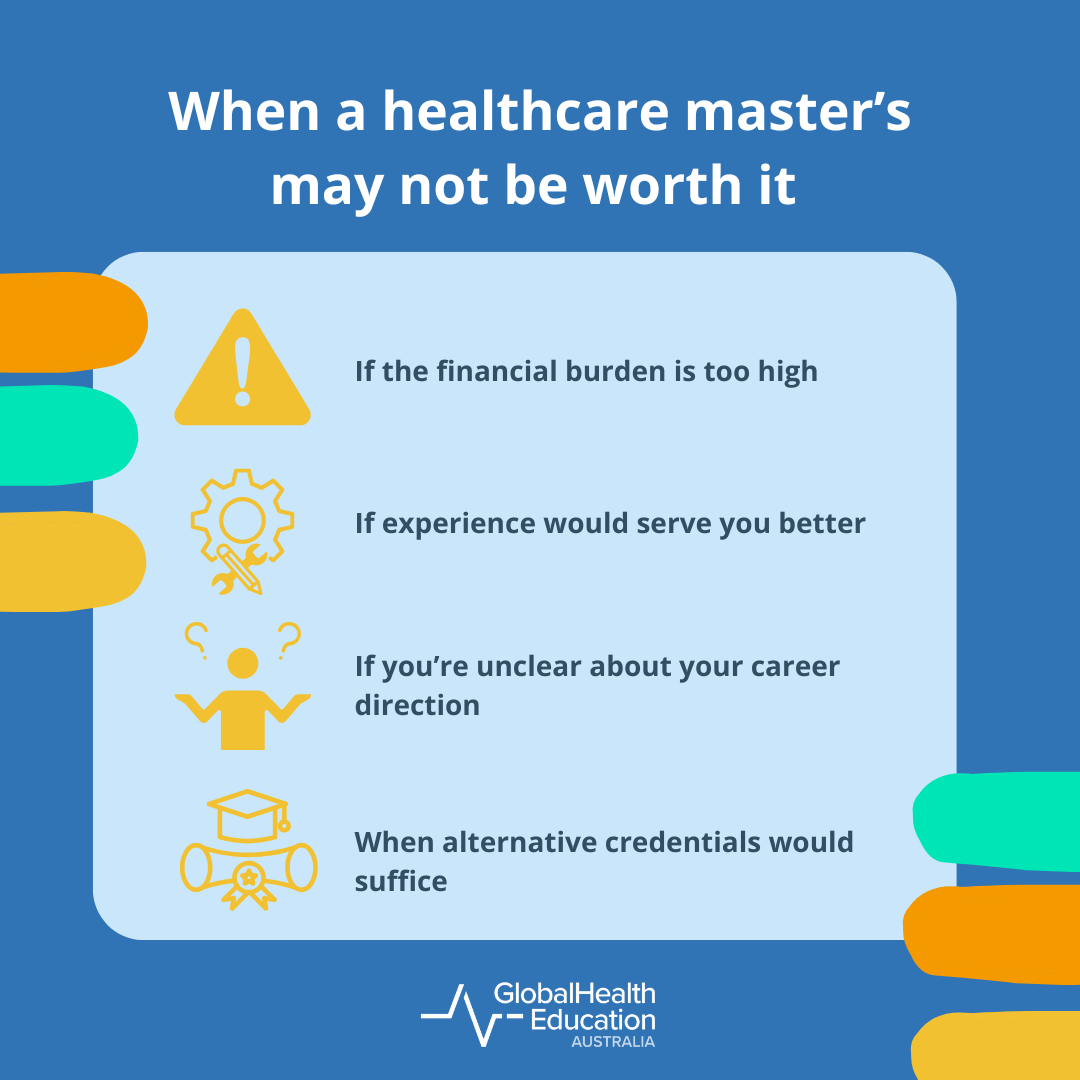
There may be instances where a healthcare master’s degree might not be the right decision, whether it’s because the timing isn’t right or because alternative pathways might be a better fit. These situations may include:
If the financial burden is too high
A master’s course can be expensive, particularly if you’re enrolled in a full-fee paying course. Before committing, consider whether you can realistically manage the cost. A master’s degree may not be the right choice if you’re:
- Already carrying a substantial amount of student loan debt from previous study
- Managing considerable financial commitments
If you’re still keen on pursuing a master’s degree, there are several ways to make it more financially manageable:
Enrol in a postgraduate CSP course
With a Commonwealth supported place (CSP), the Australian Government subsidises a portion of your tuition fees, helping to significantly reduce overall costs. For instance, completing a Graduate Certificate in Child and Adolescent Mental Health at Victoria University would normally cost $11,480 in 2026, but with a CSP, that drops to approximately $3,484.


Develop specialised skills in child and adolescent mental health, assessment and trauma-informed care through flexible online study.
Check with your employer
Some healthcare organisations offer education assistance or sponsorship programs for staff pursuing relevant postgraduate qualifications. For example, Alfred Health in Melbourne supports employees who enrol in its specialty partner postgraduate courses by providing professional development, study leave and postgraduate scholarship opportunities.
Explore scholarship opportunities
Many universities offer scholarships to support postgraduate students in healthcare. These vary in amounts, eligibility and criteria, so it’s best to check each institution’s website for the latest details.
If you identify as Aboriginal and Torres Strait Islander and are currently pursuing or planning to pursue postgraduate healthcare studies, you may be eligible for GlobalHealth Education’s Healthcare Education Scholarship, which provides $5,000 in financial support. Applications are open until 27 February 2026.
Consider online or part-time study
While some courses require full-time, on-campus attendance, many offer part-time or flexible online study options. This allows you to continue working while studying which can help balance commitments and reduce overall financial impact.
If experience would serve you better
If you’re still early on in your career, you might benefit from gaining additional years of practical experience before pursuing postgraduate study.
Those extra years can help to develop your skills, build confidence and give you a clearer sense of whether you’d like to specialise in a particular area or move into a different healthcare field. The challenges and solutions you’ve encountered in your practice can also inform your academic work, making it more relevant and impactful.
Many master’s courses, particularly those focused on specialisation or advanced practice, also typically require applicants to have several years of professional experience.
If you’re unclear about your career direction
A master’s degree is a significant investment that should align with your career goals. If you’re pursuing postgraduate study simply because your colleagues are doing so, it feels like the expected next step or because you’re uncertain about what else to do, it’s worth pausing to clarify your direction first.
Before committing, ask yourself: what’s driving this decision? What do you hope to achieve? How will a master’s degree impact your career trajectory? If you can’t articulate clear answers, you might benefit from further reflection or gaining more experience until your career goals come into sharper focus.
Example:
A midwife with a few years of experience might feel that pursuing a master’s degree is the logical next step in their career, however, if they can’t clearly define why they want to undertake further study or what they hope to achieve from it, it may not be worthwhile. Instead, they should take the time to reflect on their career goals and determine their area of interest before committing to postgraduate study.
When alternative credentials would suffice
Not all professional advancement requires a master’s degree. Alternative qualifications, such as a graduate certificate or graduate diploma, can be more suitable if you’re looking to:
- Upskill within a shorter timeframe
- Focus on practical skill development rather than in-depth research and advanced coursework typical of master’s degrees
- Gain foundational knowledge in a specific area or test your interest in a specialty before committing to a full master’s course
Example:
A registered nurse interested in palliative care wants to upskill quickly to enhance their career prospects and gain foundational knowledge in this specific area. After researching their options, they decide to complete a Graduate Certificate in Palliative Care at the Australian College of Nursing which can be completed in one year. The course will allow them to extend their palliative care capabilities and improve their overall knowledge and skills in the area without the theoretical depth and research requirements of a full master's degree.
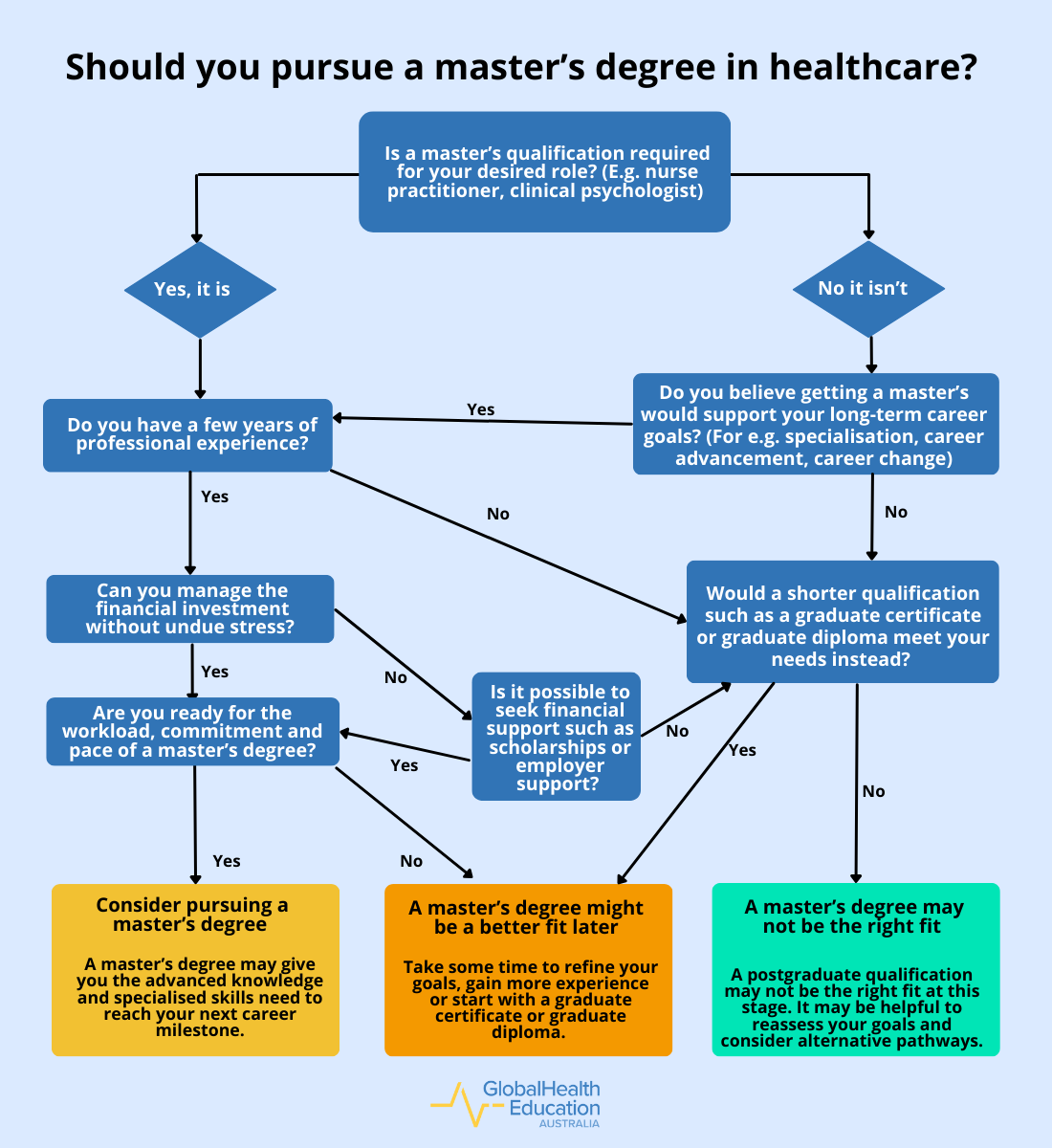
Questions to ask yourself to determine if you should pursue a master’s degree
Unsure if you should pursue a master’s degree? Here are some questions to ask yourself to help with making a decision.
Is this degree required or preferred for your desired role?
Some roles explicitly require a master’s degree, while others list it as preferred. Review job advertisements, check registration requirements and speak with professionals currently in those roles to understand whether the credential will meaningfully support your career goals.
What is your motivation?
Be honest about what’s driving this decision. Do you have clear career goals such as wanting to specialise, transition into a different field or advance into a leadership position? You should be able to articulate specific objectives like “I want to become a clinical nurse specialist in oncology” or “I want to transition from nursing into physiotherapy.”
Where are you in your career?
Are you early in your career and might benefit from gaining more practical experience first? Or do you have several years of experience under your belt and are ready to leverage that experience in postgraduate study?
Is this financially manageable?
A master’s course can be costly and you may also need to factor in potential lost income if you need to reduce work hours. If the financial burden feels overwhelming, explore options such as CSPs or scholarships to lighten the load. If none of these options work and studying a master’s course would create significant financial stress, it may be wise to revisit this later.
What does the job market look like?
Research demand for the field or role that you’d like to move into. Is the profession growing? Is there strong job security? Understanding the market helps you assess whether the investment will pay off in terms of employment opportunities and career stability.
Could a shorter qualification meet your needs?
Before committing to a full master’s course, it may be worth considering whether a graduate certificate or graduate diploma might better suit your needs. These shorter qualifications can provide focused skill development and there’s also the flexibility of starting with a graduate certificate or graduate diploma and progressing into a master’s degree later.
If you’re not sure whether pursuing a master’s degree is the right move, take the quiz below to help you find out.
Ready to take the next step?
A master’s degree in healthcare is a significant investment and while it can transform your career, it may not be the right choice for everyone.
If you’ve weighed the pros and cons and are ready to pursue postgraduate study, GlobalHealth Education lists a wide range of healthcare master’s courses in disciplines such as counselling, mental health, nursing, psychology, public health and social work from Australia’s leading universities.
Book a free professional development strategy call with our Education Consultant, Catriona. She can help guide you through your options and provide you with expert, tailored guidance.