In This Article
- What is digital transformation in healthcare?
- Areas of healthcare undergoing digital transformation
- Why is embracing digital transformation important for healthcare professionals?
- Digital skills healthcare professionals need today
- How to build and strengthen your digital skills in healthcare
- Are you ready to level up your digital skills in healthcare?

Why trust GlobalHealth Education?
-
Our in-house editorial team and healthcare advisors write and review our content.
-
The information in our content provides clarity and insights to help you compare courses.
-
We list postgraduate courses from 25+ respected and reputable institutions in Australia.
The digital landscape in healthcare is evolving rapidly and if you’re working in the sector, you’ve likely felt its impact. Whether it’s using an artificial intelligence tool, navigating an electronic referral platform, conducting consultations over video or analysing data, digital change is reshaping almost every part of how healthcare professionals work today.
What does this mean for you and the future of healthcare? In this article, we’ll cover the areas of healthcare undergoing digital transformation, why embracing it matters and the digital skills worth developing.
What is digital transformation in healthcare?
Digital transformation in healthcare refers to the ongoing process of integrating digital technologies within the healthcare system to improve the performance or reach of an organisation. The ultimate goal of digital transformation in healthcare is to improve patient outcomes, streamline workflow, optimise systems and processes, lower costs and reduce human error.
In Australia, digital transformation in healthcare is rapidly gaining momentum. The Australian digital health market was valued at over $12 billion in 2025 and is expected to reach over $44 billion by 2034. As of 2023, the Albanese Government has already invested $950 million in digital health, recognising the value of digital systems in driving better care, efficiency and collaboration across the sector.
An example of digital transformation in action is the Australian Government’s rollout of electronic health records (EHRs) across the healthcare system. This massive undertaking, which required considerable resources and coordination, delivered benefits such as improved care coordination, easier access to health information and reduced risk of medical errors.
With the recent creation of the National Digital Health Strategy 2023 – 2028, which sets the vision and pathway for Australia’s digital health future and the Digital Health Blueprint Action Plan 2023 – 2033, it’s evident that creating a sustainable and healthier future through a connected and digitally enabled health system is a priority and the future of Australian healthcare.
Areas of healthcare undergoing digital transformation
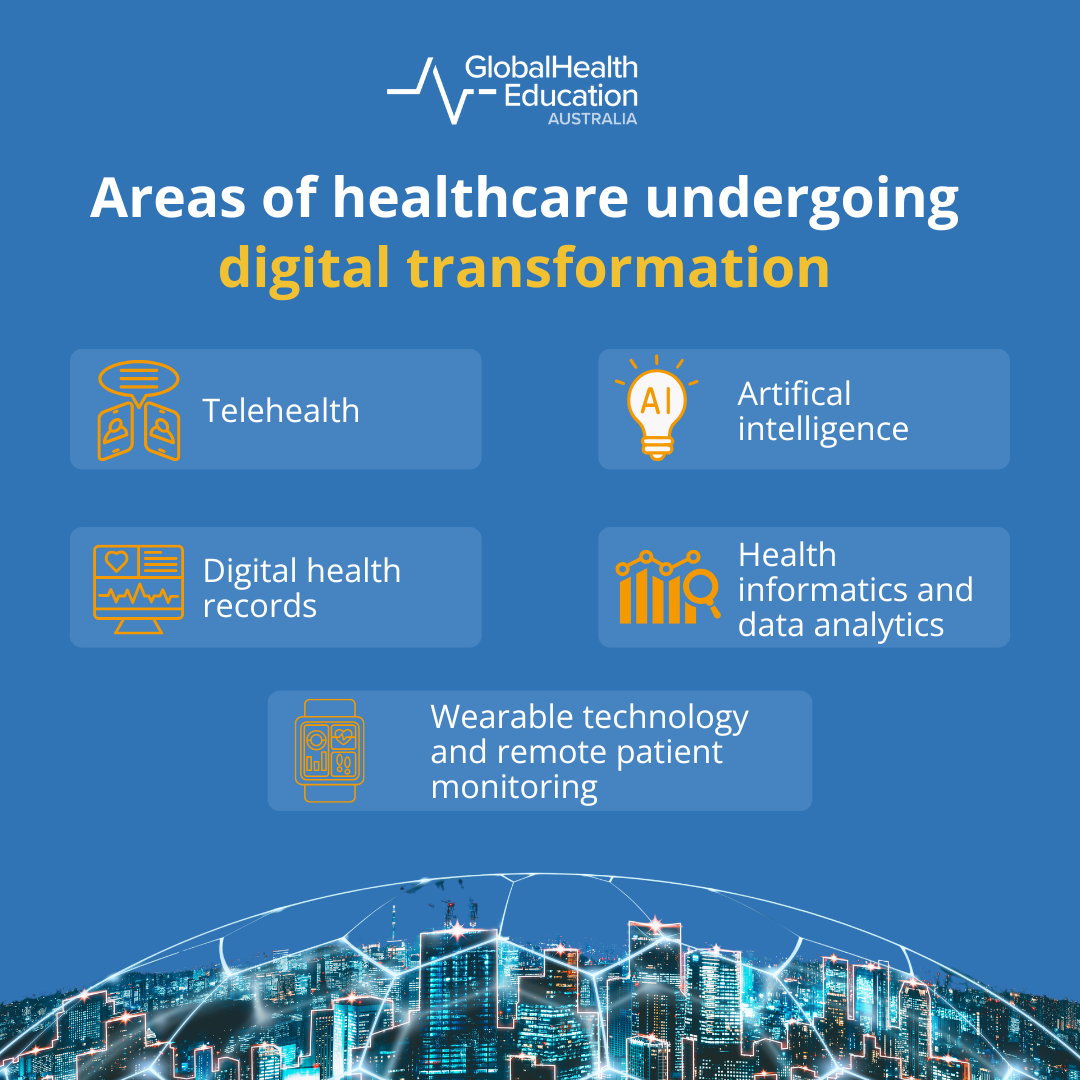
There are numerous areas of healthcare undergoing digital transformation, some further along than others. Examples include:
Telehealth
Plays a critical role in connecting individuals virtually to healthcare services.
Telehealth experienced substantial traction during the Covid-19 pandemic and continues to be a viable and valued option for many Australians. According to the Australian Bureau of Statistics, 22.5 per cent of Australians had at least one telehealth consultation in 2024 – 25, with 90.3 per cent saying they would use it again if offered. Luke Lawrence from Explore Psychology shares that telehealth continues to play an integral role in the way psychologists deliver care, with practitioners he knows “delivering at least 30 to 40 per cent of their treatment via telehealth.”
Telehealth also continues to feature prominently at a national level, with the National Digital Health Strategy Action and Impact Report identifying the improvement and expansion of virtual care as a key priority area. To support this, digital solutions are being developed and improved to enable the expanded delivery of home-based care, with the goal of providing care where it is needed for all Australians.
Digital health records
Plays a vital role in ensuring continued access to patient health information.
The Australian Digital Health Agency reports that as of January 2026, there were over 24.6 million active My Health Records with over two billion documents uploaded by consumers and healthcare providers. Out of those documents, 894 million were uploaded by healthcare providers like hospitals, pathologists and specialists and 1.2 billion were medicine documents uploaded by healthcare providers such as pharmacists and GPs.
The National Digital Health Strategy Action and Impact Report highlights continuing to modernise the digital health infrastructure (including My Health Record) and making it more accessible and discoverable as a key initiative. The overall goal is to create a digital health ecosystem that enables secure, efficient and standardised information exchange across all health and care settings.
Artificial intelligence
A tool that is revolutionising the healthcare industry.
AI is one of the most rapidly evolving areas of digital transformation in healthcare, with applications ranging from early disease detection to administrative efficiency. Luke shares that a number of psychologists he knows are “using AI tools to record and format session notes” and that AI is also being used to assist with developing treatment plans, case conceptualisations and correspondence to third party stakeholders.
AI’s transformative power is expected to continue reshaping the healthcare industry for years to come. In a 2024 survey conducted by McKinsey, over 70 per cent of respondents from healthcare organisations stated that they are already pursuing or have implemented generative AI capabilities. While there are hurdles that still need to be overcome, AI is expected to continue to make its mark in the healthcare industry.
Health informatics and data analytics
Powerful intelligence that can be harnessed into actionable insights.
As the digital health ecosystem continues to evolve, so too will the volume of data generated. With it comes the opportunity to turn this valuable data into actionable insights to assist with decision-making and quality improvements. The Australian Institute of Health and Welfare, for instance, collects and manages data on health and welfare issues before analysing and turning it into useful information and reports to support better policy and service delivery decisions.
The National Digital Health Strategy Action and Impact Report also highlights a shift towards using predictive analytics for clinical decision-making and population health monitoring and using the availability of near real-time data to support more operational and research opportunities.
Wearable technology and remote patient monitoring
Pivotal in gathering real-time information on the physiological conditions of patients.
In Australia alone, the wearables market is estimated at AUD 3.84 billion in 2025 and is forecast to keep growing. Examples of wearables include smartwatches, fitness trackers, biosensors and patches that monitor vital signs or deliver medication.
Remote patient monitoring has also been gaining traction in healthcare. It allows healthcare professionals to use software and medical devices to track a patient’s medical condition outside of traditional clinical settings, with data stored in a central system. Remote patient monitoring is particularly valuable in chronic disease management as it enables early detection of deteriorations, thereby helping to prevent costly hospitalisations.
Why is embracing digital transformation important for healthcare professionals?
To thrive in today’s ever-changing digital landscape, it’s imperative for healthcare professionals to move with the times. Here are some of the key benefits of embracing digital transformation:
You don’t get left behind
Just ten years ago, artificial intelligence existed, but it wasn’t something that was widely adopted. Fast forward to today and AI is being embraced at breakneck speed. Digital transformation is no longer a nice-to-have; it’s critical in demonstrating that you’re moving with the times. Embracing it also means you’re better equipped to respond to the complex challenges facing the healthcare industry and position yourself as a leader in your field.
Better patient and client outcomes
Digital technologies also have the ability to improve patient and client outcomes. Electronic health records, for instance, strengthen the continuity of care by ensuring that diagnoses, treatments and medications are visible across all healthcare providers. This, in turn, reduces duplication, improves patient safety and provides a clear record of episodic care.
Michelle Deroubaix, a clinical nurse and nursing career specialist, has also seen the benefits that electronic medication management has brought to medication safety. “You can actually read the medication order and it has alerts on it. It doesn’t mean that you still can’t make a mistake, but I think it’s a lot clearer and has resulted in less mistakes.”
Enhanced access to care
Around seven million Australians, or 27 per cent of the population, live in rural and remote areas. By embracing digital technologies such as telehealth, you’ll be able to treat and provide care to patients or clients regardless of their location, ensuring they continue to receive the care they need even when in-person visits are not feasible.
More time for patients or clients
Administrative tasks and documentation can eat into the hours that healthcare professionals would rather spend on patient or client care. Digital tools such as artificial intelligence can assist with reducing administrative burdens and improving overall efficiency. Luke shares that by automating session note transcription and formatting, AI has improved administrative efficiency and saved him roughly an hour every day. “I can focus my attention more on the client,” he says, “rather than having to think about if I’ve spelled something right.”
Data-driven decision making
With the large amounts of data being generated by digital tools, the ability to sift through it, analyse it and make data-driven decisions can have a massive impact on patient or client care. In nursing, for instance, nursing informaticians can utilise data to measure treatment effectiveness and patient outcomes and identify patterns and trends that can lead to the early detection and prevention of potential health issues.
Digital skills healthcare professionals need today
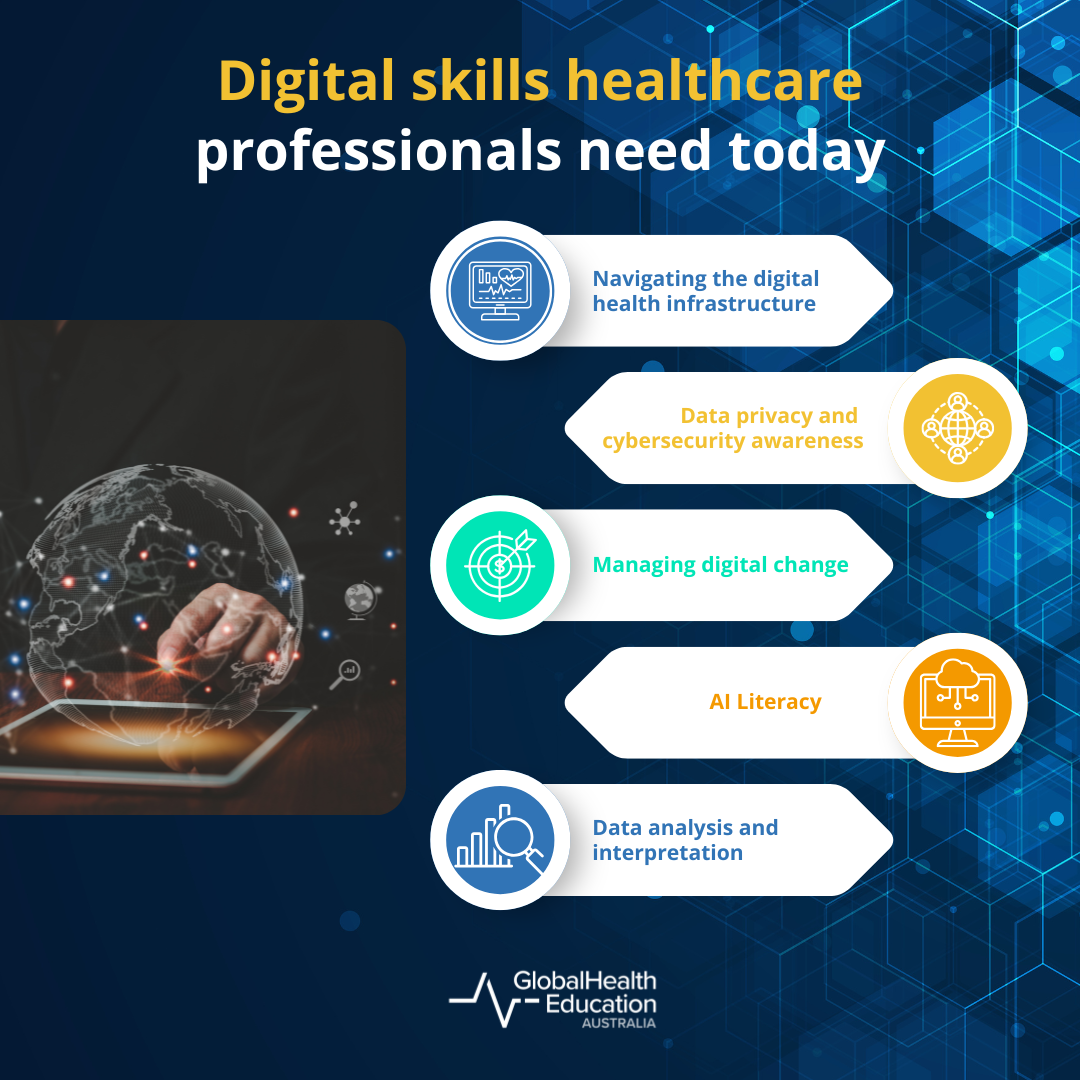
Digital upskilling isn’t just for tech teams anymore. To avoid being left behind, digital skills are a non-negotiable for healthcare professionals navigating today’s digital landscape.
Navigating the digital health infrastructure
Why it’s needed:
Digital systems such as electronic health records, electronic prescriptions and electronic referrals form the connective tissue of Australia’s healthcare system. As these digital technologies continue to evolve, the ability to navigate these digital tools confidently will form the baseline of most healthcare roles.
How it helps you:
Having the skills to navigate the digital health infrastructure provides benefits including immediate access to key health information, the ability to make informed clinical decisions quicker and easier care coordination. With these digital systems continuing to expand, the sooner you get across them, the better positioned you’ll be. As per the National Digital Health Strategy, enhancements are currently being made to the My Health Record infrastructure and a national electronic requesting capability for diagnostic imaging and pathology is also in development.
Getting started:
Beyond workplace training, there are numerous resources available on the Australian Digital Health Agency website that will get you up to speed with the systems. Examples of resources they offer include My Health Record education and training and electronic prescribing training and support.
Data privacy and cybersecurity awareness
Why it’s needed:
With the rise of telehealth, there’s an increasing amount of information being shared digitally. As Luke points out, “you’ve got information like credit card details, dates of birth, email addresses, phone numbers and addresses being transferred between health practitioners and clients.” To prevent data breaches and protect sensitive client or patient information, data privacy and cybersecurity awareness has become a fundamental area of digital literacy for healthcare professionals.
How it helps you:
Having a solid understanding of how to secure and protect a patient or client’s information is imperative in building trust and reassuring individuals that their data is handled safely and responsibly. Privacy and confidentiality breaches make up a significant proportion of professional indemnity insurance claims, so having this knowledge also helps with protecting yourself professionally and ensuring you’re adhering to regulatory obligations.
Getting started:
The Australian Digital Health Agency has numerous resources and practical guides to help you understand and defend against healthcare cyber risks. The digital health security awareness online learning course, for example, will teach you security practices to protect patient data and your healthcare organisation.
Managing digital change
Why it’s needed:
As digital transformation in healthcare continues to accelerate, so too does the need for human readiness and effective change management. Change is hard, especially when it involves shifting perspectives and adapting to new ways of working. When done well, however, it can foster a culture of resilience, adaptability and continuous improvement.
How it helps you:
For those looking to step into a leadership position within the healthcare space, the ability to manage digital change is a valuable skill to have. Having the tools to lead and manage digital change effectively will pay dividends, positioning you as both a forward-thinking professional and a leader others can look to when navigating uncertainty.
Getting started:
There are plenty of postgraduate healthcare courses that will equip you with the skills to manage change effectively. The Master of Health Management and Leadership at Charles Sturt University, for instance, includes an Innovation and Change Management unit that will help you gain the knowledge and skills to facilitate change in your workplace. The course also includes a Digital Health Management unit that will give you a comprehensive understanding of how to leverage digital health solutions to drive improvement.


Learn how to examine the culture of health service delivery and use evidence to make decisions that consider contemporary and emerging issues in the funding, financing, regulatory and policy influences on managerial practice.
AI literacy
Why it’s needed:
As a healthcare professional in the age of AI, it’s important to understand how to use common AI tools within your practice. As AI’s influence continues to grow across the healthcare landscape, it’s not just about using the technology, but also knowing how to interpret and question its outputs and recognise its limitations.
How it helps you:
There are many benefits to AI, from enabling faster diagnoses to reducing administrative workloads and supporting research and innovation. With AI making significant waves across healthcare, it’s important to question its outputs and apply a human lens to prevent an over-reliance on technology. As a healthcare professional, patients and clients look to you for your expertise, so it’s critical that the information or advice you provide is accurate and guided by your own clinical judgement.
Getting started:
AI literacy takes time to develop as it requires consistent practice. The more you work with AI tools, the more you’ll develop the ability to critically evaluate its outputs and recognise and navigate the ethical considerations that come with using AI in healthcare. Luke’s advice is to use AI as an administrative aid rather than a decision maker. “I always emphasise clinical skills and judgement over using an AI tool,” he shares. “You should always prioritise your own judgement because you've got the training. You're the human being who’s working with the client. It’s there as an administrative tool that helps us save time with the administrative responsibilities, rather than the clinical responsibility of diagnosis and treatment planning.”
Data analysis and interpretation
Why it’s needed:
With the large amounts of data generated by digital tools, the ability to analyse and interpret this information is becoming increasingly important. Analysing healthcare data can help healthcare providers identify patterns, predict healthcare trends and make evidence-based decisions. The insights harnessed from this data can also contribute to more effective and timely healthcare.
How it helps you:
With the growing use of telehealth, electronic health records and other complex digital systems, healthcare professionals who can bridge clinical practice with data-driven decision making will become increasingly sought after. Gaining the skills required to analyse and interpret data can give you a professional edge as it shows that you’ve got the capabilities to translate data into solutions that improve clinical practice.
Getting started:
There are plenty of postgraduate healthcare courses that will build your foundation in data analysis and interpretation. The Master of Health Management and Leadership at Queensland University of Technology, for instance, includes a Clinical Informatics for Intelligent Healthcare unit that focuses on areas such as data analysis and process analysis.


Acquire the skills to influence policy that will shape health systems' future.
How to build and strengthen your digital skills in healthcare
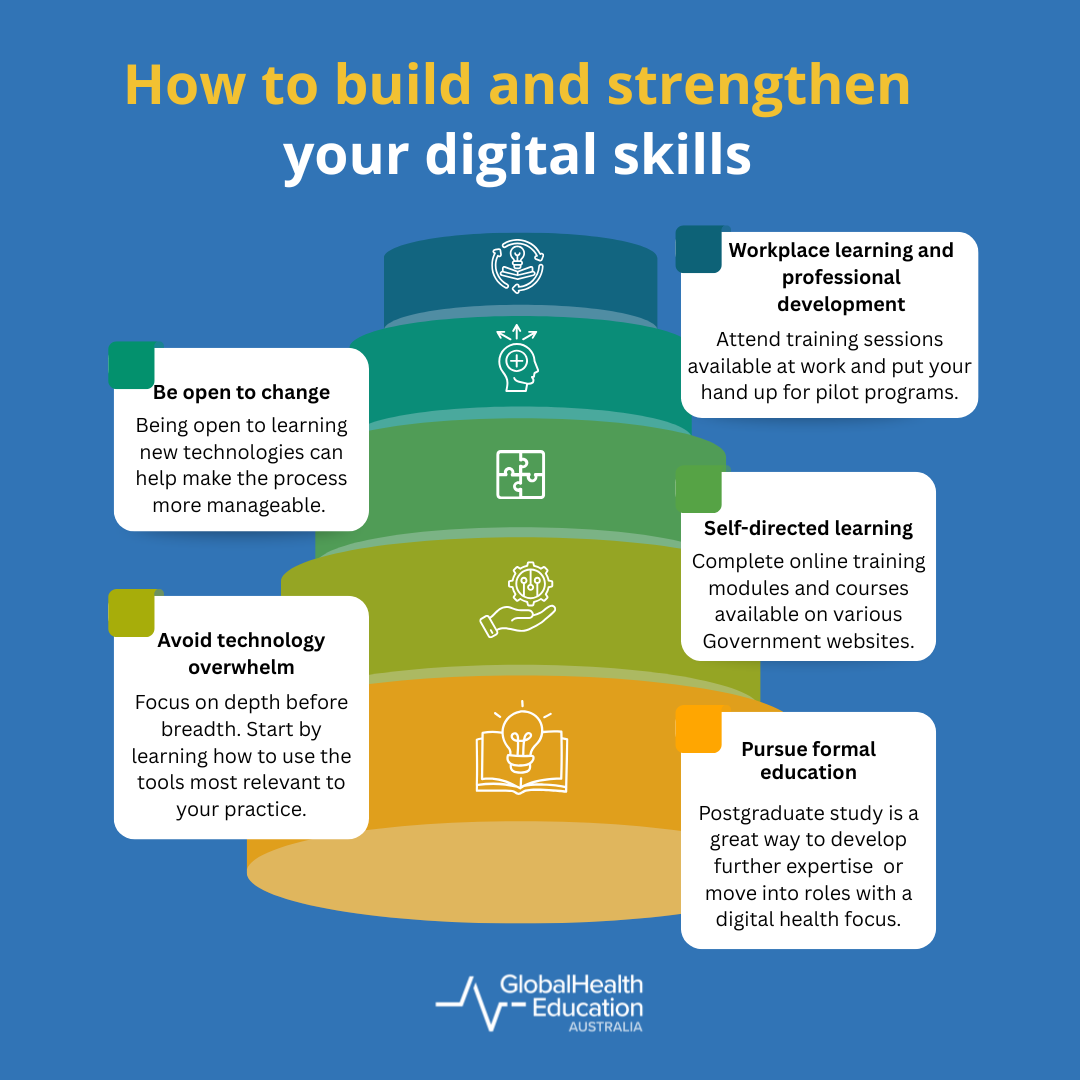
Upgrading your digital skill set doesn’t need to be a lengthy or arduous endeavour. There are many different ways you can go about strengthening and building your digital skills.
Pursue formal education
For healthcare professionals looking to develop further expertise in this space or move into roles with a digital health focus, postgraduate study might be a suitable option. Some courses to consider include:
Graduate Certificate in Digital Health Leadership and Management at the Queensland University of Technology
This course can be completed either online or on campus in a part-time capacity and covers everything from leveraging digital data to leading and managing clinical informatics initiatives. Examples of units include Clinical Informatics for Intelligent Healthcare and Leadership in Digital Health Management. It’s a well-rounded course that’s ideal for those looking to become a leader in the implementation, adoption and use of digital health systems.

Gain essential knowledge and practical skills in digital health within a clinical practice setting.
Graduate Certificate in Health Analytics at the University of Technology Sydney
This course is suitable for individuals looking to enhance their skills in data analytics. Comprising four online subjects, examples of units that you’ll complete include Data Visualisation and Visual Analytics and Fundamentals of Epidemiology. It’s an ideal course for health informatics specialists, public health and policy professionals and individuals working in health research who are looking to strengthen their analytical skills.


Delivered 100% online with a diverse range of electives this course will help you develop the fundamental knowledge and skills to evaluate and apply health research and data.
Master of Nursing (Nursing Informatics Leadership) at Victoria University
If you’re a nurse looking for a part-time course you can complete online, this nursing informatics course will provide you with a comprehensive overview of the digital healthcare landscape and the adoption of nursing informatics and practices. You’ll develop skills in data analytics, build on your leadership skills and critically assess the implementation plan of a nursing informatics system.


Combine nursing expertise with digital health leadership to improve clinical systems, workflows, patient safety and technology-enabled care.
In the years ahead, digital health education will be further embedded into university degrees to build greater capability across Australia’s healthcare workforce. Current initiatives underway as part of the Capability Action Plan include a collaboration with the University of Queensland and the Digital Health Cooperative Research Centre (CRC) to develop digital health education content and a partnership with La Trobe University to create a digital health foundations course for nursing and midwifery students preparing for clinical placement.
Be open to change
If you’ve always done things a certain way and aren’t used to working with digital tools, approaching change with the right mindset can make the process far more manageable. It’s also important to be patient with yourself and give yourself time to adjust. As Luke shares, “It’s normal to expect a relatively steep learning curve whenever there’s new software or way of doing things and it’ll take a little bit of time to accommodate that into the way that you practice.”
Lean into workplace learning and professional development
Your most accessible starting point is the learning already available within your workplace. Your organisation might conduct training on artificial intelligence tools, for instance, or run a refresher on how to use electronic health records. In Michelle’s case, she shares that she also attends short, regular sessions hosted by the customer relationship management system (CRM) that she uses. “It’s only about 15 minutes, just on something specific in the system. If you have something like that regularly, you can put it in your diary and build from there.”
Another way to build your skills is to put your hand up when your workplace is rolling out new technology. Volunteering for a pilot program means you get early exposure to the tool and once you’ve learned the ins and outs, sharing that knowledge with colleagues can further reinforce your own learning.
Invest in self-directed learning
Beyond workplace training, there are plenty of online training modules and courses in digital health available through organisations such as the Australian Digital Health Agency and the Australasian Institute of Digital Health.
If you’re a nurse, the Australian Nursing and Midwifery Federation also offers a range of resources, including podcasts and webinars, that can help further your knowledge in digital health. Many of these may also count towards your CPD hours, so you can build your digital health knowledge while also meeting your CPD requirements.
Avoid technology overwhelm
With so many new platforms, updates and digital tools emerging, it’s easy to feel overwhelmed. A practical suggestion is to focus on depth before breadth. Luke suggests “starting with one tool at a time as opposed to a number of different platforms and learning how to use it well.” Once you’ve mastered that tool, you can then look at continuing to expand your digital toolkit.
Are you ready to level up your digital skills in healthcare?
With digital health growing in relevance and importance and digital transformation continuing to reshape the healthcare industry, now’s the perfect time to build and strengthen your digital skills.
With an extensive catalogue of postgraduate healthcare courses available on the GlobalHealth Education website, there’s plenty to choose from. From health leadership to nursing, psychology and social work, there are numerous courses that incorporate a digital health element to help prepare you for the demands of today’s healthcare landscape.
Our Education Consultant, Catriona, has extensive experience in career coaching and can recommend courses and universities suited to your goals and lifestyle. She can also help you map out the next steps in your career. If you’re ready to have a chat, book a complimentary professional development strategy call with her today.