In This Article
- How is Gen Z shaping the healthcare workforce?
- What is work ethic and is Gen Z lacking it?
- What do experienced healthcare professionals think of Gen Z’s influence?
- What Gen Z wants in a healthcare career
- Why meeting Gen Z’s needs matters
- Building a thriving multigenerational workforce
- A stronger healthcare workforce for all generations

Why trust GlobalHealth Education?
-
Our in-house editorial team and healthcare advisors write and review our content.
-
The information in our content provides clarity and insights to help you compare courses.
-
We list postgraduate courses from 25+ respected and reputable institutions in Australia.
As Millennials and Generation X advance in their healthcare careers and Baby Boomers retire, a new wave of skilled healthcare professionals is entering the sector. Generation Z (Gen Z) are set to comprise around 30 per cent of the total workforce in Australia over the next five years, with the healthcare sector expected to reflect a similarly increased proportion.
The majority of Gen Z has grown up immersed in a digital era, bringing with them a set of values, expectations and career aspirations that are different to previous generations. Their current and continued influence on healthcare workplace dynamics means organisations and other generations need to be adaptable to work collaboratively with this younger cohort. It also means Gen Z can take meaningful steps to ensure they are equipped for the demands of their healthcare roles and for working alongside more experienced professionals.
This article explores how Gen Z is reshaping healthcare workforce culture, whether there’s any truth to the narrative of Gen Z’s poor work ethic and what healthcare organisations and individuals alike can do to help bridge the gap between traditional systems and new expectations in the healthcare sector.
As Gen Z takes up more space in the healthcare workforce, they are advocating for greater workplace flexibility, more meaningful learning and professional development, collaborative environments and a stronger focus on wellbeing. They want to pursue purposeful work and careers that grow along with them. These values and expectations will shape how healthcare organisations design career pathways and workplaces to ensure a stable future in the sector.
This workplace culture shift is occurring across the business sector as well, with Gen Z professionals more likely to push for better work-life balance, establish firmer boundaries and move on if they don’t feel they can grow in their role.
In the current climate, 82 per cent of health professions, including nursing, mental health and various allied health occupations, are experiencing shortages. This makes it even more important for organisations to understand the different perspectives Gen Z brings to workforce culture, to help ensure more resilience and engagement for the future.
What is work ethic and is Gen Z lacking it?
Work ethic is how seriously and responsibly a person approaches their work. It relates to the effort and attitude someone puts toward their work and an overall mindset that involves doing one’s best. Understandably, a strong work ethic in healthcare helps professionals remain accurate, compassionate and focused on positive outcomes.
The poor work ethic stereotype is one that paints the Gen Z workforce as having a shorter attention span, lower job loyalty and lazy tendencies, with many older generations labelling Gen Z as entitled and unwilling to put in the hard yards in their role.
However, a 2023 Australian Human Rights Commission report highlights how misunderstood Gen Z is and that many negative perceptions about Gen Z’s work ethic are simply value differences observed by older generations. This is coupled with a growing frustration among this younger cohort who feel that, despite working hard, they have little to show for it.
Consequently, their frustration is misinterpreted as dissatisfaction or laziness, when in reality, Gen Z is competent, ambitious, entrepreneurial and highly adaptable. This is especially observed in service and person-centred sectors like healthcare, where Gen Z professionals can make a meaningful impact and often take a dedicated approach to their work.
According to SEEK’s 2025 Workplace Happiness Index, purpose is ranked as the number one driver of workplace happiness among Australian employees. This is also true for Gen Z professionals, however, only 50 per cent report finding genuine meaning and purpose in their job.
Is it possible that a values mismatch and subsequent disengagement among Gen Z is being misinterpreted as distraction, boredom or a lack of commitment?
Like all generations, Gen Z is intrinsically motivated and engaged at work when their core needs are met. They are more likely to enjoy their work when it's interesting and manageable, when they feel recognised and valued and when they can work collaboratively in a team.
This suggests that the Gen Z work ethic is not poor at all. When healthcare organisations and professionals therein can move past the negative stereotypes and address the needs of an evolving workforce, all generations can benefit and the future of the healthcare sector will be stronger as a result.
What do experienced healthcare professionals think of Gen Z’s influence?
Two experienced registered nurses, Madeline Kessler and Michelle Deroubaix, offer their insights on how this generation appears to be impacting the healthcare sector, based on their mentoring, teaching and workplace experiences with Gen Z nurses.
A shift in mindset
Madeline reflects on working alongside a 23-year-old graduate nurse whose long-term career goal was to study medicine. She notes that gaining respect in the workplace, faster career progression and not allowing work to define one’s entire identity were important elements to this Gen Z nurse’s career. Madeline added that this latter point distinctly differs to the way many older nurses approach their careers, which shapes their overall work ethic.
She describes the differing work ethics between younger and older nurses by saying, “In terms of older generations, we take our role very personally. It’s a part of who we are. Whereas Gen Z says ‘this is a job that I do, that I’ve trained for; it’s not [necessarily] who I am.’”
In her view, this represents a positive change and an important mindset shift to help ensure the future nursing workforce doesn't burn out. “This is good, this is the change we need to happen. Gen Z are not willing to sacrifice themselves for the job they do in life. It will raise the professional profile of nursing and many other professions."
An opportunity for mutual learning
From Michelle’s experience, Gen Z nurses need to temper their expectations and appreciate the process of gaining experience, building expertise and learning from the wealth of knowledge held by more experienced nurses.
Michelle has observed how Gen Z nurses approach their roles, noting that some do only what is required and, as a result, may miss opportunities to provide essential care and to learn the art of nursing. She says that Gen Z professionals expect more variety and challenge. Michelle also acknowledges that due to many experienced nurses leaving the field, there’s more pressure for this generation to step into leadership roles, perhaps sooner than they are ready. “They still need to rely on the experience of nurses who’ve been working for years.”
Michelle believes that seeking a mentor or career coach could be a useful strategy for Gen Z nurses to help them navigate challenges and learn from a good role model with plenty of experience.
Madeline ultimately feels that Gen Z are dedicated with better boundaries and that there’s a valuable mutual learning opportunity available to younger and older nurses. “People need to stay open minded. Gen Z has a lot to learn from us, in terms of skills, management [and working in] complex cases. At the same time, we have a lot to learn from them as well.”
What Gen Z wants in a healthcare career
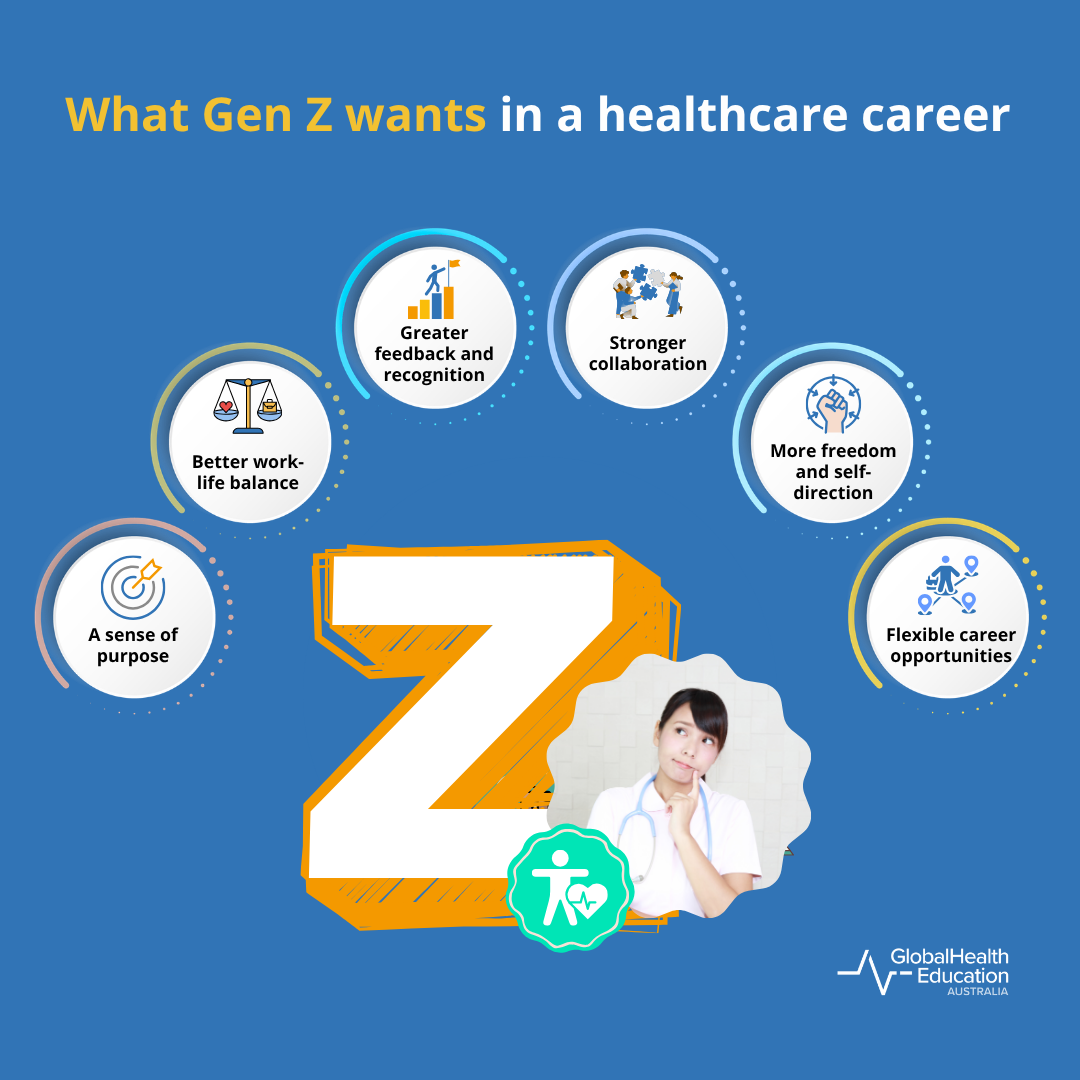
Gen Z have clear values that influence what they want from their healthcare careers. Here is a breakdown of these values and expectations:
A sense of purpose
Healthcare remains a sought-after career choice among Gen Z in Australia, with 21 per cent of this generation identifying it as their ‘dream’ career path. Roles in medicine, nursing, psychology, counselling or allied health are appealing to this generation because of the impact they can make on people’s lives.
Gen Z has grown up in a time of social awareness, climate change and global crises, with an increased emphasis on disease prevention, inclusivity and wellbeing. These influences help shape Gen Z’s career expectations, where they want to contribute, help people and make a difference. Healthcare offers ample opportunities for Gen Z to attain purpose in their work.
Supporting individuals through vulnerable moments, improving their health and quality of life are all deeply fulfilling aspects of any healthcare role. As long as Gen Z professionals find roles with purpose, they’ll have greater job satisfaction and a stronger commitment to their role over the long term.
Better work-life balance
A recent global study of more than 13,000 healthcare professionals revealed that 83 per cent of Gen Z frontline workers are experiencing burnout. Gen Z wants a better work-life balance because they want to approach their work in a sustainable way. Rather than working at all hours, for years on end and risking burnout, Gen Z are interested in roles that include predictable or flexible work hours, more work from home opportunities, greater variety and less stress overall.
When these expectations are met, Gen Z has more capacity to pursue interests outside of work, take on further study or spend more time with family and friends. Interesting, good work-life balance ranks just behind purpose in driving job satisfaction and is considered even more important than salary by many Gen Z healthcare professionals. Compared to previous generations, Gen Z are more aware of the importance of prioritising their own mental health and practising self-care as proactive measures against burnout, which is often seen in professionals like nursing and psychology, for example.
Gen Z views work-life balance as essential to the success of their healthcare role and the care they ultimately provide. A generation that understands that they need to take care of themselves to better care for others is more likely to enjoy a rewarding and sustained career.
Greater feedback and recognition
Feedback matters a great deal to Gen Z, as this helps them feel valued and worthwhile in the workplace. The lives they lead are often fast-paced and full of instant reward, particularly in social and digital environments. They are therefore more likely to expect similar, recurrent professional feedback in their work environments.
Annual performance reviews or less frequent check-ins may, therefore, not be sufficient to support their growth, confidence and development of clinical skills. Instead, more regular feedback from peers and managers helps Gen Z understand where they excel, where they can improve and how their contributions are making a difference.
Whether it's going above and beyond to provide high-quality care or completing professional development training, regular feedback is vital to Gen Z. Both internal and more public recognition opportunities can also help Gen Z professionals feel seen and appreciated, which helps them remain committed to their roles and the organisation's needs.
Stronger collaboration
Gen Z nurses and other healthcare professionals thrive in collaborative, team-based environments where ideas are shared openly and contributions are valued. The interconnectedness they are used to, due to the ability to instantly communicate and share perspectives, means Gen Z are quick-thinkers who can solve problems in novel ways.
For them, a stronger sense of collaboration at work can help contribute to better outcomes for patients and clients in a more cohesive work environment. It also provides unique opportunities for learning from senior staff and other healthcare professionals within multidisciplinary teams. Strongly aligned with their desire for purpose in their role, this generation wants to see their ideas influence decisions and make a positive difference overall.
Collaborative environments also foster a sense of belonging, which promotes greater engagement and motivation to learn, grow and develop skills. In the context of healthcare, Gen Z understands the value of taking a holistic approach to care and acknowledges that other professionals bring their unique expertise and perspectives to the table. Careers that prioritise collaboration help keep things fresh and interesting, providing much-desired variety to Gen Z’s roles.
More freedom and self-direction
This aspect of what Gen Z wants in their careers may be tricky to accomplish in certain roles. However, the more agency they have over their daily tasks or workload, the greater their confidence and job satisfaction will be. Giving Gen Z healthcare workers ownership over their work signals that they are trustworthy and don't need to be micromanaged.
As the youngest generation entering the healthcare workforce, trust is a form of currency that motivates responsibility and proper investment into their individual roles. More autonomy allows them to make meaningful contributions in environments that value their critical thinking and initiative.
Demonstrating competence at work also shows more senior staff that they are preparing for greater responsibilities and advanced roles in the future. As experienced healthcare professionals transition out and retire, Gen Z will eventually fill leadership and frontline roles. Providing opportunities for them to build skills in complex environments will help ensure the organisation’s future and that patient or client care remains in capable hands.
Flexible career opportunities
The thought of climbing a traditional, linear career ladder may not be so appealing to many Gen Z healthcare professionals. Instead, what matters to them is flexibility in how their career looks and the ability to pivot if their needs or individual circumstances change. This generation values customisation and expects to tailor their careers to suit their interests and strengths.
Gen Z are highly entrepreneurial and thrive on variety and challenge, often seeking opportunities to gain additional or specialised skills that give them a competitive edge. They may pursue non-linear career pathways, microcredentials or development opportunities that help them diversify their skill set. They may also seek ways to switch careers and leverage their existing skills via postgraduate study to become qualified as a practitioner in another healthcare field.
Their creativity, adaptability and eagerness to learn and grow will help prepare them for leadership or management roles, or for complex care and specialised roles in a constantly evolving healthcare landscape. Depending on their interests, doors to healthcare opportunities in other countries may also open, giving them the chance to broaden their experience, gain new skills and make a meaningful difference in diverse healthcare environments and populations.
Why meeting Gen Z’s needs matters
Around 22 per cent of the Gen Z healthcare workforce are considering leaving the field and ignoring the needs of Gen Z creates short-term dissatisfaction and long-term negative consequences for Australia’s healthcare system.
High attrition among Gen Z risks exacerbating the existing skills shortages across multiple healthcare disciplines. Roles such as nursing, mental health, allied health and more are already struggling to meet nationwide demand.
Gen Z brings a level of digital fluency, recent clinical training and new perspectives to the table, which could be lost if they feel undervalued and undersupported in healthcare. Organisations could miss out on the energy, ideas and innovation that Gen Z provides, which also means missed opportunities to improve care delivery and workflow – essential elements of an evolving healthcare landscape.
Importantly, the ripple effects of Gen Z’s disengagement could ultimately affect patient and client outcomes, as the loss of skilled and motivated healthcare professionals disrupts continuity, potentially leading to more clinical errors and lower overall quality of care. This intensifies workforce strain and places additional demands on older generations to maintain a high-quality level of care.
Building a thriving multigenerational workforce
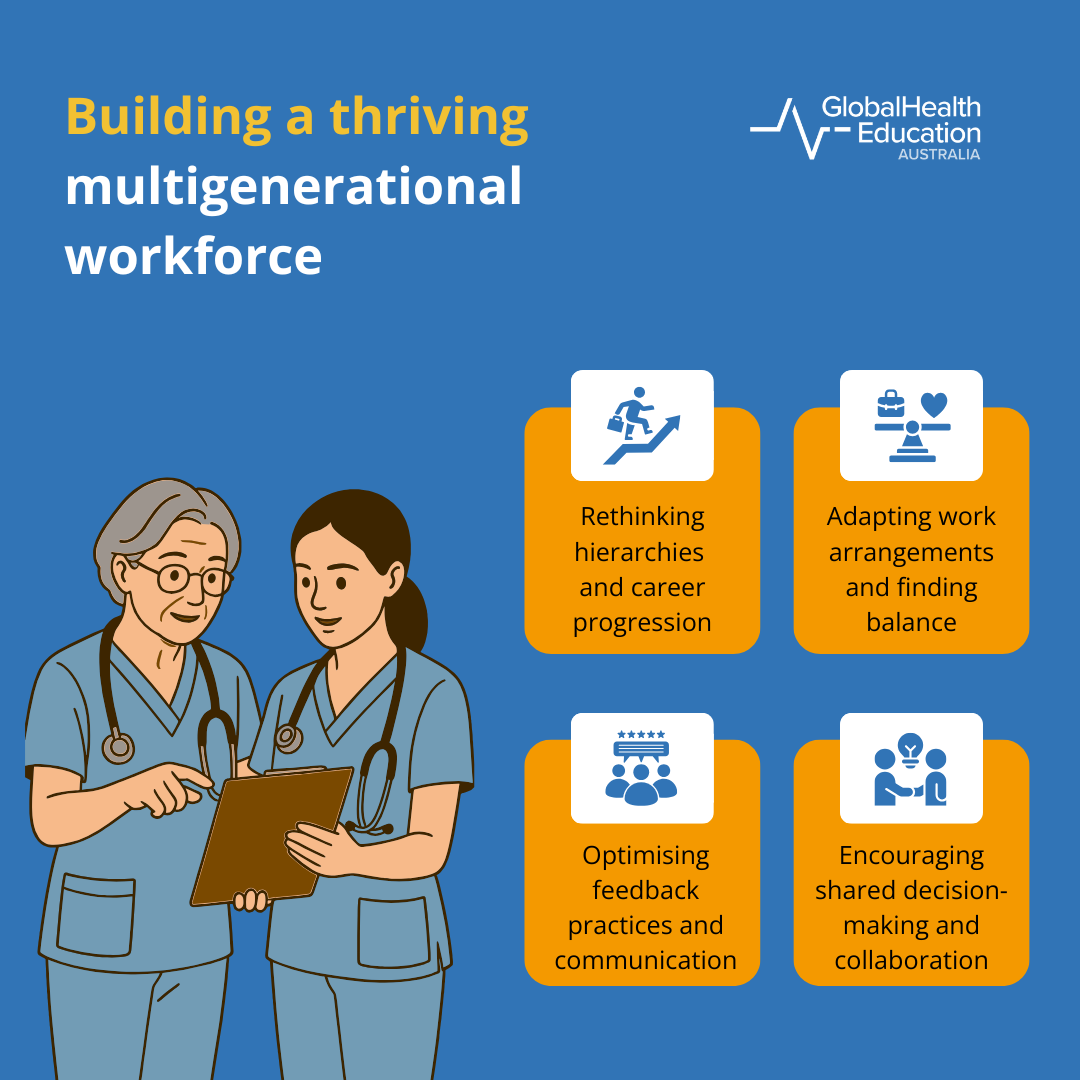
Realistically, the healthcare workforce will comprise multiple generations, each bringing different skills, strengths and levels of expertise.
Below are some key areas where both Gen Z and older generations can take action and consider some ways to build a more cohesive, collaborative and efficient workforce. A thriving multigenerational healthcare workforce can help improve retention, job satisfaction and patient or client care.
Rethinking healthcare hierarchies and career progression
A Deloitte survey, which included over 23,000 respondents across 44 countries, found that within the Gen Z workforce, 88 per cent want more practical skill development to support their career, particularly early on.
Career progression can feel slow for some Gen Z professionals, including Gen Z nurses. Many healthcare organisational structures are based on a traditional hierarchy, which often means that expertise and advanced positions are linked to those who’ve been in roles the longest.
This generation wants opportunities to move forward in their careers based on their competencies, rather than their tenure. Some workplaces offer clear career development pathways, mentorship or training, while in other situations, Gen Z healthcare professionals may need to take some initiative to propel their career.
Gen Z can support their progression by gaining skills in leadership and management, which can give them an advantage in their career, more confidence and may provide a faster pathway into more senior roles.
For example, if you’re a Gen Z registered nurse interested in pursuing a future leadership role, you might consider enhancing your clinical and leadership skills with a Graduate Certificate in Advanced Nursing from the University of Technology Sydney. You can progress to the UTS Master of Advanced Nursing, which builds on the skills gained in their nested graduate certificate, giving you a comprehensive qualification to pursue roles such as nurse unit manager, clinical nurse consultant, nurse educator and nurse researcher.
The courses below are listed by qualification level, from lowest to highest.


Delivered 100% online by a multi-award-winning school, this course focuses on advanced skills in leadership, clinical practice, applied pathophysiology, and implementing evidence in nursing.

Delivered in at least two years, 100% online and influenced by strong healthcare industry partners, it offers four specialist pathways - Acute Care, Chronic and Complex Care, Quality and Safety and Leadership and Management.
If you have a bachelor’s degree in any health-related discipline, the Graduate Certificate in Healthcare Leadership from Southern Cross University could be an ideal postgraduate study path to help progress your career at a pace that suits you. Use the skills gained in the SCU graduate certificate to progress into their Master of Healthcare Leadership. This master’s degree can open up more opportunities as you acquire transferable skills to help you lead teams, manage organisational change and improve healthcare service delivery. As a Gen Z professional with this qualification, you’ll confidently progress your career sooner into an advanced practice or leadership role.
The courses below are listed by qualification level, from lowest to highest.

Delivered online and designed to build your knowledge to meet leadership challenges in multidisciplinary and complex healthcare delivery.

Delivered 100% online, this course is suitable for people from a broad range of backgrounds and is designed to give you a range of skills you can take with you into the future.
On the other hand, if you’re an experienced registered nurse interested in supporting the future healthcare workforce, you might consider becoming a nurse educator.
The University of Southern Queensland’s online Master of Nursing (Clinical Education) is an ideal option to consider. This course takes three years to complete at a part-time study load and is aimed at registered nurses who have completed a Bachelor of Nursing. You’ll gain advanced skills in teaching, curriculum design and leadership to help shape the next generation of nurses. In addition to completing the core and specialised subjects, you can also choose from a range of selective units to customise your course. Topic areas include emergency nursing, gerontology and the cultural determinants of health, as examples.

Equips experienced nurses with advanced skills in teaching, leadership and curriculum design to shape the next generation of healthcare professionals.
Beyond nursing, if you’re a healthcare professional and want to utilise your experience gained throughout your career to inspire future generations, Monash University offers a Graduate Certificate of Health Professions Education. This course is a 12-month online course for those with a bachelor’s degree or equivalent in a health-related discipline. You can progress your studies and complete Monash’s Master of Health Professions Education, with the graduate certificate providing RPL credits towards your qualification. This master’s degree consists of three parts – core studies, applied studies and elective studies. You’ll graduate with the capabilities to pursue roles in teaching, mentoring and supervision applicable to clinical and non-clinical contexts relevant to your field.
The courses below are listed by qualification level, from lowest to highest.

Enhance the skills of health professionals through dynamic teaching, assessment and mentoring across diverse clinical settings.

Apply educational theory to teach and supervise in health professions, building on prior certification through interactive, practice-based learning.
Adapting work arrangements and finding balance
In settings such as public and private hospitals, aged care facilities or in rural and remote healthcare, shift work, weekends and on-call duties are inherent to many of the roles therein. While previous generations largely accepted this structure as part of the job, Gen Z professionals are more likely to view inflexible or unpredictable schedules as negatively impacting their quality of life and overall job satisfaction.
Gen Z has witnessed their parents, older family members or siblings from the Boomer, Gen X and Millennial generations experience burnout due to their work. They are therefore more protective of their time and wellbeing. As previously mentioned, one thing high on Gen Z’s priority list is good work-life balance, which means organisations should consider more flexible work arrangements wherever appropriate to do so.
Options including shift-swapping, more flexible start and finish times and greater input into rostering can increase Gen Z’s sense of control over work hours, even if the total hours remain the same over a given period.
In environments like private clinics or community care, there is often more scope for flexibility, including pursuing part-time roles, staggered work hours across a rostered period or incorporating telehealth services.
Even slight improvements to work predictability and arrangements can have a significant positive impact on how satisfied Gen Z healthcare professionals feel in their careers. This can help establish healthier boundaries and promote better job retention over the long term.
Optimising feedback practices and communication
Implementing regular feedback opportunities, such as weekly or fortnightly check-ins, pulse surveys or short performance snapshots, can help Gen Z employees stay engaged and motivated in their roles.
Frequent communication provides clearer direction, encourages professional growth and helps younger professionals feel supported as they navigate fast-paced healthcare environments. It also allows them to see in real time how their contributions positively influence patient care, team performance and broader workplace outcomes.
Because Gen Z values being seen and heard, they may also benefit from more public displays of recognition, which should also be timely and specific. Public acknowledgement during team meetings, internal communications or digital recognition platforms can help reinforce a sense of belonging while encouraging peer feedback and connection.
Recognition linked to specific behaviours, such as taking initiative, communicating effectively with colleagues or patients and efforts to foster a more inclusive workplace culture can help Gen Z build confidence and stay connected to their purpose.
It’s important to remember that effective communication is a two-way street and something that both parties participate in equally. This means both more experienced and younger healthcare professionals can benefit from building these skills in their workplace contexts.
If you’re a registered nurse interested in developing your communication skills, the Master of Nursing Majoring in Advanced Practice at James Cook University includes the communication unit: Professional Communication in Healthcare. This unit equips graduates with the skills to manage challenging conversations, engage in persuasive arguments and strive for more impactful and collaborative communication in diverse healthcare contexts.
Developing this important soft skill is useful for both Gen Z and older generation nurses, alongside all health professionals. You’ll build more capacity to engage in constructive feedback, communicate concerns with greater confidence and professionalism and navigate conversations with managers and colleagues more effectively. It can also support your ability to advocate for yourself and others, helping you feel heard and recognised in your nursing role.


Enhance your skills in this 100% online advanced practice major, which includes four specialized units designed to equip you with the necessary skills to deliver advanced patient care.
Encouraging shared decision-making and collaboration
Gen Z wants to contribute ideas and is keen to partake in decision-making processes wherever possible. They may challenge the status quo more than other generations because they have grown up in a world that encourages exploration and independent thinking. Many have grown up in a culture of side hustles, where the potential to craft a career from scratch leads to greater control over one’s career trajectory. Some may seek a similar level of autonomy over their roles in healthcare.
However, autonomy is something that’s gained over time, when clinical competence can be demonstrated effectively in a variety of settings, often under pressure. One way to give younger healthcare professionals more agency is to provide opportunities for shared decision-making in a team-based and collaborative context.
This may involve an organisational shift toward more inclusive approaches to making decisions relevant to both clinical and non-clinical environments. An example of this could be ‘all-in’ style team meetings where everyone, regardless of seniority, can contribute meaningfully and offer ideas.
For Gen Z healthcare workers, this gives them a chance to collaborate on decisions that would impact their workflow or certain patient or client care processes. Participating in shared decision-making helps foster trust and mutual respect with better engagement and cohesion, where all staff members grow and thrive.
Building advanced skills in teamwork and collaborative practice is equally important for Gen Z professionals as well as those with more career experience. Courses with a focus on collaboration, teamwork and building interpersonal skills can help you contribute to decisions more effectively in your healthcare role.
If you’re a registered nurse belonging to any generation, Victoria University's Master of Nursing (Leadership) can help you develop advanced skills in clinical leadership, strategic decision-making and collaboration within complex healthcare environments. Through two dedicated units: Care Coordination in Practice and Complex Care Coordination, you’ll gain specialised skills to work effectively in multidisciplinary and interdisciplinary teams as a collaborative professional in your nursing role.


Lead with purpose. Strengthen your capacity to guide nursing teams, manage healthcare services and improve patient outcomes through advanced study in leadership, workforce and financial management, quality improvement and evidence-based change.
The Master of Business Administration (Health Services Management) from Southern Cross University is another postgraduate course with a focus on effective communication in a healthcare management context. This course is aimed at professionals with extensive managerial experience or professionals with a prior bachelor’s degree from any field, including healthcare. Units such as Management Communication, Project Management Principles and Organisational Behaviour help graduates develop strong collaboration and project management skills, while also building awareness of effective interpersonal team dynamics.

Designed for busy professionals and delivered 100% online, this course will help enhance your business management expertise.
A stronger healthcare workforce for all generations
With Gen Z set to make up the largest share of Australia’s healthcare workforce in the near future, workplace environments and skills for success also need to evolve.
For Gen Z healthcare professionals, this means advocating for more flexible environments, while also seeking out skills and qualifications that build soft skills to open up new career possibilities, faster. For other generations, contributing to your field as an educator, leader and experienced collaborator can help you instill confidence, foster more solidarity and allow you to pass on your expertise to the next generation of healthcare professionals.
With a variety of postgraduate programs to explore in GlobalHealth Education’s course catalogue, you’ll find a course that aligns with your needs, no matter your generation or where you are in your healthcare career. Beyond the courses listed in this article, the extensive range includes courses in social work, counselling, psychology, mental health, public health, nursing, leadership and management and more.
Choosing a course that helps you advance your career in a meaningful way takes careful consideration. Our Education Consultant, Catriona, is ready to guide you through your options and help you enrol in a program that’s right for you. Book a complimentary call today to take your next step toward the healthcare career you’ve always imagined.