
Why trust GlobalHealth Education?
-
Our in-house editorial team and healthcare advisors write and review our content.
-
The information in our content provides clarity and insights to help you compare courses.
-
We list postgraduate courses from 25+ respected and reputable institutions in Australia.

You’ve likely heard of the terms career change and career transition, but what about a career plateau? If you’ve noticed the days starting to feel the same at work, can’t seem to see a way forward in your career and no longer feel challenged in your role, you might have hit a career plateau.
In this article, we’ll peel back the layers of a career plateau, uncovering aspects such as what it is, signs of one and why it’s a common phenomenon in healthcare. We’ll draw on insights from our advisory team and experienced career coach and Senior Education Careers Consultant, Catriona, including suggestions on how to overcome a career plateau and get your career moving again.
What is a career plateau?
According to Oxford Languages, a plateau refers to a “state of little or no change following a period of activity or progress.” A career plateau isn’t far off from this definition, with Catriona sharing that it occurs “when a professional feels stagnant, stuck or ‘blocked’ in terms of their career trajectory or advancement and no longer feels a sense of meaning in their role.”
A career plateau may not always be visible on paper. You could be a successful nurse unit manager, for example, who oversees nursing teams, provides clinical leadership and manages operations. While the role might look successful externally, you could still be feeling stuck and unfulfilled on the inside.
Career plateaus can also hit people at different stages. As a new employee, you might feel underused or ready to tackle bigger challenges, whereas if you’re a more experienced worker, you could find yourself hitting the ceiling of your industry with little ability to progress further. No matter the circumstances, a career plateau typically results in less motivation, minimal fulfilment, frustration and lower job satisfaction.
Types of career plateaus
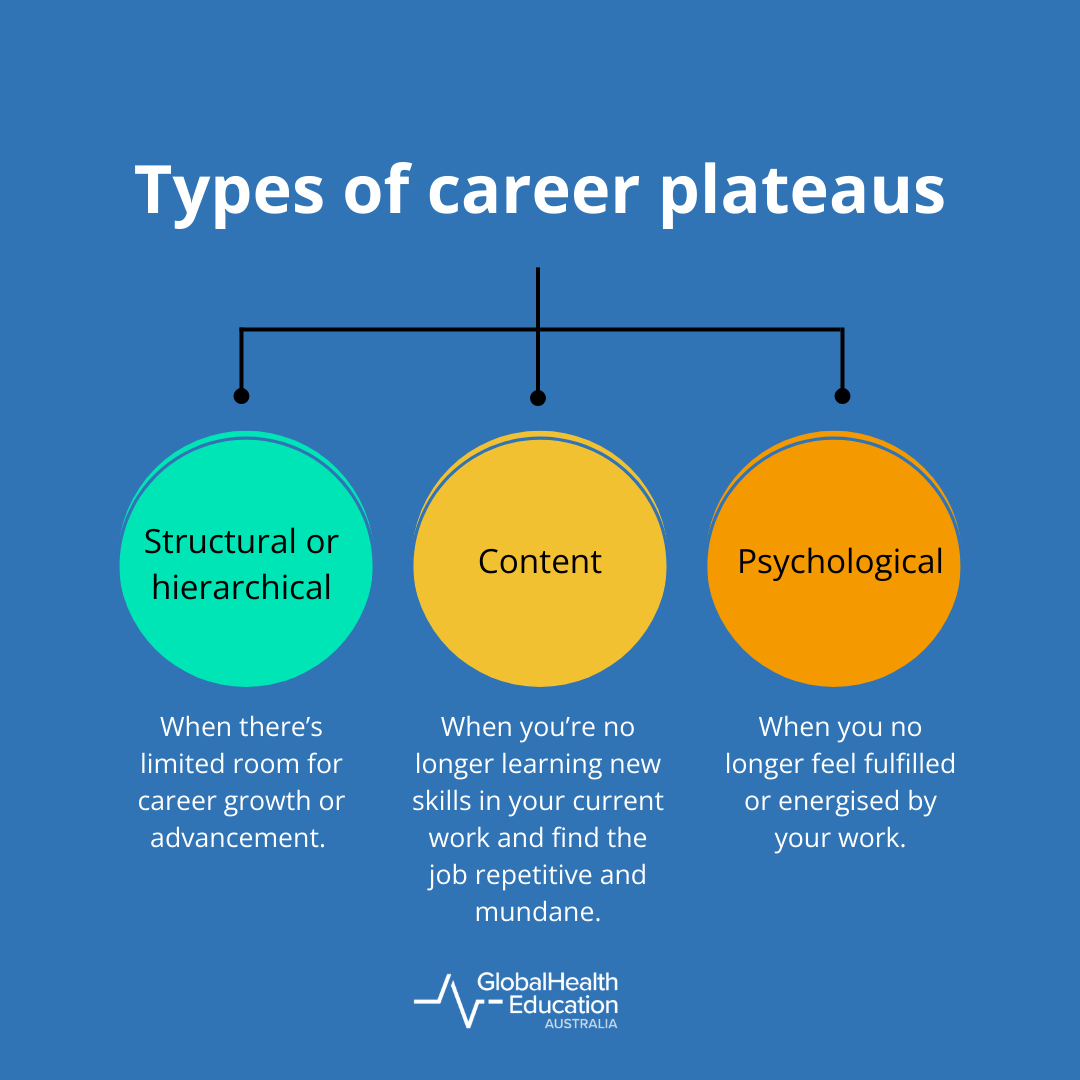
While there are many different types of career plateaus, Catriona highlights that the three main ones to consider are structural or hierarchical, content and psychological. Here’s a breakdown of what each one is:
Structural or hierarchical
A structural or hierarchical plateau occurs when there’s limited room for growth or advancement from your current role to the next. This could be due to a lack of available positions or a rigid organisational hierarchy with limited room for upward mobility.
Example: A highly skilled occupational therapist has spent several years building expertise in their field and wants to step into a more senior role. The organisation they work for, however, has no senior positions available. Despite their qualifications and capability, there is no way for them to move forward.
Content plateau
A content plateau occurs when you’ve mastered your current role, are no longer learning new skills and find the work repetitive, mundane and no longer challenging or intellectually stimulating.
Example: A public health officer has been working in their current role for a couple of years and has mastered the day-to-day requirements of the position. Having not taken on new projects, developed new skills or been given added responsibilities in quite some time, they’re beginning to feel stuck, bored and disengaged.
Psychological plateau
A psychological plateau, also known as a mental plateau, is when you’re continuing to put in the effort at work, but the sense of progress fades. You might still be showing up and doing what you’re supposed to do, but finding that the work no longer energises or fulfils you like it once did.
Example: An experienced mental health nurse is well-regarded in their role and has pathways to progress, but finds that they’re going through the motions. The sense of purpose and meaning they once felt in their work has gradually faded and they’re beginning to question whether they’re in the right field altogether.
Luke Lawrence, principal psychologist at Explore Psychology, also highlights that for him, a career plateau typically manifests in the form of burnout, where he feels that “nothing really ticks the boxes anymore. I’m not feeling challenged and I’m not stimulated.” He adds that this is what makes career plateaus in healthcare distinct from the ones he encountered earlier in his corporate career, which were more structural in nature. In healthcare, they often show up as emotional and psychological exhaustion before anything else.
Is a career plateau bad?
While a career plateau can stir up negative feelings such as decreased job satisfaction and disengagement, Catriona shares that it’s far from a dead end. “It’s a sign that you’re ready to stretch yourself, grow and take on new challenges. You have reached a stage where you know you need to do something and can reconnect with your strengths and values to discover your future career direction.”
Clinical nurse and nursing career specialist, Michelle Deroubaix, echoes this sentiment, reflecting on her own experience. “At times, you’d feel a bit discouraged, but then something always comes up that you can do and change.” For Michelle, hitting a career plateau midway through her nursing career led her toward education and coaching, a path she has pursued ever since.
Luke also adds that accepting a career plateau can sometimes be a deliberate choice depending on where you’re at in your life. While we’ve mentioned the main types of career plateaus above, there’s also a personal plateau where you choose not to pursue further growth due to personal circumstances.
In Luke’s case, when he went back to university to study psychology, he consciously settled into a short-term stable role. “I accepted that I was at a plateau because I was emphasising my learning in another direction and didn’t want to bite off more than I could chew.” For Luke, a career plateau was a temporary choice while he worked towards something bigger.
Signs you may have reached a career plateau
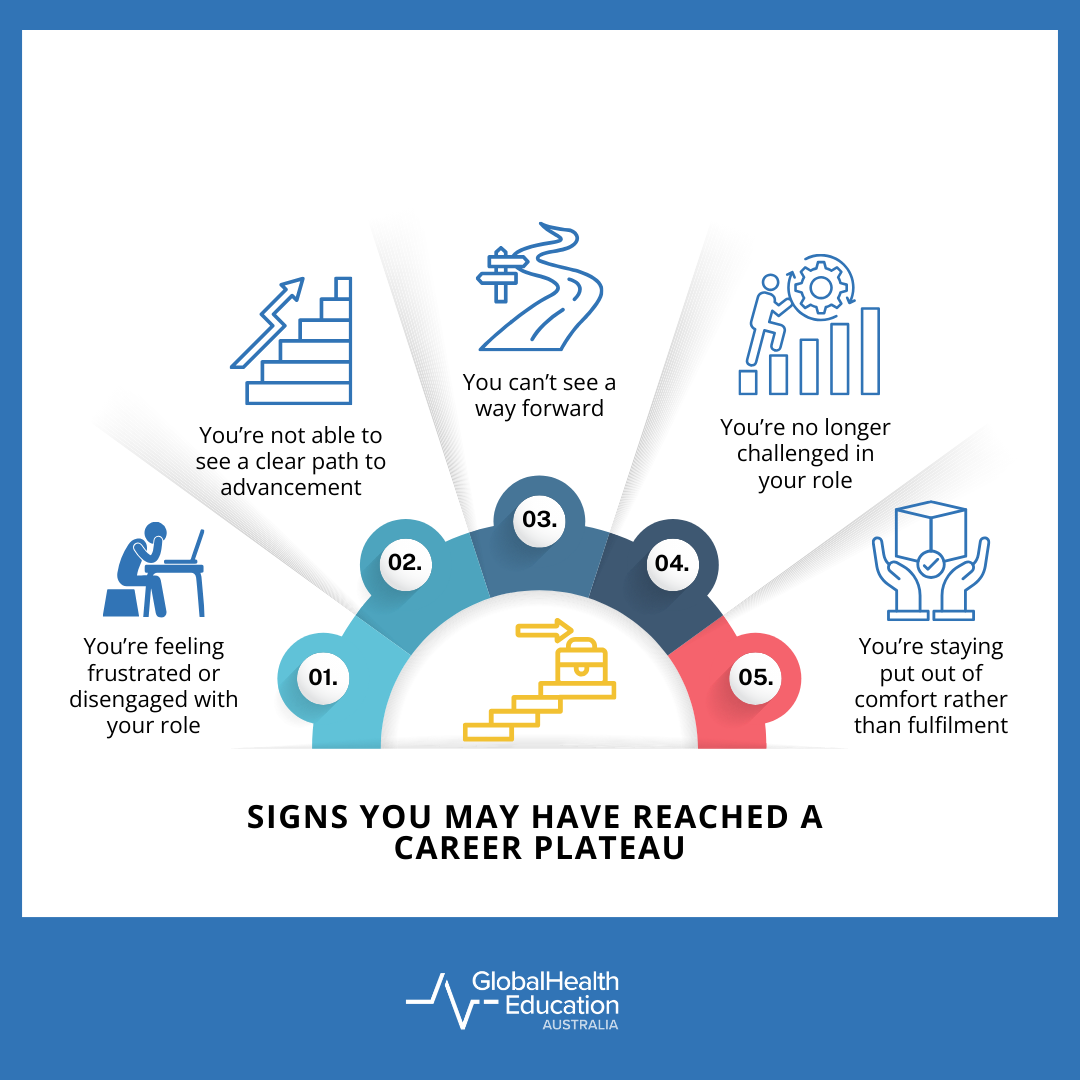
Not sure if you’re undergoing a career plateau or just going through a hazy point in your career? Here are some signs that point towards one:
You’re feeling frustrated or disengaged with your role
Perhaps you’re finding that no new projects or responsibilities have come your way, there’s a lack of learning and development or the work feels repetitive and uninspiring. If thoughts of quitting have also been creeping into your mind, you might have reached a career plateau.
Michelle knew she had hit one when she found herself feeling incredibly discouraged in a nurse management role where she felt neither valued nor supported and was actively considering leaving the profession altogether.
You’re not able to see a clear path to advancement
If you’re looking to advance in your career and have tried speaking to your manager about a promotion without any luck, noticed a lack of internal promotion opportunities or feel like you’ve reached the ceiling in your current field, you’ve probably hit a career plateau.
Luke recalls a pattern that repeated itself throughout his earlier corporate career, where every two or three years, he’d want to grow and keep moving forward, but would hit a point where he felt like he wasn't getting anywhere. “I would always want to either move on or up and that was a struggle because you reach a point where you’re relying on the organisation you’re working for to offer those opportunities for growth and development. If they don’t have them, you have to consider moving on.” It was this recurring frustration that led him to change careers and retrain as a psychologist.
You can’t see a way forward
If you’ve ever thought to yourself, “this is it?”, you’re likely experiencing all three types of career plateaus mentioned above. You could have a reduced level of commitment to your organisation, feel disillusioned with the field or have a quiet but persistent feeling that this isn’t right for you anymore. If any of that resonates, it’s probably time to explore your options.
You’re no longer challenged in your role
If you feel like you’ve exhausted the skills you can develop and nothing in your current role is serving your long-term goals or helping you reach that next step, you’re likely in a career plateau.
“If you’ve reached a level of mastery, that is fantastic and should be celebrated,” Catriona shares. “If there’s nothing left for you to learn, however, it might be time to move on. This might not even mean leaving your role or looking for something new. It could look like taking on a teaching or mentoring role where you can impart the knowledge you’ve learned.”
You’re staying put out of comfort rather than fulfilment
Sometimes a career plateau isn’t immediately obvious because on the surface, everything looks great. You’re showing up, doing well and getting along with your colleagues, but underneath, you know you’ve outgrown your role and are staying just because it feels comfortable.
While there’s nothing wrong with embracing stability, once it starts to eat into your fulfilment, something needs to change. Nurse coach and emotional health educator Madeline Kessler shares that she found herself staying in a role because it felt comfortable. Being a naturally curious person who thrives on being challenged and learning new things, however, she began to realise that her role had grown stale and no longer challenged her. That realisation, she reflects, was what she needed to move forward.
Why career plateaus are common in healthcare
Healthcare professionals frequently experience burnout, staff shortages and a lack of organisational support, all of which can contribute to career plateaus.
Limited pathways for advancement
While this largely depends on your healthcare profession and the organisation you work in, hitting a ceiling or having limited pathways for advancement isn’t uncommon in healthcare.
If you’re a nurse working in Australia’s public health system, for instance, public hospitals follow state government enterprise agreements with structured pay scales. While this provides a degree of stability and transparency, advancement eventually hits a ceiling for many, typically around the eight-year mark. From there, the other alternative pathways are either leadership, clinical specialist, education or nurse practitioner roles. For nurses who don’t see themselves heading in those directions, it can feel like a dead end.
Overwork and understaffing
According to the Australian Institute of Health and Welfare, the Skills Priority List 2023 report shows that more than four in five health professional occupations (82 per cent) were in shortage. “Workforce shortages and understaffing can see people locked into rigid rosters and roles without room for growth,” Catriona shares. Additionally, when you’re focused on getting through a busy day, there’s little bandwidth to think about where your career is heading.
Burnout
Burnout is pervasive throughout the healthcare industry. A recent survey conducted by Ahpra in 2024 found that one in 10 of the 25,752 health practitioners surveyed were unsure about their future and had plans to leave within a year, with mental burnout cited as a key reason why.
Michelle has seen burnout take its toll on many. “There’s a huge level of burnout now in nursing, more so than in my day,” she shares. “I think it’s because the workplace has become a lot more complex and hectic.” Over time, this emotional, physical and mental exhaustion may tip into a psychological plateau.
Shift work
The healthcare industry is the second-largest body of shift workers in Australia. When you’re rotating across different shifts and hours, finding the headspace to think about your career trajectory becomes tricky. Even if you’ve mapped out a plan to change or move your career forward, actioning it can be difficult when you’re exhausted from the demands of your job.
Stress
Research by Monash University has revealed that frontline healthcare workers are under immense pressure, with 59.8 per cent experiencing anxiety, 70.9 per cent experiencing burnout and 57.3 per cent experiencing depression. Over time, periods of chronic stress can erode your sense of ambition, purpose and direction, making a plateau almost inevitable.
“Healthcare is full of purpose and meaning and the flip side of this is the plateau,” Catriona shares. “When the system is stretched and you are feeling pushed and pulled in every which way rather than the direction you saw yourself heading, a plateau is a natural outcome.”
Ways to overcome a career plateau
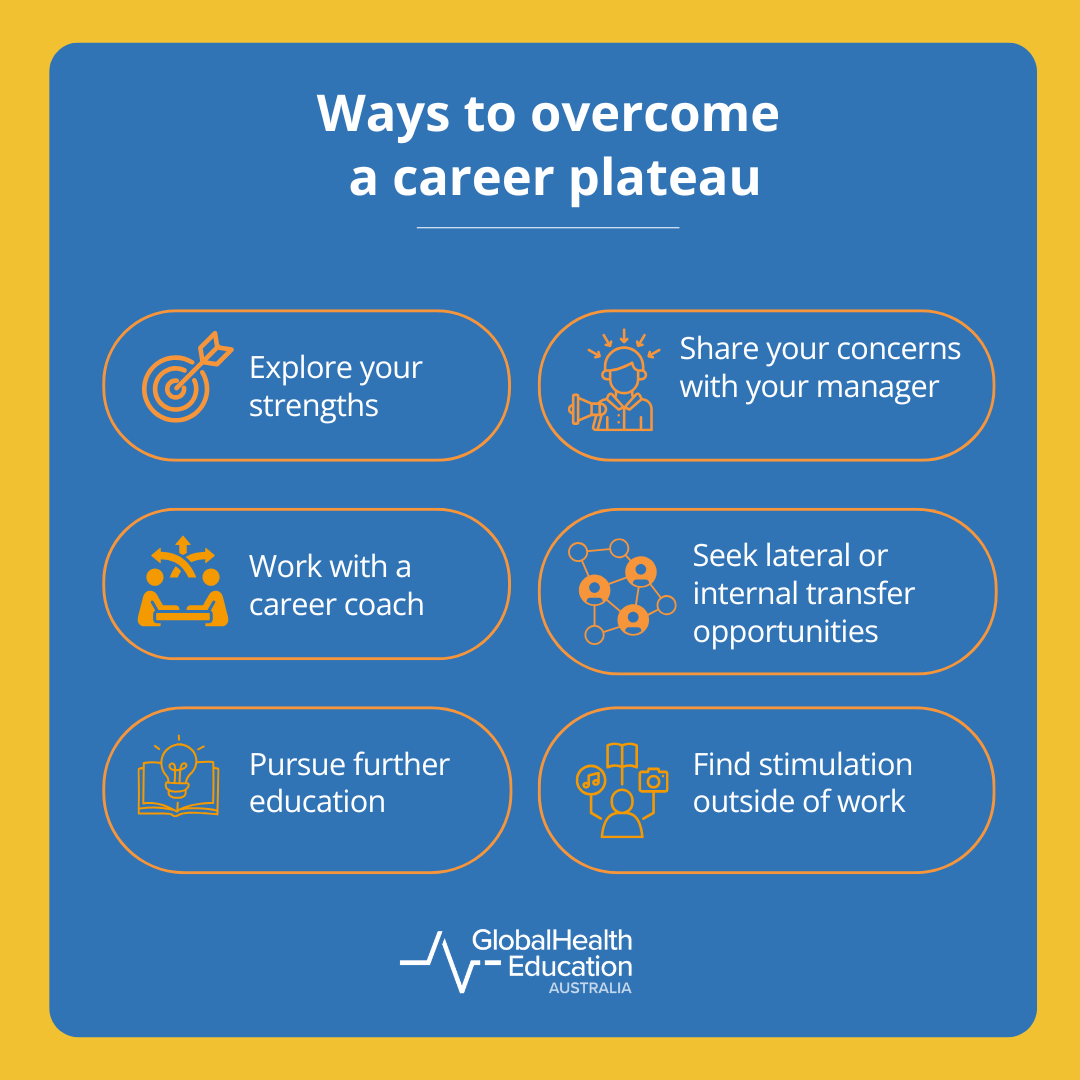
Catriona shares that “from a positive psychology perspective, experiencing a career plateau typically reflects a misalignment between your strengths, your evolving skillset and your work environment.” She highlights that, “it’s not a deficit within you, but rather an opportunity to reframe the situation and open new doors.”
If you have already hit a plateau or sense that you may be approaching one, there are a few things you can do.
Explore your strengths and how your current role aligns with them
To explore your strengths, Catriona recommends starting with the VIA Character Strengths tool, a free resource that can help you discover your strengths and how they map to your current role. She suggests using the information to aid with job crafting, redefining the narrative of your career, considering career diversification or exploring further education.
“Chances are, when you were first drawn to healthcare, your innate desire to help others and make a positive impact on the world was your driving force. If you take a step back and re-examine this through the lens of your strengths, however, you might find the tools to move forward and stay engaged in your current role or realise that it might be time to start on a fresh, new path.”
Catriona also acknowledges that this process isn’t always a quick one. “It might take you a fair bit of time and some soul searching to define your next move, but that’s the best way to do it.”
Need help unpacking your VIA Character Strengths results? Catriona offers a complimentary mini debrief to help you unpack what it means for your next steps. To get started, you can book a call with her on the GlobalHealth Education website. Find out more below.
Work with a career coach
When you work with a career coach, you’ll have someone in your corner whose sole purpose is to support and encourage you. While a few calls won’t magically fix an under-resourced system, career coaching can help you reconnect with your strengths, see your options through a fresh lens and take the next step with clarity and confidence.
Michelle shared that it was her experience with a career coach that gave her the confidence to pursue a path she hadn’t previously considered possible. “She believed in me more than I believed in myself,” she reflects.
If you’re interested in working with a career coach, Catriona has many years of experience in career coaching. If you book a complimentary professional development strategy call with her, she can work with you to forge a path forward.
“When you work with me, I don’t finish a session by asking you to do some ‘homework’. I like to call it your ‘own work’. To move out of your plateau, you need to dedicate time to working on your most important asset – you.”
When you work with Catriona, the call might involve:
- Working on strengths and values mapping to uncover what makes you feel most alive in your work and what drains you
- Identifying areas for development and growth in your current role
- Thinking about alternate pathways and careers, based on something completely new and fresh or building on the career you have already established
- Co-creating action plans
Pursue further education
One of the best ways to combat a career plateau is by pursuing further education. Whether it’s picking up a new skill through an online course or completing a postgraduate healthcare course to specialise in a particular area, further education can open up new possibilities and reignite a sense of purpose and direction in your career.
Michelle speaks to this from experience, sharing that “education can be such a wonderful way of giving a new outlook and it certainly opened a lot of doors for me.” While a postgraduate master’s course is ideal if you’re looking to gain advanced knowledge and move into a new career, a graduate certificate or graduate diploma is a great option if you’re looking to specialise, upskill within a shorter timeframe or give your practical skills a boost.
Some postgraduate healthcare courses to consider include:
Graduate certificate
Graduate Certificate in Child and Adolescent Mental Health at Victoria University
Hone your skills in child and adolescent mental health and wellbeing with this eight-month part-time course covering units from Mental Health Foundations to Effective Trauma-Informed Care.
Graduate Certificate in Advanced Nursing (Perianaesthesia Nursing) at the University of Tasmania
This course is perfect for nurses looking to specialise and advance their knowledge in a specific area. Other than perianaesthesia nursing, the university also offers 20 other specialisations, from emergency nursing to mental health nursing and neonatal care.
Graduate Certificate of Counselling (Addiction) at the University of Southern Queensland
Gain specialised skills in addiction support and complete this online course in 12 months part-time. You’ll learn how to work with individuals with substance and behavioural addictions at different life stages and explore core components of counselling practice.
The courses below are listed by qualification level, from lowest to highest.


Develop specialised skills in child and adolescent mental health, assessment and trauma-informed care through flexible online study.


Hones specialised skills for every phase of the anaesthetic journey, empowering nurses to deliver seamless, high-stakes care where precision, vigilance and calm under pressure are paramount.


Offers a focused and flexible pathway for professionals to gain specialised skills in addiction support, blending evidence-based strategies with real-world application to make a lasting impact in communities.
Graduate diploma
Graduate Diploma of Health (Perinatal and Infant Mental Health) at Federation University
This course will equip you with the knowledge and skills required to educate and support families experiencing mental health difficulties. In this online, part-time course, you’ll complete units such as Advanced Therapeutic Skills and Advanced Perinatal and Infant Mental Health.
Graduate Diploma in Health Management and Leadership at Queensland University of Technology
Ideal if you’re looking to step into a leadership role in health policy or healthcare, this course consists of units such as Leadership in Healthcare and Health Management Principles and Practice. You’ll also be able to choose from a range of electives including Foundations of Digital Health and Health Statistics.
The courses below are listed by qualification level, from lowest to highest.


Advance your career by specialising in the rewarding field of perinatal and infant health. Support families in community and institutional settings during this challenging time of transition.


Develop a comprehensive understanding of health management and discover effective strategies for leading health service delivery.
Master’s
Master of Healthcare Leadership at Southern Cross University
Designed to be completed 100 per cent online, this course intends to give you the skills required to achieve innovative change and transform healthcare systems. Units include Leading Change in Healthcare and Building a Professional Portfolio, along with a wide range of electives to choose from.
Master of Nursing Majoring in Advanced Practice at James Cook University
Enhance your skills with this course designed to transform your practice and expand your clinical capabilities. You’ll complete units including Advanced Health Assessment, Effective Clinical Governance and Quality Use of Medicines in Practice.
The courses below are listed by qualification level, from lowest to highest.


Delivered 100% online, this course is suitable for people from a broad range of backgrounds and is designed to give you a range of skills you can take with you into the future.


Enhance your skills in this 100% online advanced practice major, which includes four specialized units designed to equip you with the necessary skills to deliver advanced patient care.
Share your concerns with your manager
If you haven’t already, speaking with your manager is a good starting point for working through a career plateau. Career stagnation often stems from a lack of stimulation, advancement or growth opportunities and your manager may not be aware of your ambitions unless you make them known. “Make it known that you want to grow,” Luke shares. “I think it’s important for a team leader or manager to know that there is someone in the team they can promote.”
Ways to open that conversation include expressing interest in cross-functional projects, volunteering to step into a leadership or mentoring capacity or asking what opportunities exist for further development within the organisation.
If the conversation doesn’t lead anywhere, however, Luke acknowledges that it may be the nudge you need to start looking elsewhere. “Sometimes you have to take that away and consider, ‘Can I accept being where I am or do I need to consider moving on?’”
Seek lateral or internal transfer opportunities
While career progression is often associated with moving up the ladder, not all progress has to be upward. Catriona suggests that when you’re in a career plateau, it helps to “take a step back and ask yourself, ‘Is it the role itself or the employer? Would you feel this way in the same role at a different location?’”
If you’re happy with the role but not the setting, requesting an internal transfer to a different team, ward or setting could be the change you need. Lateral moves can also be an effective way to break out of a career plateau, as you’ll broaden your skill set and expose yourself to new opportunities without requiring a complete career overhaul.
Look beyond your current role
Sometimes overcoming a career plateau is about recognising that healthcare is far broader than the role you’re currently in. “The great thing about healthcare is that you can shine your torch on a lot of different areas,” Madeline shares. “If you get granular enough, you can find yourself in a role that combines a lot of your skills and interests.”
In nursing alone, for instance, there are a plethora of specialisations to choose from. For example, if you’re drawn to data and technology, nursing informatics could be an ideal direction. Many of the skills developed in your nursing career are also transferable to industries such as education and training, business and management and operations and logistics.
Find stimulation outside of work
If you’re not in a position to make a career move just yet, whether due to financial reasons, tenure or other personal circumstances, Luke’s advice is to look beyond your role and find something that you’re hyped up or passionate about. “Think about ways you can stimulate yourself outside of work,” Luke suggests. “Cognitive stimulation, physical stimulation, emotional stimulation, whatever gives you a better perspective on work.”
This would look different for everyone, but some outlets to consider include hobbies like pottery or crafting or nurturing a new passion such as gardening or baking. Learning something new, whether that be a language or a sport, may also offer the intellectual stimulation you need.
Take ownership of your career
Almost every healthcare professional will encounter a career plateau at some point in their career journey. If you’re experiencing one right now, it’s important not to give up and to stay proactive, curious and open to change. A career plateau has the potential to propel your career forward in ways you might not have anticipated. All you’ve got to do is take your career by the reins and steer it in the right direction.
If you’re looking to overcome your career plateau by pursuing further education and expanding your skill set, take a look at GlobalHealth Education’s extensive postgraduate healthcare course catalogue. With over 500 courses ranging across disciplines from counselling and mental health to nursing, public health and social work, there are plenty of courses to choose from, no matter where you are in your career journey.