
Why trust GlobalHealth Education?
-
Our in-house editorial team and healthcare advisors write and review our content.
-
The information in our content provides clarity and insights to help you compare courses.
-
We list postgraduate courses from 25+ respected and reputable institutions in Australia.
Choosing where to study nursing is an important decision to make. The university you decide on can play a part in shaping your clinical skills, professional network and overall career path. It makes sense to want to seek out the best nursing schools in Australia, narrow down your options and make an informed choice.
To help with the decision-making process, we’ve compared the University of Technology Sydney (UTS) and Monash University – two top-tier universities in Australia that offer high-quality nursing programs.
We explore some key differences between UTS and Monash, such as their university rankings in nursing, details on their nursing courses, tuition fees and what student life is like at each institution. We also analyse the graduate outcomes for each university so you can get a clearer picture of which one aligns with your goals, circumstances and vision for your nursing career.
Determining the best nursing school in Australia depends on a few key things.
According to the QS World University Rankings for Nursing, UTS is the top-ranked nursing school in Australia, while Monash ranks second and both are within the top 20 universities for nursing worldwide. Both universities also have extensive clinical learning opportunities and excellent graduate employment outcomes.
UTS might be a better option if you want to study at a prestigious and highly ranked university. Monash might be more ideal for you if you’re pivoting into nursing and want to leverage your skills from another field.
Overall, neither university is objectively better than the other. Deciding which one is right for you may come down to your location, what matters to you regarding your specific course or placement opportunities, where you are on your nursing education journey and what your future career goals include.
Comparing nursing schools: UTS vs Monash
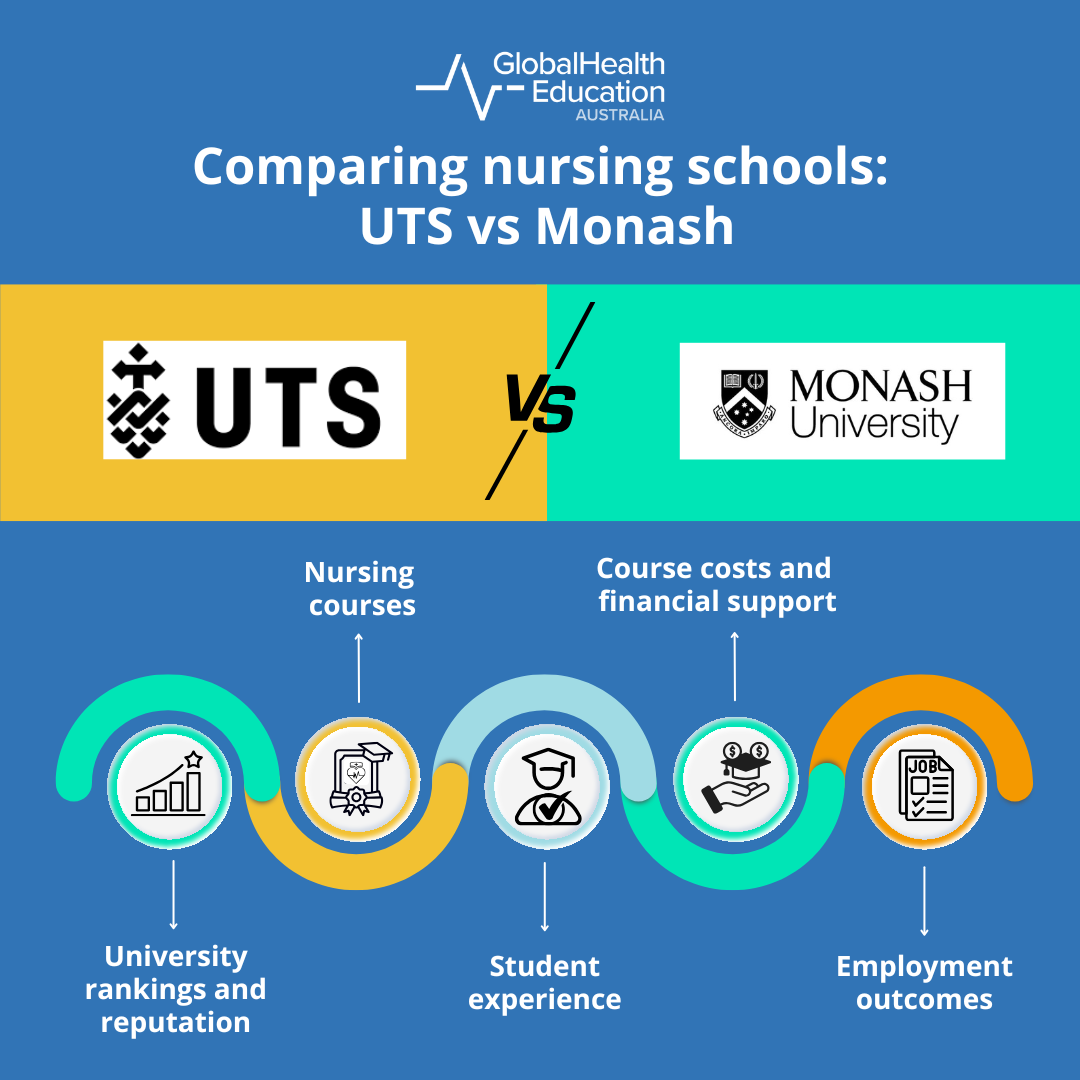
Below is a detailed breakdown of how UTS and Monash’s nursing schools compare across various measures.
University rankings and reputation
Each university ranking system has its own methodology and weightings to compare institutions. Data such as research output, employer opinion, teaching quality, equity, access and employment outcomes are combined to produce an overall score and ranking. The results can provide a useful snapshot of how universities compare nationally or globally, which can support your decision-making process in choosing the right nursing school.
If you want to learn how university rankings work and why they matter, read more here.
University of Technology Sydney
Ranking overview
- UTS is currently ranked #1 in Australia and equal #16 globally for nursing, according to the 2026 QS World University Rankings
- Nursing falls under the medical and health subject category according to the 2026 Times Higher Education World University Rankings, which positions UTS at #10 in Australia and within the top 150 universities globally
University reputation for nursing
Established in 1988 in central Sydney, UTS is Australia's #1 young university with a strong reputation in many areas, including health, business, design and technology. The UTS School of Nursing and Midwifery has a strong national and international reputation, both in nursing research and academia.
This nursing school is located at the UTS Campus in Ultimo, Sydney, local to the city’s central business district. Its metropolitan location helps support close partnerships with major hospitals and health services, which feed directly into the school’s clinical training and research collaborations. Students can engage in a mix of theoretical and practical learning through industry experts in various educational settings. Nursing students can learn in person, online and in cutting-edge simulation labs. They may also complete extensive clinical placements, preparing them for real-world nursing and healthcare environments.
Research at the UTS School of Nursing and Midwifery focuses on improving health systems, policy and patient outcomes through current evidence-based practice. Key research areas include models of midwifery and maternity care as well as technological innovations in women’s health. Notably, the UTS is host to the World Health Organisation Collaborating Centre for Nursing, Midwifery and Health Development, which influences healthcare policy in the nursing and midwifery sector across various countries.
Monash University
Ranking overview
- The latest QS World University Rankings places Monash University at #2 in Australia and #19 globally for nursing
- Times Higher Education World University Rankings has Monash at #2 in Australia and as equal #27 globally in 2026 for the medical and health category, which encompasses nursing
University reputation for nursing
Established in Melbourne in 1958, Monash has a strong national and international reputation as a research-focused university across a wide range of fields, including medicine, science and technology. Those undertaking an on-campus course in nursing typically learn at the Monash Peninsula campus, which is considered one of the best nursing schools in Victoria, offering multidisciplinary healthcare facilities, catering to nursing and allied health students.
Clinical learning environments occur across Melbourne and regional Victoria. Monash has robust industry connections with Victorian health services, including Monash Health, which encompasses over 40 hospitals and healthcare facilities throughout the Melbourne metropolitan area.
Research at Monash University involves collaboration with industry partners and communities to help innovate in a range of health areas, including mental health nursing, emergency care, aged care and women's health. Notable research and initiatives include the Monash Addiction Research Centre and the Rehabilitation, Ageing and Independent Living Research Centre. These projects highlight Monash’s commitment to research excellence, improving patient care models and its mission to make a local and global impact.
Nursing programs
University of Technology Sydney
If you’re researching where to study nursing in Sydney, you can find a course at UTS to help you start or expand your nursing career. UTS has a range of undergraduate, dual degrees, postgraduate coursework, postgraduate research, postdoctoral and specialised nursing courses. In total, there are currently over 27 UTS courses applicable to nurses, midwives and other health professionals, with 10 of these aimed exclusively at nurses.
Undergraduate UTS nursing degrees
For example, the UTS Bachelor of Nursing provides students with core training and clinical skills in nursing practice. UTS also offers various combined degrees for nursing or midwifery, such as the Bachelor of Nursing/Bachelor of Creative Intelligence and Innovation or the Bachelor of Midwifery Bachelor of Creative Intelligence and Innovation. Both of these courses are uniquely designed to provide clinical skills in either midwifery or nursing, coupled with additional expertise in creative problem-solving, innovation and entrepreneurship.
The typical entry requirements for the Bachelor of Nursing program at UTS currently include a minimum ATAR of 69.05 or equivalent. UTS also offers alternative admission pathways for mature-age students and those with a year 12 qualification or equivalent Australian or overseas qualification at the required level. Upon completion of a UTS Bachelor of Nursing degree, graduates are eligible for registration as a nurse with the Nursing and Midwifery Board of Australia (NMBA).
Postgraduate UTS nursing degrees
The UTS range of postgraduate nursing programs include various graduate certificates, graduate diplomas and master’s degrees in different practice areas. For example, UTS offers a Graduate Certificate in Acute Care Nursing and a Graduate Certificate in Critical Care to help nurses advance their careers with specialised clinical skills. These courses can progress into a master’s-level qualification, with the Master of Advanced Nursing (Acute Care) and the Master of Advanced Nursing (Critical Care) for comprehensive expertise to work in a variety of nursing settings.
UTS also offers courses in niche areas, including nursing education, palliative care, chronic and complex care, women’s health and child and family health.
For those interested in a research pathway, the UTS Master of Nursing (Research) is a two-year postgraduate degree that allows registered nurses to research and present a nursing-related topic with the aim of improving nursing practice and supporting industry innovation.
The courses below are listed by qualification level, from lowest to highest.


Delivered 100% online, with regular intakes every two months, this course enables you to balance your work and family commitments while learning the critical skills and clinically-based learning strategies to improve the core competencies associated with person-centred care.

Delivered 100% online by the #1 school in Australia for academic reputation in Nursing, this course focuses on patient care in the ICU and EDS.

Delivered 100% online and specialising in acute care, this course is focused on comprehensive physical assessment and diagnostic reasoning, quality and safety in medicines, plus managing clinical deterioration and responding to nursing-sensitive indicators.

Empowers experienced nurses to lead in high-stakes environments through a flexible, evidence-based curriculum tailored to the evolving demands of critical care.

Offers nurses a dynamic pathway to advance healthcare through rigorous research training, fostering innovation and leadership in clinical inquiry.
Where do UTS nursing students complete their clinical placements?
Many nursing students at UTS undertake more than 840 hours of clinical placements, primarily within the Sydney metropolitan area across more than 100 health facilities in private and public healthcare settings, including the Royal Prince Alfred Hospital and Prince of Wales Hospital. These are conducted through the UTS Clinical Practice Unit, where nursing and industry experts coordinate placement opportunities in hospitals, aged care, mental health clinics, specialist clinics, day surgeries, community health centres and in rural and remote healthcare environments. Clinical placements provide important learning opportunities in real-world healthcare settings, with each placement duration usually lasting between two to six weeks, depending on the specific course and placement requirements.
Monash University
The range of nursing courses at Monash includes two undergraduate degrees, one dual degree, several postgraduate degrees and a postdoctoral pathway to help nurses gain foundational and advanced knowledge across various nursing practice areas. There are 14 courses in total at Monash that are applicable to nurses and other health professionals, with six of these aimed exclusively at nurses.
Undergraduate Monash nursing degrees
If you're weighing up where to study nursing in Melbourne, Monash offers a Bachelor of Nursing, Bachelor of Nursing (Honours), and a Bachelor of Nursing and Bachelor of Midwifery (Honours) dual degree as undergraduate pathways to becoming a registered nurse. Entry into the Bachelor of Nursing at the Peninsula campus currently requires an ATAR of 70.50, while the Bachelor of Nursing and Bachelor of Midwifery (Honours) requires an ATAR of 81.15.
Alternative pathways into nursing at Monash
For those who have completed an undergraduate degree in a non-nursing field, the Master of Nursing Practice builds on previous skills and knowledge and allows professionals to become qualified as a registered nurse in two years. This course is delivered full time and on campus and equips graduates with skills in mental health, contemporary nursing practice, Indigenous healthcare and patient safety.
Graduates who complete the above nursing courses at Monash University are eligible for nursing registration with the Nursing and Midwifery Board of Australia (NMBA).

Enhance your knowledge and skills to develop professional nursing practice through collaboration with expert clinical nurses, contemporary nursing theories and practical experience.
Postgraduate Monash nursing degrees
Registered nurses can pursue further study in a postgraduate course at Monash to advance their expertise in various areas. These include specialisations such as cardiovascular perfusion, advanced healthcare practice, advanced clinical nursing, personal injury management and clinical trials.
Monash offers postgraduate courses at the graduate certificate and graduate diploma levels to expand nursing expertise in wound care management. Entry into the Graduate Certificate of Wound Care includes at least two years of relevant clinical experience and nursing registration.
This course is delivered online over 12 months at a part-time study load and includes four units to help build an evidence-based practice in wound management.
The Graduate Certificate of Forensic Nursing and Midwifery is a 12-month part-time, face-to-face program for nurses interested in pursuing a career in forensic nursing. This course equips nurses with the necessary skills to provide safe, ethical care to patients recovering from physical assault, knowledge of medico-legal reporting and an understanding of the Australian legal and criminal justice system.
For nurses interested in advancing their clinical practice, Monash University’s Master of Advanced Nursing (Advanced Nursing Studies) is a two-year online postgraduate course that helps nurses build expertise to further their careers. Graduates gain important evidence-based skills in advanced nursing practice and can customise their master’s degree with a specialisation in education, healthcare in disasters, trauma nursing, palliative care and more. This flexible course is designed for nurses interested in pursuing senior positions in a range of healthcare settings.
Monash’s Master of Advanced Nursing (Leadership and Management in Healthcare) is a two-year online program for nurses who want to explore clinical leadership, financial management and advanced positions. Graduates develop advanced knowledge to coordinate and evaluate healthcare systems and the confidence to effectively lead healthcare teams, prioritising improvements in patient care outcomes.
The Master of Advanced Nursing (Advanced Midwifery) is another two-year online program for experienced registered midwives seeking to develop leadership skills and clinical expertise in maternal and neonatal health. You’ll gain advanced skills to manage complex health concerns affecting birthing mothers and babies, including maternal critical care, lactation and infant feeding support and knowledge of midwifery-specific diagnostics and screening.
Have you ever wondered if midwifery is harder than nursing? Read insights from a registered nurse and midwife as they share their verdict, here.
The courses below are listed by qualification level, from lowest to highest.

Acquire advanced knowledge and skills in assessing, treating and managing various types of wounds.

Acquire knowledge of the Australian legal system, laws of evidence and the classification of injuries, along with the forensic responsibilities that arise from physical injuries and sexual assault.

Emphasises advanced nursing practice, evidence-based care and expertise in managing complex patient needs across various healthcare settings.

Enhance your advanced leadership, management and strategic skills to effectively lead and improve healthcare organisations and teams.

Develop skills to provide comprehensive, evidence-based care for women and newborns, with a focus on leadership, clinical expertise and advocacy in maternal and neonatal health.
Where do Monash nursing students complete their clinical placements?
At Monash, placements are a major part of many nursing degrees, with foundational nursing courses typically comprising a minimum of 840 hours of practical placement learning throughout Victoria. These include opportunities to learn in Monash Health hospital networks and major teaching hospitals therein, such as Monash Medical Centre Clayton, Dandenong Hospital and Casey Hospital. Some students may also undertake placements in regional or rural areas through programs supported by Monash Rural Health. Opportunities for placements may also be available at Alfred Health, which includes The Alfred and Caulfield Hospital.
In some cases, placements may also be completed using a ‘home hospital-based’ model, which allows nursing students to remain at the same hospital throughout all placements, moving between different units for broad clinical exposure. Placements typically occur in full-time blocks, sometimes including weekends and public holidays, over a range of between one to five weeks, with an expected commitment of 40 hours per week.
Student experience
University of Technology Sydney
UTS student experiences snapshot
2024 data from Quality Indicators for Learning and Teaching (QILT) shows that for students completing a nursing undergraduate degree at UTS:
- 77.8 per cent of students had a positive overall experience
- 86.3 per cent of students felt positive about their skills development
- 86.9 per cent were happy with facilities and resources
- 72.3 per cent rated support and services positively
For those completing a postgraduate nursing degree:
- 78.3 per cent of students had a positive overall experience
- 83.7 per cent of students felt positive about their skills development
- 89 per cent were happy with facilities and resources
- 79.1 per cent rated support and services positively
Campus life at UTS
UTS has several campuses in the Sydney city area, with the main Broadway campus located about 10 kilometres from the CBD and housing the School of Nursing and Midwifery. Beyond this campus, UTS has several interconnected precincts in Sydney, including the Haymarket and Chippendale campuses, which accommodate various teaching, student and heritage areas together. There are also specialised facilities across Sydney, including Moore Park, Botany and Randwick, providing students with industry-focused learning spaces in areas such as sport science, engineering and IT.
Campus life at UTS is bustling and social, thanks to the close proximity to central Sydney. Students can engage in social events, enjoy live music and cultural celebrations, or equally enjoy the relaxed student spaces while attending courses on campus. For nurses, the UTS Nursing and Midwifery Society provides a way for nursing and midwifery students to connect and socialise while studying. UTS student cohorts are diverse, and with over 3,000 currently enrolled in nursing courses, there is a unique opportunity to network and learn from others in a supportive environment.
Monash University
Monash student experiences snapshot
QILT data shows that for students completing a nursing undergraduate degree at Monash:
- 80.1 per cent of students had a positive overall experience
- 88.5 per cent of students were positive about their skills development
- 87.4 per cent were happy with facilities and resources
- 75.3 per cent rated support and services positively
For those completing a postgraduate nursing degree at Monash:
- 81.2 per cent of students had a positive overall experience
- 88 per cent of students were positive about their skills development
- 83.5 per cent were happy with facilities and resources
- 73.3 per cent rated support and services positively
Campus life at Monash
Nursing students at Monash typically study at the Clayton and Peninsula campuses in Victoria. The main campus for the Faculty of Medicine, Nursing and Health Sciences is the Clayton campus, located about 20 kilometres south-east of Melbourne’s CBD. Monash is known for its diverse and international student community, with cultural events and student-led activities operating throughout the year, contributing to a lively and social campus atmosphere.
Within the nursing program itself, the cohort culture is collaborative and supportive. Student groups, such as the Monash Nursing and Midwifery Society, provide enjoyable opportunities for connection, mentoring programs, networking events, workshops and social activities, including the annual ball, specifically for nursing students.
For postgraduate students, many programs are available fully online, providing flexibility for working nurses across Australia to study without relocating. This is a significant advantage for nurses outside of Victoria or for those balancing work and family commitments.
According to student profiles on the university’s website, many graduates and current students say their nursing courses have helped them discover their passion for patient care, develop confidence and build lasting connections with classmates and teachers. Several highlight the supportive peer networks they formed in lectures, clinical skills sessions and placements, as well as the satisfaction they experience when making a positive difference in patients’ lives.
If nursing is something you’re passionate about pursuing or you want to level up your nursing career, booking a call with one of our dedicated career experts can help. We have a range of career coaches as well as experienced nursing coaches, Michelle Deroubaix and Madeline Kessler, who can support you as you take the next steps in your nursing journey.
Course costs and financial support
At many Australian universities, some nursing degrees are offered as Commonwealth Supported Places (CSPs) and others are full-fee places – a difference that impacts what students pay.
A CSP is subsidised by the Australian Government, meaning students only pay a portion of the course cost, known as the student contribution amount. This amount is much lower than the cost of the full tuition fees and makes starting a nursing degree financially easier.
The majority of undergraduate degrees are offered as CSPs, whereas CSPs are available in limited numbers for postgraduate courses. Learn more about how CSP courses work, including eligibility details here.
In contrast, full-fee places are not government-subsidised, so students must pay the entire course cost, resulting in much higher overall tuition fees. Full-fee places also typically apply to postgraduate courses. Because of this difference, the same or similar nursing qualification may have varying price points depending on whether it is offered as a CSP or as a full-fee program.
Whether the course is offered as a CSP or as a full-fee course, students can typically defer the applicable costs through a higher education loan, known as either HECS-HELP or FEE-HELP. Learn more about these government-supported loan schemes here.
University of Technology Sydney
The Bachelor of Nursing program is a three-year CSP course, with a student contribution amount of $4,738 for one year of full-time study. The total student contribution amount for domestic students is $14,572 for this program.
The majority of UTS postgraduate courses are full-fee paying courses and are priced per unit. This means the more units a course includes, the more expensive the overall course fees will become.
For example, the Graduate Certificate in Palliative Care costs $2,894 per unit and comprises four units, which makes the total course fees $11,575. The Graduate Certificate in Acute Care Nursing costs $3,431 per unit and comprises four units, resulting in an indicative total course cost of $13,723 for a domestic full-fee paying place.
In contrast, the Master of Advanced Nursing (Acute Care) has a per-unit price of $3,078 and comprises 12 units to be completed over two years full-time. This results in an indicative total of $36,936 for a domestic full-fee paying place. The Master of Women’s and Children’s Health includes 12 units, at a per-unit price of $3,431, totalling $41,172, whereas the UTS Master of Nursing (Research) is a more expensive postgraduate course, with first-year tuition fees costing $26,670 and a total course cost of $54,540.
Depending on what program you’re interested in, the total fees for a nursing course at UTS is $31,588 on average.
NB: Tuition fees are indicative and subject to change. For the most up-to-date pricing, check with UTS and the specific course page.
UTS scholarships
There are several scholarships available to students who are completing a nursing degree at UTS.
For example, the UTS Health Dean’s Scholarship is valued at $10,000 and is open to high-achieving year 12 school leavers who are enrolling into an undergraduate degree in the Faculty of Health, which includes nursing. The scholarship funds are allocated to students for one year of full-time study and can be used to cover study-related costs, including tuition fees, learning materials, or may be used as financial aid to offset living expenses.
Another scholarship option is the Equal Access Scholarship, which is designed to support students experiencing financial hardship or disadvantage. The scholarship applies to those commencing or continuing their studies in any undergraduate or postgraduate course and provides between about $500 and $6,000 as flexible financial support. Funds may be used to assist with general living expenses and study costs, helping students stay enrolled in their courses and achieve their educational goals.
For Aboriginal and Torres Strait Islander students studying nursing, the Mediserve Indigenous Nursing Scholarship provides financial support of $5,000, which can be used to cover study-related and living costs. This scholarship is applicable to students commencing the second year of a nursing undergraduate degree and is aimed at high-achieving, passionate students who have aspirations to give back to their community and contribute meaningfully to the nursing profession.
The University of Technology Sydney also offers a wide range of undergraduate and postgraduate scholarships that are open to students across many disciplines, which nursing students may also be eligible for, in addition to nursing-specific scholarships. These may include merit-based scholarships, bursaries and financial support for Aboriginal and Torres Strait Isalnder students pursuing nursing.
Check their scholarship listings and eligibility criteria to learn more about the financial options that may help cover fees and study-related costs relevant to your course.
Monash University
At Monash, the Bachelor of Nursing is a CSP course with a student contribution amount of $6,500 for one year of full-time study. This course takes three years to complete, which means the total student contribution amount is estimated at $19,500. The domestic full-fee total for this course is estimated at $40,000, which means the CSP option is around 51 per cent cheaper comparatively.
The Bachelor of Nursing and Bachelor of Midwifery (Honours) is also a CSP course, with a student contribution amount of $7,000 for one year of full-time study and takes four years to complete, totalling $28,000 as an estimate. Whereas the domestic full-fee course total is around $40,500. If students enrol in the CSP course option, they’ll benefit from a 31 per cent discount compared to the full-fee course.
Tuition fees for postgraduate nursing courses vary widely at Monash. For example, the Graduate Certificate of Wound Care costs $18,200, while the Graduate Certificate of Forensic Nursing and Midwifery costs $15,550 for a domestic full-fee paying place. Both of these courses are only 12 months in duration, which means these fees are the total tuition fees for each course.
The Master of Advanced Nursing program is a CSP course which costs $4,738 for the first year of full-time study and takes approximately two years to complete, totalling $9,476. This CSP amount applies to each specialisation relevant to this master's degree, including the Advanced Nursing Studies, Advanced Midwifery and Leadership and Management in Healthcare programs. The total course cost for these courses for a domestic full-fee paying place is estimated at $31,100, which means the CSP option is 69.5 per cent cheaper overall.
The Master of Nursing Practice is another CSP course costing $5,500 for the first year of full-time study, taking two years to complete and totalling $11,000 as an estimate. The full-fee tuition cost for this course is estimated at $36,400, meaning the CSP is discounted at 69.8 per cent, making it a more affordable overall option.
Depending on the specific course you’re considering, you can typically expect to pay an average of $5,900 per year for a CSP course or about $16,900 per year for a domestic full-fee paying nursing course at Monash.
NB: Tuition fees are indicative and subject to change. For the most up-to-date pricing, check with Monash’s specific course page.
Monash scholarships
A wide range of scholarships are available at Monash University. Each is designed to support students with different needs and at different stages of their studies. Some scholarships recognise academic excellence, while others are equity-based, assisting students facing financial hardship or disadvantage. Monash also offers scholarships for Aboriginal and Torres Strait Islander students to support their education.
For example, the Margaret and John Crutch Indigenous Midwifery or Nursing Scholarship, valued at $6,000 per annum paid for each year of the degree, is open to students who identify as Indigenous Australian commencing or continuing a Bachelor of Nursing or Midwifery at Monash.
The Medicine, Nursing and Health Sciences Equity Travel Grant is a one-off payment of $2,000 to eligible undergraduate students completing a course in the Faculty of Medicine, Nursing and Health Sciences. This scholarship applies to nursing students undertaking a placement in a seriously disadvantaged Australian community or a developed country.
Similar to UTS, Monash also offers a variety of undergraduate and postgraduate scholarships for all students, inclusive of nursing students. There are also financial support options such as fee-reduction schemes, living stipends, relocation payments and other benefits that help partially cover the costs associated with completing an undergraduate or postgraduate degree. Explore their scholarships and financial support options for more information.
External nursing scholarships
Additional scholarships may be available through state government programs, private organisations and professional bodies specific to nursing.
The New South Wales and Victorian Departments of Health offer various financial support options for nursing students, including undergraduate placement grants, re-entry to nursing scholarships and postgraduate scholarships for Aboriginal and Torres Strait Islander nursing students as examples.
Organisations such as the Australian College of Nursing and the Australian College of Nurse Practitioners (ACNP), in partnership with the Australian Government Department of Health and Aged Care, offer several scholarships for nursing students to help advance their careers and boost the nursing workforce. The Australian Nurses Memorial Centre also offers various postgraduate nursing scholarships to support the nursing profession.
If you are an Aboriginal or Torres Strait Islander student completing an undergraduate or postgraduate healthcare degree, you may be eligible for GlobalHealth Education’s Healthcare Education Scholarship. Funds can be used to cover tuition fees, course and learning materials and travel costs. The 2026 scholarship recipient is a Monash student completing a physiotherapy degree. However, students from any institution can apply. Read more about the scholarship, eligibility criteria and how to apply here.
Employment outcomes
According to the Graduate Outcomes Survey 2024, 85.5 per cent of nurses at university who completed an undergraduate degree found full-time employment after graduation, while the rate was even higher for postgraduate nursing graduates, at 94.3 per cent.
The average annual salary for registered nurses in Australia is $93,000, with a strong job growth projection of 13.9 per cent over the next five years. Moreover, the nursing workforce increased by 12,600 professionals over the last year in Australia.
The data above shows positive employment outcomes for nurses at both levels of tertiary education across Australian universities, which is reflected in graduate data from UTS and Monash. In general, nurses who graduate from both UTS and Monash are highly employable, can attract competitive salaries and may explore diverse career pathways.
Below is an overview of how each university compares.
University of Technology Sydney
2024 QILT data showed:
- 90.6 per cent of nursing graduates secured full-time employment after completing an undergraduate nursing degree
- $69,300 was the typical salary for entry-level nursing graduates
- 89.7 per cent of nursing graduates secured full-time employment after completing a postgraduate nursing degree
- $93,900 was the typical salary for nurses who entered the workforce after completing a postgraduate degree
Salary potential for University of Technology Sydney nursing graduates may also vary depending on location, seniority and specialisation.
Monash University
2024 QILT data showed:
- 89.5 per cent of nursing graduates secured full-time employment after completing an undergraduate nursing degree
- $67,200 was the typical salary for entry-level nursing graduates
- 93.1 per cent of nursing graduates secured full-time employment after completing a postgraduate nursing degree
- $90,200 was the typical salary for nurses who entered the workforce after completing a postgraduate degree
As registered nurses progress their career, gain experience and complete postgraduate study, they may move into more advanced or specialised roles within the healthcare system. For example, nurses who move into midwifery through studying a Master of Advanced Nursing (Advanced Midwifery) at Monash may expect to earn between $93,000 and $105,000 annually.
Nurse leaders can also earn significantly higher salaries as they are in managerial roles, often responsible for overseeing the operations of healthcare teams and departments.
Where can UTS and Monash nursing graduates work?
Nursing graduates from either university can pursue careers across a wide and expanding range of practice areas. These include roles in public and private hospitals and positions in metropolitan, regional, rural and remote communities across Australia and internationally.
There are various roles available in primary care, aged care, community health and in various specialisations. These can include critical care, emergency and acute care, perioperative nursing, neonatal nursing, palliative care, oncology nursing, paediatric nursing and mental health nursing to name a few.
Top nursing schools comparison summary: UTS vs Monash
Below is a comparison table summarising the key elements of nursing at UTS and Monash.
| Key feature | University of Technology Sydney (UTS) | Monash University |
| Ranking overview for nursing |
|
|
| Reputation and facilities for nursing | #1 young university in Australia with a reputation for research and academia across health, business and technology. Dedicated nursing school with advanced teaching and student facilities – UTS School of Nursing and Midwifery. | Prestigious, research-focused university. The Faculty of Medicine, Nursing and Health Sciences provides advanced multidisciplinary healthcare facilities. |
| Practical learning opportunities | Over 840 hours of clinical placements typically apply to Bachelor of Nursing and Bachelor of Midwifery students.
Practical learning or field placement occurs in Sydney metropolitan areas and rural and remote NSW areas. These are carried out through the UTS Clinical Practice Unit for nursing and midwifery students. | Minimum 840 hours of placements typically apply to Bachelor of Nursing or Bachelor of Nursing/Bachelor of Midwifery students.
These opportunities are available throughout Victoria, including within the Monash Health hospitals network and in ‘home hospital-based’ placement models to build connections and promote continuity of care. |
| Healthcare industry connections | Strong local partnerships with NSW Health and the Northern Sydney Local Health District and the Prince of Wales Randwick Precinct. These facilities support clinical placements, industry research and development for student nurses. | Close industry links with Victorian health services including Monash Health, which covers Monash Medical Centre Clayton and Dandenong Hospital. Partnerships with Peninsula Health are also available to students to support placements and training. |
| Undergraduate nursing pathways | Bachelor of Nursing as well as combined degree options, such as Bachelor of Nursing/Bachelor of Creative Intelligence and Innovation. | Bachelor of Nursing, Bachelor of Nursing and Midwifery (Honours) and Master of Nursing Practice available to students from other professional fields. |
| Postgraduate nursing pathways | Bachelor of Nursing (Honours), various graduate certificates, graduate diploma and master’s degree options in fields such as acute care, critical care, women’s health and nursing education. Master of Nursing (Research) program also available. | Master of Advanced Nursing (various specialisations) and several graduate certificates and graduate diplomas in areas such as cardiovascular perfusion, wound care, forensic nursing and clinical trials. |
| Entry requirements | ATAR of 69.05 (Bachelor of Nursing) with alternative pathways for mature-age students and year 12 equivalent applicants. A nursing undergraduate degree and typically one year of clinical experience are required for entry into UTS postgraduate nursing courses. | ATAR of 70.50 (Bachelor of Nursing) and ATAR of 81.15 (Bachelor of Nursing and Bachelor of Midwifery (Honours). A nursing undergraduate degree is required for entry into the Master of Nursing Practice. |
| Average tuition fees | The UTS Bachelor of Nursing total student contribution amount is $14,572 (CSP course).
The UTS Graduate Certificate in Acute Care Nursing costs approximately $13,723 in total for a domestic full-fee place. | The Monash Bachelor of Nursing total student contribution amount is $19,500 (CSP course).
The Monash Graduate Certificate of Wound Care costs approximately $18,200 in total for a domestic full-fee place. |
| Scholarships | Various options, such as the Health Dean’s Scholarship ($10,000), Equal Access Scholarship ($500 - $6,000) and Mediserve Indigenous Nursing Scholarship ($5,000). Other university-wide scholarships are available. | Multiple nursing scholarships and support, such as the Margaret and John Crutch Indigenous Scholarship ($6,000 per year) and Equity Travel Grant ($2,000). Various general Monash scholarships are also available. |
| Student experience | QILT data: 77.8 per cent positive (undergraduate students), 78.3 per cent positive (postgraduate students).
Additional student support and social activities through the UTS Nursing and Midwifery Society. | QILT data: 80.1 per cent positive (undergraduate students), 81.2 per cent positive (postgraduate students).
Collaborative cohort culture supported by Monash Nursing Society. |
| Graduate employment outcomes | 90.6 per cent (undergraduate) and 89.7 per cent (postgraduate) secured full-time employment. | 89.5 per cent (undergraduate) and 93.1 per cent (postgraduate) full-time employment. |
| Typical graduate annual salaries | Around $69,300 for entry-level UTS graduate nurses, rising to around $93,900 after postgraduate study. | Around $67,200 for entry-level Monash graduate nurses. Postgraduate-qualified nurses may earn around $90,200. |
Deciding between UTS and Monash: which nursing school is best suited to you?
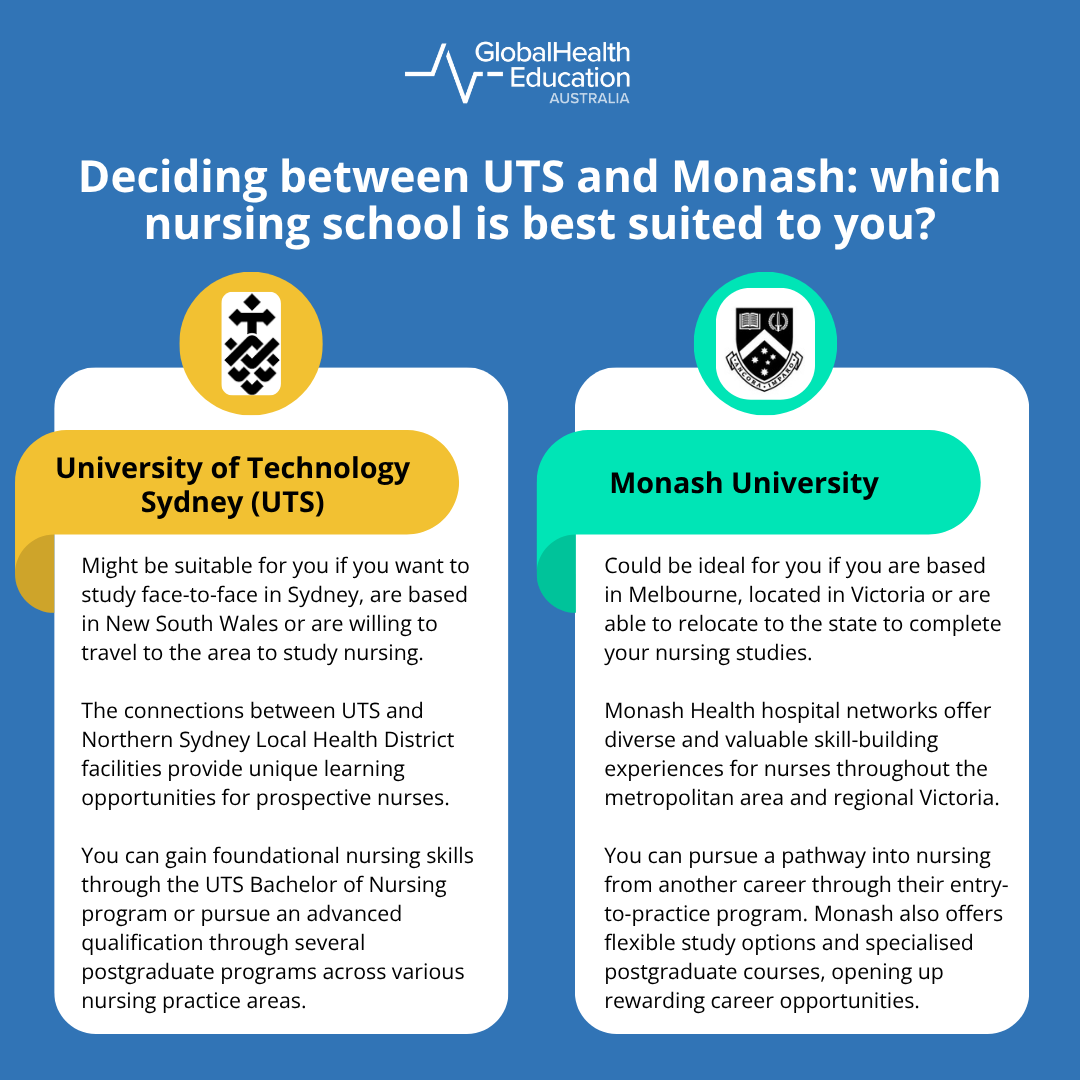
UTS vs Monash: some general things to consider
The good news is this: both UTS and Monash will provide you with a rigorous nursing education and a qualification that is recognised by the NMBA, is respected by employers across the country and can open up career opportunities worldwide.
So, which is the right fit for you?
If you’re still considering where to study nursing, here are a few things to reflect on as you weigh up your options:
Location and lifestyle
If you are based in New South Wales or prefer Sydney, the UTS nursing school could be the ideal starting point to your career in nursing. If you are in Victoria or prefer Melbourne's ecosystem, Monash has a strong partnership with Monash Health. If you’re located anywhere in Australia and want to advance your nursing career, both universities offer online course options to suit your needs.
Specific programs
If you’re interested in a unique, dual degree that blends nursing and innovative thinking, UTS could be worth considering. If you’re looking at pathways to build skills in areas such as palliative care, chronic and complex care or women’s health, UTS can provide these options.
If you are a non-nursing graduate wanting to enter the profession, Monash's Master of Nursing Practice is purpose-built for you to make a career change. For specialisations in wound care, forensic nursing, advanced midwifery or leadership and management, Monash's postgraduate courses also provide diverse career opportunities.
Placement preferences
For those who want to take advantage of learning opportunities available in some of Australia’s leading healthcare settings, the Royal Prince Alfred Hospital (RPA) in Sydney was ranked the top hospital in Australia in 2025, while the Alfred Hospital in Melbourne was ranked second. Both RPA and the Alfred are part of the various networks where UTS and Monash nursing students can complete their respective placements.
Course costs
The costs involved to qualify as a registered nurse through a Bachelor of Nursing program at both universities are comparable, with UTS being around $5,000 less expensive than Monash. Comparing the specific fees for your chosen program, particularly for postgraduate courses, is worthwhile before you apply as they vary extensively.
Peer connections
Campus culture, proximity to work and peer community may also be important to you. It’s a good idea to attend open days, speak with current or past students and connect with student support services at both UTS and Monash to gain more insight before making your final decision.
Pursue nursing with confidence at UTS or Monash University
Both the University of Technology Sydney and Monash University are among the top institutions in Australia offering nursing programs.
Deciding between these or other universities often comes down to your personal preferences, study requirements and where you live. It may also depend on what specific course you’re interested in, such as a nursing specialisation or if CSP courses are important to you.
In reality, Australia is home to a wide range of top nursing schools, with plenty of options to suit you based on your career needs. If you’re considering other institutions to complete your nursing studies, there is a range of nursing courses from various respected Australian universities, including our university partners to explore.
Courses beyond nursing, such as graduate certificates, graduate diplomas and master's degrees in counselling, mental health, psychology, social work, public health and more are also listed by GlobalHealth Education for you to explore.
If you’ve narrowed down your top two choices for nursing, you may need more help deciding the right path forward. Our Education Consultant, Catriona, is ready to help you navigate your options and help you enrol. Book a complimentary call today to take the first step toward your nursing career.