In This Article
- Is it too late to change careers at 40 and beyond?
- Common concerns about changing careers at 40 and beyond
- Why working in healthcare is ideal for career changers at 40 and beyond
- How to change careers at 40 and beyond and pivot into healthcare
- 10 healthcare courses that can help you switch careers faster
- Pivot into a healthcare career at 40 and beyond

Why trust GlobalHealth Education?
-
Our in-house editorial team and healthcare advisors write and review our content.
-
The information in our content provides clarity and insights to help you compare courses.
-
We list postgraduate courses from 25+ respected and reputable institutions in Australia.
Changing careers can feel daunting at 40 and beyond, but age doesn’t have to be a deterrent. If you’re feeling unfulfilled in your current role, no longer feel challenged or notice a shift in your interests, a career change could be the right path forward.
With the healthcare industry offering a blend of job security, growth and meaningful work, it’s no wonder an increasing number of individuals are viewing it as a viable career option. If you’re 40 and older and looking to switch into healthcare, this article will address common concerns, explain why healthcare is a strong choice for a career change and walk you through the practical steps required to make a successful switch.
Is it too late to change careers at 40 and beyond?
No, it is not too late to change careers in your 40s, 50s or 60s. In fact, you might be better positioned for a career change now than you were in your 20s or 30s. Many people are more prepared at this stage as they’ve got more life experience, transferable skills they can draw on and may be in a more financially stable position to pursue a career change.
If you’re thinking of making the switch, know that you’re not alone. A 2024 Robert Half report found that 56 per cent of Australian workers are willing to change careers in the next 12 months. The majority of generations also indicate that they are open to a career change. This includes:
- 61 per cent of millennials (29 to 44 years old)
- 59 per cent of Generation X (45 to 60 years old)
- 57 per cent of baby boomers (61 to 70 years old)
The advantages you bring to a career at 40 and beyond
It’s easy to assume that being older is a disadvantage when changing careers, but in reality, the opposite is often true. Changing careers later in life brings certain advantages, including:
Not having to start from scratch
With decades of professional experience behind you, you would’ve developed skills such as communication, empathy, teamwork and problem-solving. Known as soft skills, these interpersonal skills are highly transferable and especially valued in industries such as healthcare. Established work habits, professionalism and industry knowledge from your previous jobs may also help expedite your transition into a new career.
A stronger sense of self
By this stage of life, you generally know yourself better. You’re more aware of your strengths, interests and values and have a clearer sense of what you want your next career to offer. You’ve also learned what drains you and can actively seek out the opposite.
Purpose-driven motivation
Unlike your twenties, where education can sometimes feel like a box to tick, pursuing further study later in life is usually a deliberate choice. You’re investing your own time and resources with a clear understanding of what’s at stake. As a result, you’re more likely to stay motivated and approach your studies with focus and intent.
Greater resilience and perspective
Life experience often helps to build resilience and perspective. Over time, navigating setbacks, change and uncertainty helps develop effective coping mechanisms such as emotional regulation and the ability to reframe negative thoughts. This can strengthen self-efficacy and support your ability to manage the challenges of retraining or transitioning into a new field.
Common concerns about changing careers at 40 and beyond
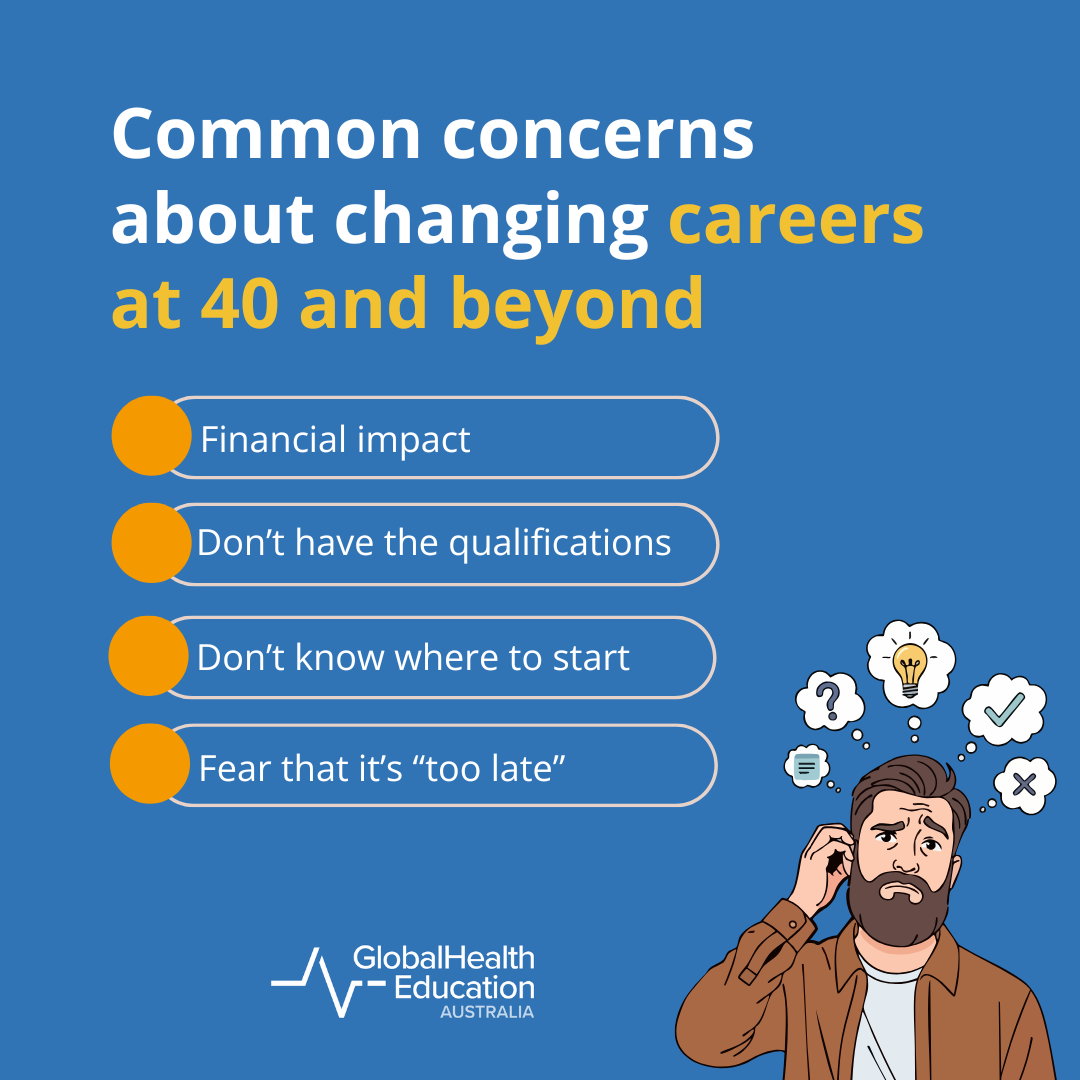
If you’ve hesitated about making a career change, you’re not the only one. SEEK’s Evolving Work Life report found that, out of more than 3,000 Australian workers surveyed, 44 per cent were open to the idea of a career change, but only 7 per cent were actively moving towards one. The main reason for being reluctant to change? The fear that it’s “too late”.
While we’ve established that it’s never too late to change careers at 40 and beyond, here are some other concerns that might be holding you back and how to work through them.
I’m concerned about the financial impact
This was the second most common barrier in SEEK’s report, with 41 per cent of respondents citing financial concerns as a reason for not making a career change. It’s a valid worry as changing careers might encompass paying for further study, cutting back hours at work or taking an initial cut in income – all of which involve taking a financial hit.
Some ways to minimise the financial impact include:
- Conducting a thorough financial review to see if there’s a way to live more frugally while adapting to your new career
- Estimating what the career transition might cost and building a financial buffer before you make the leap
- If further study is required, looking into Commonwealth supported place (CSP) courses or exploring part-time and online options that allow you to continue working while you study
I don’t have the qualifications to work in an industry I’d like
This reason came in third in SEEK’s report, with 29 per cent of respondents saying a lack of qualifications was holding them back from making a career switch. While obtaining a new qualification can be a lengthy endeavour that costs time and resources, there are ways to speed up the process:
- Some courses accept Recognition of Prior Learning (RPL), allowing you to receive credit for skills, knowledge and experience acquired through previous studies or work
- If you’re looking to move into healthcare and already hold a bachelor's degree, there are graduate entry courses that will allow you to complete your qualification in a shorter time frame
- A full degree isn’t always necessary. Shorter credentials, such as a graduate certificate or graduate diploma, may be enough to build the knowledge and skills required for certain roles
I don’t know where to start
Not knowing where to begin is another common barrier, with 25 per cent of respondents in SEEK’s report citing this as a reason for not pursuing a career change. You might know that you want to move into healthcare, for example, but the idea of pivoting can feel overwhelming. You might have questions such as, ‘What role should I pursue?’ or ‘What’s the first step?’.
If you’re feeling stuck, creating a career development plan can help clarify your direction and build confidence. Our easy-to-follow career development plan includes a six-step framework that will help you move from uncertainty to having a clear path forward.
If you’d like further guidance, it’s worth speaking with a career consultant who can help you navigate your options. At GlobalHealth Education, our Education Consultant, Catriona, has years of experience in career coaching and education consulting and can help you map out a workable, realistic plan. Book a complimentary professional development strategy call to get started.
Why working in healthcare is ideal for career changers at 40 and beyond
When it comes to changing careers, healthcare is an ideal industry to move into for those aged 40 and beyond. The industry rewards the skills you’ve already built, welcomes experienced professionals and offers a blend of job security and meaningful work.
Your existing skills are already in demand
While you’ll need to build technical skills to work in healthcare, you’ve already spent years developing interpersonal skills that are highly valued in this field. With healthcare being a fundamentally people-focused profession, the skills that you’ve developed managing difficult conversations, working within a team and adapting to change are all capabilities that will help you thrive in the industry.
It’s an industry made up of an older workforce
Healthcare is made up of a predominantly older workforce, which means you’re less likely to feel out of place as a mature-age entrant. According to data from Jobs and Skills Australia, there are numerous healthcare roles where the majority of workers are aged 35 to 59. These include:
- Counsellors (57.7 per cent)
- Social workers (57.3 per cent)
- Registered nurses (52.2 per cent)
- Midwives (51.8 per cent)
Job security that’s hard to match
In an era of automation anxiety and industry disruption, healthcare stands out as an industry that continues to offer strong job security. An ageing population means demand for healthcare workers is only going to continue to grow and despite the rise of AI, many healthcare roles will not be replaced by these technologies.
There are also numerous healthcare roles currently in shortage. As of 2025, the occupation shortage list highlights registered nurses, midwives, occupational therapists, physiotherapists and social workers as being in high demand across Australia.
For career changers, this translates to stability and opportunity in a sector that’s not expected to slow down anytime soon.
Meaningful work
According to SEEK’s evolving work life report, 28 per cent of Australians regretted their choice of career because they felt their work was unfulfilling. With the average person spending over a total of 13 years of their life at work, finding meaning in what you do matters.
Healthcare remains one of the most meaningful careers because of the positive impact you’re able to make on someone’s life. Whether that’s helping someone going through a tough time or supporting a family through a difficult diagnosis, it’s a career that’s incredibly rewarding.
Diverse pathways and flexibility
From direct patient care to allied health, there are plenty of different healthcare professions to choose from. In allied health alone, there are over 20 distinct professions you could move into depending on your interests and strengths.
Flexibility may also be an important consideration at this stage of life, particularly if you have a young family. Healthcare professions tend to offer part-time roles, shift options and varied work settings, making it possible to build a career that fits around family commitments or other responsibilities.
How to change careers at 40 and beyond and pivot into healthcare
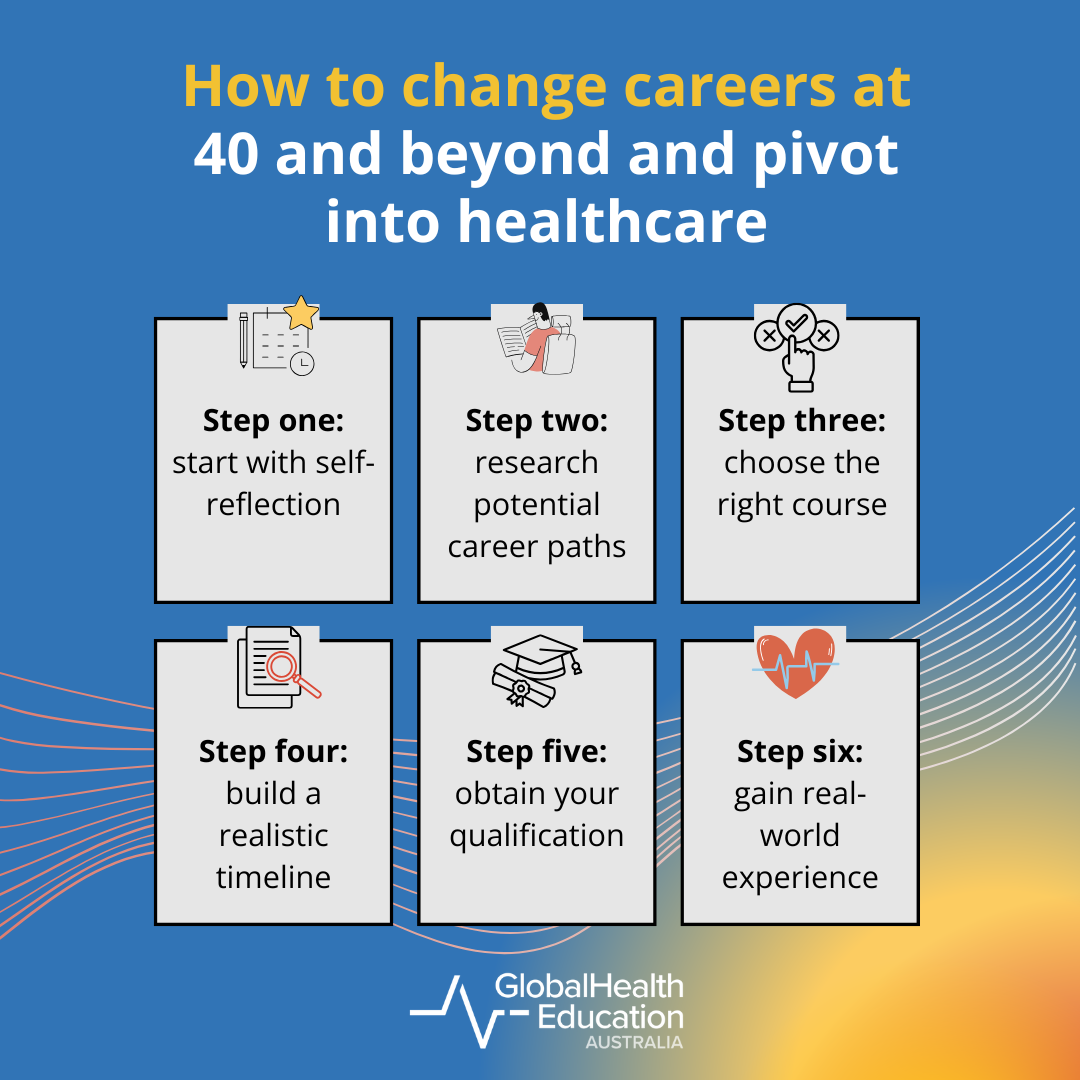
If you’ve decided that you’d like to move into the healthcare industry, but aren’t sure how to make the transition, breaking down the process into steps can make it feel more manageable. Here’s how you can get started:
Step one: start with self-reflection
The first step is figuring out what your strengths, interests and values are. Healthcare is a broad industry and different roles suit different personalities and working styles. To help narrow your options, consider:
- Using self-assessment tools such as RIASEC or VIA Character Strengths to identify your strengths and weaknesses
- Making a list of the skills you’ve developed throughout your career. This can include both technical and interpersonal skills
- Reflecting on what energises you versus what drains you at work
- Speaking with a career coach who can help guide you in the right direction
Step two: research potential career paths
Once you have a clearer sense of what you’re looking for, the next step is exploring healthcare roles that align with your strengths, interests and values. Some ways to do this include:
- Taking our healthcare career quiz to see which career might suit you best
- Tapping into your professional network and speaking with people in different healthcare roles to get a sense of what their day-to-day work involves
- Shadowing or volunteering in a healthcare setting. St Vincent’s Hospital in Melbourne, for example, offers opportunities to volunteer in areas such as administration and companionship
- Joining online communities on platforms such as Reddit, LinkedIn and Facebook to ask questions and gain insight into different healthcare roles
Step three: choose the right course
Once you’ve decided on the healthcare career you’d like to pursue, you’ll likely need to complete further study before you can work in the field. Some questions to consider when choosing a postgraduate course include:
- What are the entry requirements?
- What will I learn and how does the course prepare me for the role?
- What study modes are available?
- How much does it cost and what financial support is available?
- Are there clinical placements and how are they structured?
Step four: build a realistic timeline
Once you’ve chosen a course, it’s time to map out your next steps. Having everything laid out ahead of you can help with making the transition feel less overwhelming. Your action plan should include:
- Which intake you plan to apply for and key application deadlines
- Who you’d like to inform or involve in your plan, whether that’s family, friends or colleagues
- Practical considerations such as how you’ll manage work commitments, finances and childcare during study
- Key milestones and deadlines to keep you on track
Step five: obtain your qualification
Once you’ve done your research and planning, it’s time to enrol and commit to the learning ahead. If you’re returning to study after a long break, it may take a few weeks to get into the swing of things as you adjust to the rhythm of lectures, deadlines and assignments.
If you’re studying online as a mature-age student, setting up a dedicated study space, creating a study timetable and connecting with other online students can help you stay engaged and on track.
Step six: gain real-world experience
After completing your qualification, you’ll likely need to register with the relevant professional body before you can work in the field. To become a qualified physiotherapist, for example, you will need to register with the Physiotherapy Board of Australia (PBA) through the Australian Health Practitioner Regulation Agency (Ahpra).
Once registered, you can begin applying for roles through platforms such as job boards and health services. When applying, make sure to highlight your transferable skills. If you’re applying for a graduate nurse position, for example, your cover letter and resume should emphasise skills such as communication, time management and problem-solving.
10 healthcare courses that can help you switch careers faster
To help you get started, we’ve compiled a list of postgraduate healthcare courses suited to career changers. If you already hold a bachelor’s degree, these courses are often the fastest pathway into the field. If you don’t have one, some of these courses may consider RPL. Otherwise, you’ll need to start by completing a bachelor’s degree.
Want to become a nurse?
If you’d like to become a registered nurse and already hold a bachelor’s degree, the fastest way to become a registered nurse is through the graduate entry pathway. Some nursing courses to consider include:
Master of Nursing Practice (Graduate Entry) at the University of Canberra
Entry requirements
A bachelor’s degree in any discipline, completed within 10 years of application. If your degree was completed more than 10 years ago, evidence of further study, such as a postgraduate certificate or diploma, may suffice.
Length of course
Two years full-time.
Delivery mode
On campus.
Is CSP available?
Yes, CSP is available.
Clinical placement hours
Over the two years, you will complete 800 hours of clinical practice across a range of local and regional medical settings.
How the course prepares you for a nursing role
You’ll learn through a variety of methods including hands-on learning, simulation, theory and clinical placements. A unique feature of this course is also the learning that takes place within a simulated environment. You will have the opportunity to hone your skills through simulation trainers and emerging technology such as AI and VR.
Master of Nursing (Graduate Entry) at the University of Queensland
Entry requirements
A bachelor’s degree (or equivalent in any discipline). Your previous qualification must have been completed within the last 10 years.
Length of course
Two years full-time or the part-time equivalent.
Delivery mode
On campus.
Is CSP available?
Yes, CSP is available.
Clinical placement hours
Over the two years, you will undertake 840 hours of clinical practice across a range of specialty areas.
How the course prepares you for a nursing role
In addition to extensive supervised clinical placements, you’ll learn the latest theories and skills from experienced health and nursing professionals. The course also includes a unit on Working with Aboriginal and Torres Strait Islander Peoples and Communities as well as Critical Appraisal of Research, where you’ll develop advanced analytical and critical thinking skills to engage with scholarly literature.
Want to become a counsellor?
If you’re looking to kickstart your career in counselling, a Master of Counselling can prepare you for the demands of the role. Some counselling courses to consider include:
Master of Counselling at the University of Canberra
Entry requirements
Have an undergraduate or postgraduate degree in any discipline.
Length of course
Two years part-time.
Delivery mode
Online.
Is CSP available?
No, CSP is not available but FEE-HELP is.
Clinical placement hours
This course includes a mandatory counselling placement of 200 hours that you will be required to undertake within an appropriate agency. University of Canberra Online has a dedicated placement team that will help you find a suitable placement.
How the course prepares you for a counselling role
This course is accredited by the Australian Counselling Association (ACA) and places an emphasis on skills development, interactive teaching, experiential learning and self-awareness. In addition to extensive placements, you’ll attend a five-day intensive workshop where you’ll meet your peers face-to-face. The course also has a comprehensive course structure, consisting of 12 units that combine core counselling theory with applied practice.


Develop advanced counselling knowledge and practical skills through online study, supervised placement and experiential learning, with a focus on ethical practice, diversity, mental health and inclusive counselling.
Master of Counselling at Edith Cowan University
Entry requirements
A bachelor’s degree in any discipline or equivalent prior learning, which includes at least five years of relevant professional experience.
Length of course
Two years part-time.
Delivery mode
Online.
Is CSP available?
No, CSP is not available but FEE-HELP is.
Clinical placement hours
With 220 hours of counselling placement, you’ll graduate career-ready and with the confidence to apply your skills across a range of settings.
How the course prepares you for a counselling role
This online course will give you the tools to deliver flexible, ethical and culturally responsive counselling. Other than being accredited by the ACA, you’ll develop your micro-counselling skills during a three-day on-campus intensive where you’ll participate in live role plays and simulated counselling sessions. As part of this course, you’ll also get to study specialist units like Mental Health Counselling and Child and Adolescent Counselling.
Want to become a social worker?
If you’re interested in becoming a social worker, a Master of Social Work (Qualifying) will equip you with the skills and competencies to excel in the role. Some courses to consider include:
Master of Social Work (Qualifying) at the University of Canberra
Entry requirements
A bachelor’s degree or equivalent in a related field and at least one year of full-time study or equivalent in social sciences and human behaviour. Examples of related areas of study include allied health, psychology, education and teaching, human resource management and marketing studies.
Length of course
32 months to three years part-time.
Delivery mode
Online.
Is CSP available?
No, CSP is not available but FEE-HELP is.
Field education placement hours
1,000 supervised hours, including 28 hours of integrative seminars. The placements must be completed in two distinct fields and organisations.
How the course prepares you for a social work role
The course has been developed to meet the Australian Social Work Education and Accreditation Standards (ASWEAS). You’ll learn through case scenarios, simulated settings and in-person intensive components while applying what you learn in field education placements. You’ll also be taught by experts with numerous years of experience in the social work field.

Develop professional social work knowledge and practice skills across areas including diversity, psychosocial health, ethics, research, policy, trauma and family practice, supported by intensive learning and 1,000 hours of supervised field education.
Master of Social Work (Qualifying) at the University of Sydney
Entry requirements
A relevant bachelor’s degree, evidence of the ability to meet the required prerequisite knowledge in relation to human development and society and evidence of at least two years of relevant employment history in human and community services.
Length of course
Two years full-time or the part-time equivalent.
Delivery mode
On campus.
Is CSP available?
Yes, CSP is available.
Field education placement hours
You must complete 980 hours of work-based training under the direct supervision of a qualified social work practitioner.
How the course prepares you for a social work role
The course is accredited by the Australian Association of Social Workers (AASW) and you’ll complete core units in areas such as mental health, child protection, violence against women and ageing. In addition to elective units such as Global Social Policy and Dying, Death and Mourning, you’ll also complete an Integration of Learning capstone that enables you to contribute to knowledge building and practice in the social work profession.
Want to become a physiotherapist?
Begin a rewarding career as a physiotherapist and fast track your way into a physiotherapy career. If you already possess a health-related degree and want to move into a career in physiotherapy, these courses will help you graduate faster and enter the industry with a competitive edge.
Master of Physiotherapy at the University of Technology Sydney
Entry requirements
A completed Australian bachelor’s degree or higher with a minimum GPA of 5.25/7 and tertiary level studies in two human anatomy subjects and one human physiology, exercise physiology, neuroscience, psychology and research methods subject. Applicants must also have communication skills, interpersonal skills, an interest in physiotherapy and a commitment to physiotherapy as a career (assessed through an interview).
Length of course
Two years full-time.
Delivery mode
On campus.
Is CSP available?
No, CSP is not available but FEE-HELP is.
Placement hours
You will complete 700 to 800 hours of clinical placements in a range of locations.
How the course prepares you for a physiotherapy role
Developed by experienced physiotherapy academics, this comprehensive course covers musculoskeletal, neurological, orthopaedic and cardiorespiratory physiotherapy. You will complete units such as Outpatient Rehabilitation, Acute Physiotherapy Care and Pain Neuroscience and Management. The course also offers a high volume of work-integrated learning, giving you the opportunity to apply your knowledge in a wide variety of settings.
Master of Physiotherapy at Swinburne University of Technology
Entry requirements
A completed bachelor’s degree in a health science-related discipline and tertiary level studies in a minimum of two units in both human anatomy and human physiology.
Length of course
Two years full-time.
Delivery mode
On campus.
Is CSP available?
No, CSP is not available but FEE-HELP is.
Placement hours
You will be required to complete a total of 800 hours of clinical practice across both core and clinical placement units.
How the course prepares you for a physiotherapy role
This course focuses on technology, digital health, leadership and enterprise and is accredited by the Australian Physiotherapy Council. You’ll complete units such as Neurological Physiotherapy and Leadership and Management for Health Professionals, along with extensive clinical placements that will allow you to put what you’ve learned into practice.
Want to become an occupational therapist?
Be a part of one of Australia’s fastest-growing allied health professions by completing a Master of Occupational Therapy. Courses to consider include:
Master of Occupational Therapy at the University of Tasmania
Entry requirements
A completed bachelor’s degree from an Australian university or equivalent. You must have also completed two units of relevant systems human anatomy and physiology, one unit focused on social perspectives in health (such as psychology or sociology) and one unit on research methods.
Length of course
Two years full-time.
Delivery mode
On campus.
Is CSP available?
Yes, CSP is available.
Placement hours
The course includes 1,000 hours of mandatory work integrated learning and professional experience placements.
How the course prepares you for an occupational therapy role
This two year full-time course will provide you with the knowledge, skills and attributes to become a competent occupational therapist. You will develop skills in clinical reasoning, and learn how to communicate and work with individuals from a variety of backgrounds. The course also includes a two week-long residential school in Launceston and the opportunity to undertake community-based projects to hone your occupational therapy skills.
Master of Occupational Therapy Practice at La Trobe University
Entry requirements
A completed bachelor’s degree in any discipline. Subsequent postgraduate study and/or work experience in a relevant area may also be considered.
Length of course
Two years full-time.
Delivery mode
On campus.
Is CSP available?
No, CSP is not available but FEE-HELP is.
Placement hours
You will complete 1,000 hours of placement, including six weeks in your first year and two eight-week professional practice blocks and a ten-week project-based learning placement in your second year.
How the course prepares you for an occupational therapy role
The course focuses on client-centred practice and evidence-based learning, along with the opportunity to build skills through supervised placements. With units such as Evidence Based Practice in Occupational Therapy and Enabling Change: Group Work in Occupational Therapy, you’ll be well prepared to tackle the profession. Subject to local requirements, you may also have the option to complete an overseas placement in your second year.
Pivot into a healthcare career at 40 and beyond
Changing careers at 40 and beyond is more than possible and age shouldn’t be a barrier. Taking the first step is often the hardest part, but having a plan in place can make the transition more manageable.
Other than the courses mentioned above, GlobalHealth Education has an extensive range of postgraduate healthcare courses from reputable universities. Explore courses in areas such as mental health, psychology, public health and more to find the right fit for you.
At GlobalHealth Education, we also have career coaches in healthcare disciplines such as nursing, counselling, psychology and social work. Get in touch with them to receive personalised support and gain a better understanding of what working in their field looks like.