Why trust GlobalHealth Education?
-
Our in-house editorial team and healthcare advisors write and review our content.
-
The information in our content provides clarity and insights to help you compare courses.
-
We list postgraduate courses from 25+ respected and reputable institutions in Australia.
Artificial intelligence (AI) is rapidly emerging and a major concern that many people have is whether it could eventually replace their jobs. According to a report by investment bank Barrenjoey, one in three jobs is currently at risk of being replaced by technology.
Even so, some jobs face a much higher risk than others. Jobs and Skills Australia, for example, highlights that health and medical care is among the sectors least at risk of automation, while clerical and administrative roles are the most vulnerable.
If you’re looking to move into a career that is more resilient to AI, allied health is an area to consider. This article delves into why allied health roles are here to stay and outlines courses that can help you get started or pivot into the field.
How will AI transform healthcare?
AI has been making strides in healthcare since the early 2000s and it continues to gain significant momentum.
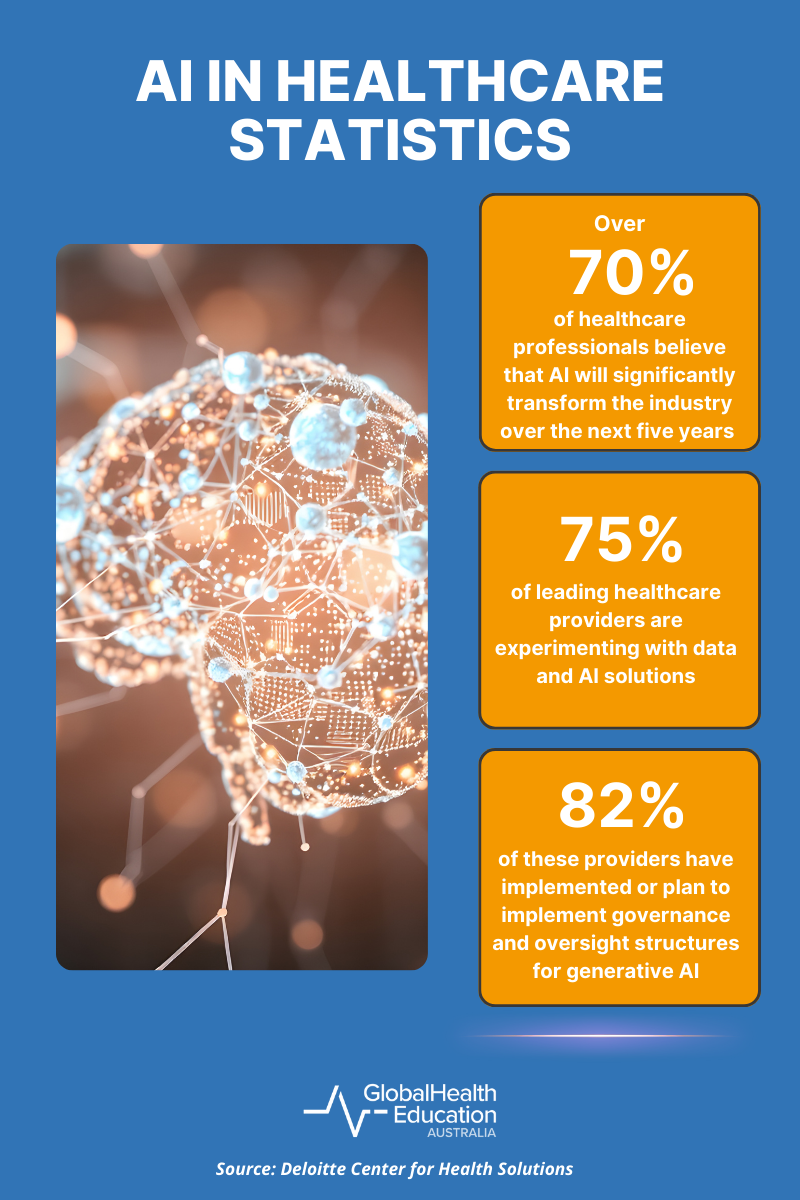
According to the Deloitte Centre for Health Solutions, over 70 per cent of healthcare professionals believe AI will significantly transform the industry within the next five years. In addition, 92 per cent of leaders see potential in generative AI for improving efficiencies and 65 per cent believe that it’ll enable quicker decision-making.
Will AI replace healthcare professionals?
Even with AI’s rapid evolution, at this stage, it is unlikely that AI will replace healthcare professionals. While AI has delivered benefits across healthcare by helping to streamline administrative workflows and enhance diagnostic precision, research suggests that AI will augment and complement the work that healthcare professionals do rather than replace them entirely.
The human advantage: what makes allied health roles AI–proof
There are over 300,000 registered allied health professionals in Australia and the workforce is rapidly growing. This diverse field includes an array of professions from occupational therapists to speech pathologists, radiographers, social workers, counsellors, psychologists and more.
What makes allied health roles particularly resistant to AI automation is its reliance on human connection and person-centred holistic care. Rather than a one-size-fits-all approach, allied health professionals tailor their treatment to each individual’s unique needs, circumstances and goals. This requires humanistic traits such as empathy, intuition and adaptability, qualities that are irreplaceable by AI.
Let’s take a look at these reasons, along with several others, in greater detail:
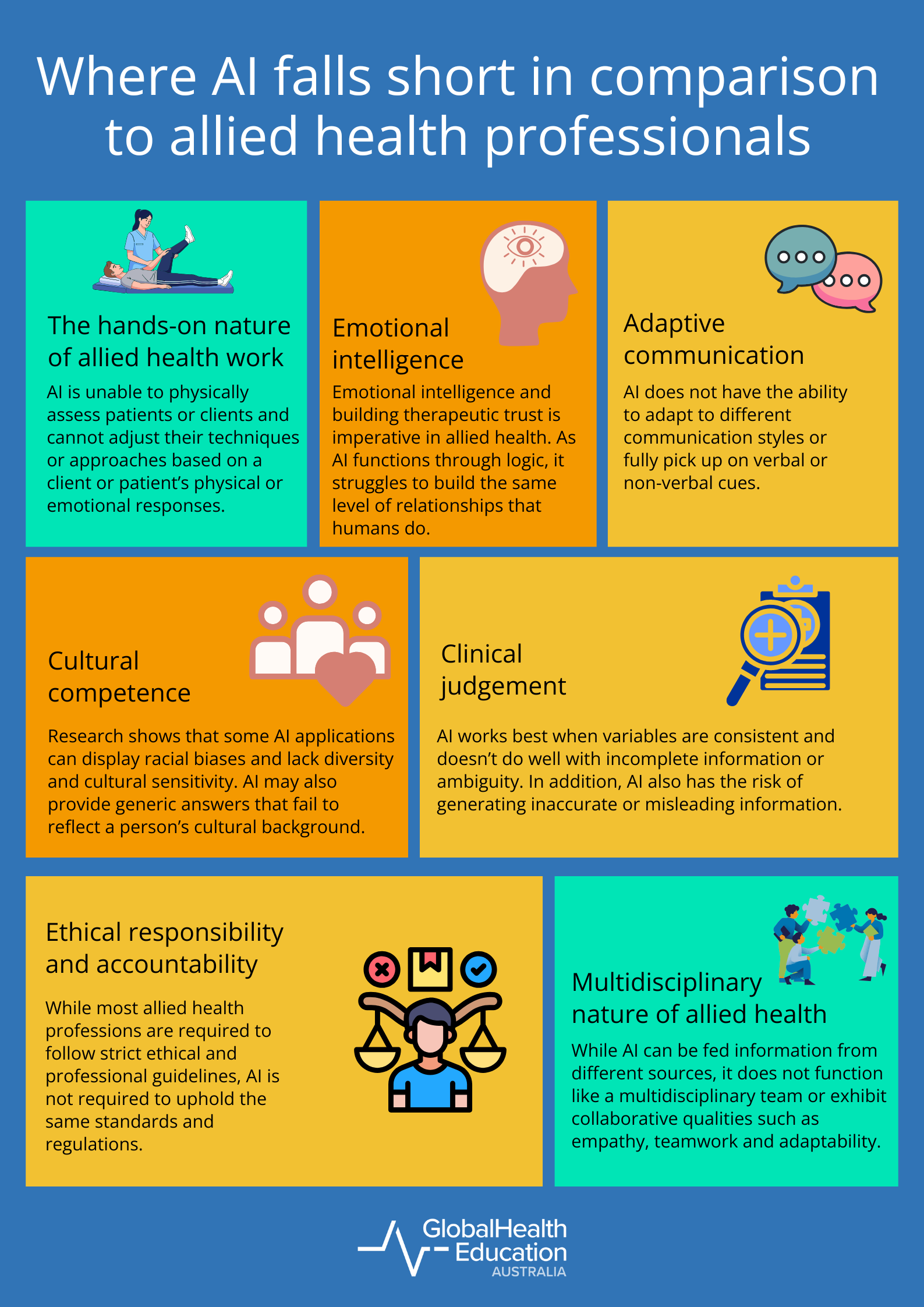
1. The tactile, hands-on nature of allied health work
Touch and the ability to physically assess patients or clients are important aspects of many allied health professions. Physiotherapists, for instance, use hands-on techniques such as joint mobilisation and soft tissue therapy, podiatrists examine foot structure and gait and chiropractors perform manual adjustments.
AI’s limitations
AI lacks the sensory capability to conduct hands-on physical assessments and cannot detect subtle changes in muscle tension, assess tissue quality or perform biomechanical assessments like allied health professionals can.
In addition, while allied health professionals can continuously adjust their techniques, modify pressure or shift approaches based on a client or patient’s physical and emotional responses during treatment, AI is unable to do so.
Example
A patient visits a physiotherapist for neck pain, explaining that they’re having difficulty tilting their neck. After an initial assessment, the physiotherapist uses careful movements and stretches to relax tight muscles and manual therapy to increase circulation.
Throughout the session, they continuously monitor the patient by asking how they’re feeling, adjusting their technique based on the patient’s responses, breathing and body language. The physiotherapist might reduce pressure when they feel the patient tense up or switch to a different technique if the patient expresses discomfort.
Other than lacking the physical capability to conduct hands-on assessments or perform manual therapy, AI also cannot sense when a patient might be uncomfortable or modify their approach based on the patient’s responses.
2. Emotional intelligence and building therapeutic trust
Allied health professionals often work with patients or clients facing a wide range of challenges such as recovering from injury, adapting to disability or managing chronic conditions. While technical skills matter in these instances, so too does the ability to recognise emotions, respond with empathy and create an environment that’s safe and non-judgemental.
Building strong therapeutic relationships is also key, as it forms the bedrock of successful treatment. Psychologists and counsellors, for instance, need to exhibit empathy, encourage collaboration and build trust to create an environment where clients feel comfortable sharing their thoughts and experiences openly.
AI’s limitations
While AI chatbots and virtual assistants are increasingly used in areas such as mental health support, research suggests that AI cannot exhibit the same level of emotional awareness as humans. While AI can simulate empathy by recognising and responding to emotional cues based on pattern recognition and language modelling, its capabilities are limited as it cannot holistically understand someone’s experience or reciprocate emotions.
As AI fundamentally lacks emotional understanding and functions through logic, it is unable to build the same level of therapeutic trust that an allied health practitioner can. For instance, while a counsellor can actively listen and intuitively sense when to encourage, challenge or provide reassurance, that is not something that AI is able to do.
Example
An occupational therapist is working with a stroke survivor who is learning to dress independently. During the session, the occupational therapist notices that the patient becomes increasingly frustrated as they struggle to button up their shirt.
The occupational therapist recognises that this isn’t just a physical difficulty, but the emotional weight of needing help with something that once felt effortless. Responding with empathy, they reassure the patient and assist by helping to break the task into smaller, more manageable steps.
Over time, this consistent support and understanding helps to cultivate a strong therapeutic relationship. The occupational therapist comes to understand what motivates the patient, recognises their fears and learns what approach helps them feel most supported in their recovery journey.
This level of emotional depth and relationship building cannot be replicated by AI. As its responses are derived from algorithms and data patterns, it limits its effectiveness in areas that require human connection and emotional intelligence.
3. Adaptive communication
Effective communication has long been recognised as a fundamental element of quality healthcare delivery. As allied health professionals work with a variety of individuals from children to older adults, they must tailor their communication style to meet each person’s unique needs.
This encompasses identifying verbal indicators, but also picking up on non-verbal indicators such as body language, facial expressions and tone of voice.
AI’s limitations
While AI, particularly AI chatbots, can hold conversations with patients or clients, it may not be able to fully pick up on verbal cues or adapt its communication style based on someone’s body language, eye contact or demeanour.
For example, if a patient or client is confused by an AI chatbot’s response, the chatbot is unlikely to recognise this unless prompted. In contrast, an allied health professional may pick this up immediately through subtle cues such as a furrowed brow, a lack of eye contact or a shift in focus.
Example
A social worker meets with a client experiencing anxiety. During the conversation, the client speaks softly, avoids eye contact and provides short, hesitant responses.
From their responses, the social worker recognises that the client has a passive communication style. To build trust and psychological safety, they adapt their communication approach by asking open-ended questions, validating the client’s thoughts and concerns while maintaining an open posture with soft eye contact.
While some AI systems can analyse non-verbal signs such as facial expressions or voice tone under controlled conditions, this technology is still emerging. Most AI, such as AI chatbots, are unable to replicate this level of adaptive communication as they are not capable of fully understanding or interpreting social cues.
4. Cultural competence
Cultural competence is an important component of delivering person-centred care in allied health and involves tailoring one’s approach to work within a patient or client’s cultural framework. When allied health practitioners demonstrate cultural competence, it helps patients and clients to feel seen, builds trust and improves healthcare outcomes.
AI’s limitations
Research shows that certain prominent AI applications can display racial biases and lack diversity and cultural sensitivity. For example, a recent study from Oxford University tested five major AI models against cultural values from 107 countries. Results indicated that all models exhibited cultural values resembling English-speaking and Protestant European countries. As AI relies on data to generate its responses, biases can appear when the data is not comprehensive or if there is an imbalanced distribution.
Cultural competence also requires recognising that even individuals from the same cultural background may hold different beliefs, preferences and lived experiences. AI may struggle with this as it often draws from general patterns in its data rather than asking questions and personalising its responses in accordance with a patient or client’s circumstances.
Example
A dietitian may be working with a patient who is diagnosed with type 2 diabetes. Rather than making assumptions about the patient based on their cultural background, the dietitian asks open questions to learn more about the patient’s usual diet, eating habits and routines. Through this conversation, they learn that the patient has specific religious dietary needs and prefer meals that align with their cultural background.
By asking questions and being open and curious about the patient’s experience, the dietitian is able to design a management plan that is both clinically appropriate and culturally responsive.
AI, however, draws on data to generate its responses. This can lead to generic answers with preconceived assumptions or biases that fail to respect or reflect a person’s cultural background.
5. Clinical judgement in unpredictable environments
Allied health is an unpredictable field. Allied health practitioners regularly work with patients or clients that present with multiple comorbidities, respond differently to the same intervention or experience rapid changes in their condition. This means allied health practitioners are continuously assessing, interpreting and adapting their approach in accordance with the patient or client’s condition and circumstances.
AI’s limitations
AI systems work best when variables are known and consistent. But in allied health, where situations change rapidly and symptoms evolve, AI struggles to work with incomplete information and navigate this ambiguity.
AI also has the risk of generating inaccurate or misleading information. These errors, known as AI hallucinations, occur when a model produces inaccurate output. Without human oversight, such misinformation could lead to inaccurate diagnoses or misinterpretation of symptoms.
Example
A counsellor is working with a client who is grieving the loss of a loved one. As the client begins to share their feelings, the counsellor notices their breathing quickening along with growing restlessness and emotional distress. In response to this shift in demeanour, the counsellor adjusts their approach by holding space for the client, slowing the pace of the session and incorporating grounding and mindfulness techniques to help the client with managing their emotions.
The ability to recognise emerging symptoms, interpret them and adapt to changing circumstances is not something that AI is currently adept at.
6. Ethical responsibility and accountability
In Australia, many allied health professions such as chiropractors, pharmacists, radiographers and optometrists are required to be registered with Ahpra. Even for self-regulated allied health professions, there are still established processes to ensure members are appropriately qualified, meet professional standards and maintain ongoing professional development.
These safeguards help ensure that allied health practitioners in Australia are ethical, competent and accountable in the care that they provide.
AI’s limitations
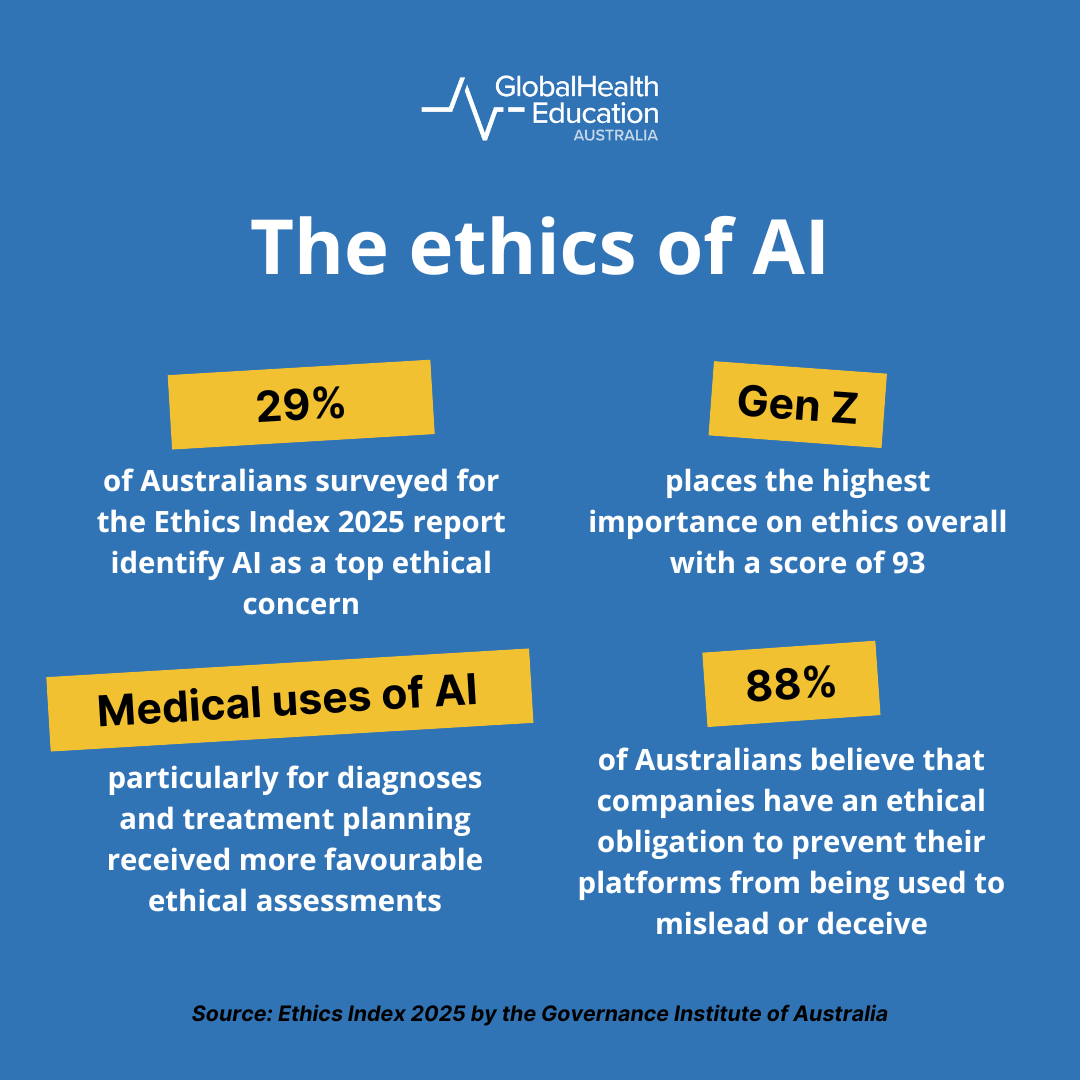
Ethics and governance have constantly been an area of contention in AI, particularly in healthcare. Research highlights concerns around patient consent and confidentiality, lack of accountability and limited transparency around how AI models reach conclusions.
While the World Health Organisation has introduced guidance on the ethical use and governance of large multimodal models (LMMs), these are recommendations rather than enforced regulations. At present, there is no clear ethics and governance framework that holds AI systems to the same ethical responsibilities or professional standards required of allied health practitioners.
Example
A radiographer must follow strict ethical and professional guidelines outlined by the Medical Radiation Practice Board of Australia.
This includes applying knowledge of anatomy, physiology and pathology to practice, using clinical information systems appropriately and ensuring that each procedure is confirmed in accordance with clinical indicators. If they encounter a patient whose condition is deteriorating or who is no longer able to safely undergo an examination, they must respond promptly and in line with standards of safe, high-quality care.
AI, however, is not required to uphold these guidelines. It does not take responsibility for potential errors, is not required to meet competency standards and does not operate within clinical protocols.
7. The multidisciplinary nature of allied health
Allied health professionals often work within multidisciplinary healthcare teams, collaborating with healthcare professionals from a range of disciplines. A speech pathologist, for instance, may work alongside an occupational therapist, psychologist and general practitioner to ensure the patient or client receives holistic and effective care.
AI’s limitations
AI predominantly works in isolation. While it can be fed information from multiple sources, it does not function like a multidisciplinary team where team members work in parallel towards a common therapeutic goal.
Effective multidisciplinary practice also relies on human qualities such as adaptability, open-mindedness, empathy and teamwork, traits that AI cannot replicate.
Example
To help a client with a severe injury recover, an allied health team consisting of a physiotherapist, occupational therapist and dietitian work together to develop a coordinated and comprehensive rehabilitation plan that addresses every aspect of the client’s recovery.
While the physiotherapist assists with restoring function and ability, the occupational therapist helps the client regain independence in daily activities and the dietitian provides nutritional guidance to support healing and recovery.
This level of collaboration and coordinated multidisciplinary care is not something that AI is able to do.
Start your journey in an AI-proof job by exploring these postgraduate allied health courses
While allied health is one of the most AI-resistant sectors in healthcare, some roles are more AI-proof than others. Professions such as psychology, social work, counselling and occupational therapy, for example, are among the most AI-proof as they rely heavily on skills such as emotional intelligence, adaptive communication and clinical judgement.
If you’re interested in pivoting into one of these allied health roles, a postgraduate healthcare course can help you develop the skills and knowledge required to make the move. Here are some options to consider:
Psychology
Due to the extensive training required, becoming a psychologist typically takes six to eight years. The exact length of time depends on whether you plan to practise as a general psychologist or pursue an area of endorsement such as clinical psychology.
If you already have a bachelor’s degree in another field, you may be able to take the first step towards pursuing a career as a psychologist by completing a Graduate Diploma of Psychology. Examples of courses include:
- Graduate Diploma of Psychology at Edith Cowan University
- Graduate Diploma in Psychology at the University of Technology Sydney
- Graduate Diploma of Psychology at Charles Sturt University
If you don’t have a bachelor’s degree, but have at least five years of experience, some universities may allow you to start by completing a Graduate Certificate of Psychology before progressing to a Graduate Diploma of Psychology. Examples include:
- Graduate Certificate of Psychology at Edith Cowan University
- Graduate Certificate of Psychology at Swinburne University of Technology
Counselling
If you are looking to move into a counselling role, a Master of Counselling will provide you with the knowledge and practical skills needed to work as a competent counsellor. These courses also include counselling placement hours, giving you the opportunity to apply what you have learned in real-world settings. Courses to consider include:
- Master of Counselling at Edith Cowan University
- Master of Counselling at the University of Canberra
- Master of Counselling at the University of the Sunshine Coast
Want to work as a genetic counsellor? These two-year graduate entry courses will provide you with the knowledge and skills required to build a career in this field:
- Master of Genetic Counselling at The University of Melbourne
- Master of Genetic Counselling at the University of Technology Sydney
Social work
If you have a bachelor’s degree in another field, a Master of Social Work will equip you with the skills and knowledge needed to succeed as a social worker. In addition to completing units focused on social work, theory and research, you will also undertake supervised practical placements across a range of organisations.
Examples of courses include:
- Master of Social Work (Qualifying) at the University of Canberra
- Master of Social Work (Qualifying) at the University of Sydney
- Master of Social Work (Qualifying) at the University of Queensland
Physiotherapy
If you already hold a bachelor’s degree in a health science discipline, a Master of Physiotherapy can prepare you for a career as a physiotherapist. Throughout the course, you’ll study units focused on clinical assessment, treatment planning and rehabilitation while also undertaking supervised clinical placements where you can put your skills into practice.
Some examples of courses to consider include:
- Master of Physiotherapy at Flinders University
- Master of Physiotherapy (Graduate Entry) at the Adelaide University
- Master of Physiotherapy at the University of Canberra
Occupational therapy
If you are looking to transition into a career as an occupational therapist, a Master of Occupational Therapy will equip you with the knowledge and skills needed to deliver high-quality, person-centred care. Through a combination of coursework and clinical placements, you will learn how to empower and transform the lives of those in need.
Some courses to consider include:
- Master of Occupational Therapy at Bond University
- Master of Occupational Therapy at Curtin University
- Master of Occupational Therapy at the University of Canberra
Other allied health professions
Medical imaging and diagnostics
If you are interested in becoming a sonographer or diagnostic radiographer, the following courses can help you get started:
Graduate Certificate in Ultrasound at the University of Canberra
Completing this course is the first step on your pathway towards a career in sonography. You’ll learn the physical principles of ultrasound and complete units such as Abdominal Ultrasound and Ultrasound Physics and Instrumentation. To be eligible, you will need to have completed a bachelor’s degree along with at least two units of degree-level anatomy and physiology.
Master of Medical Imaging at the University of Canberra
This course is designed for individuals looking to develop proficiency in diagnostic radiography. You will study areas such as radiation biology, medical imaging research and radiographic image interpretation. Applicants must hold a bachelor’s degree and have completed at least two units of degree-level anatomy and physiology.
Pharmacy
If you’re looking to become a pharmacist, this two-year full-time Master of Pharmacy course at the University of Canberra will equip you with the knowledge and clinical decision-making skills required to practise safely and effectively. To be eligible, you must have completed a bachelor’s degree and at least one unit of degree-level chemistry, biochemistry, microbiology, anatomy, physiology and pharmacology.
Nutrition
Designed for those looking to deepen their knowledge in the field of nutrition, the Graduate Diploma in Nutrition Science at the University of Canberra is a one-year full-time course that will further your understanding of human nutrition and its application in professional practice. To be eligible for the course, you will need to have completed a bachelor’s degree in science or a related discipline along with two degree-level units in chemistry, human biology and human physiology.
Speech pathology
The Master of Speech Pathology at the University of Canberra is open to applicants with a bachelor’s or postgraduate degree in any discipline. Through units such as Diversity in Communication and Paediatric Language and Literacy, you will develop the competencies needed to work as a speech pathologist and support individuals with communication and swallowing difficulties.
Pivot into allied health and AI-proof your career
While AI is transforming healthcare, it is unlikely to replace allied health professionals. Instead, AI will become a tool that allied health professionals use to complement and augment their practice. If you are considering moving into an allied health career, GlobalHealth Education features a range of healthcare courses from reputable universities to help you get started.
Book a complimentary one-on-one professional development strategy call with our Education Consultant, Catriona. She can help provide personalised guidance based on your goals, experiences and interests.