In This Article
- What is the fastest way to become a registered nurse?
- What are the most common pathways into nursing?
- What financial support options apply to each nursing pathway?
- Benefits of pursuing a faster pathway into nursing
- Tips on choosing which faster nursing pathway is right for you
- Fast-track your nursing career today

Why trust GlobalHealth Education?
-
Our in-house editorial team and healthcare advisors write and review our content.
-
The information in our content provides clarity and insights to help you compare courses.
-
We list postgraduate courses from 25+ respected and reputable institutions in Australia.
If you’ve ever dreamed of becoming a registered nurse, you might be wondering about the education requirements needed to become qualified. Perhaps you’re coming from another industry or you’re a healthcare professional looking to switch careers into nursing.
However, the thought of returning to university for another three or four years might be a barrier that causes you to shelve your nursing dreams altogether. If this is you, the good news is that you don’t necessarily have to start from scratch. There are fast-track nursing options specifically designed to get you qualified more quickly, so you can begin your career as a registered nurse.
This article covers the common pathways into nursing, including graduate entry options that take half the time as of traditional nursing degrees. You’ll understand the benefits of pursuing a faster route into nursing, financial support options and whether a particular pathway is the right way to go based on your unique circumstances and needs.
What is the fastest way to become a registered nurse?
The fastest way to become a registered nurse in Australia depends on your educational background and whether you have any previous qualifications. You can become a registered nurse in approximately two years if you are either a current enrolled nurse (EN) or if you have an existing bachelor’s degree. If you have no prior relevant diploma or degree, your pathway will likely involve completing a Bachelor of Nursing, which takes around three years to complete full-time.
If you have an international nursing qualification, the Nursing and Midwifery Board of Australia (NMBA), via the Australian Health Practitioner Regulation Agency, will determine your competencies through an assessment process and can provide additional support to help you obtain nursing registration as necessary.
If you have previously been a registered nurse in Australia but your registration has lapsed, you can complete a re-entry to practice program. These courses are faster options that take between three and six months and are aimed at nurses who have been away from nursing practice for five or more years. It allows previously registered nurses to refresh their skills, meet current NMBA practice standards and return to the workforce.
What are the most common pathways into nursing?
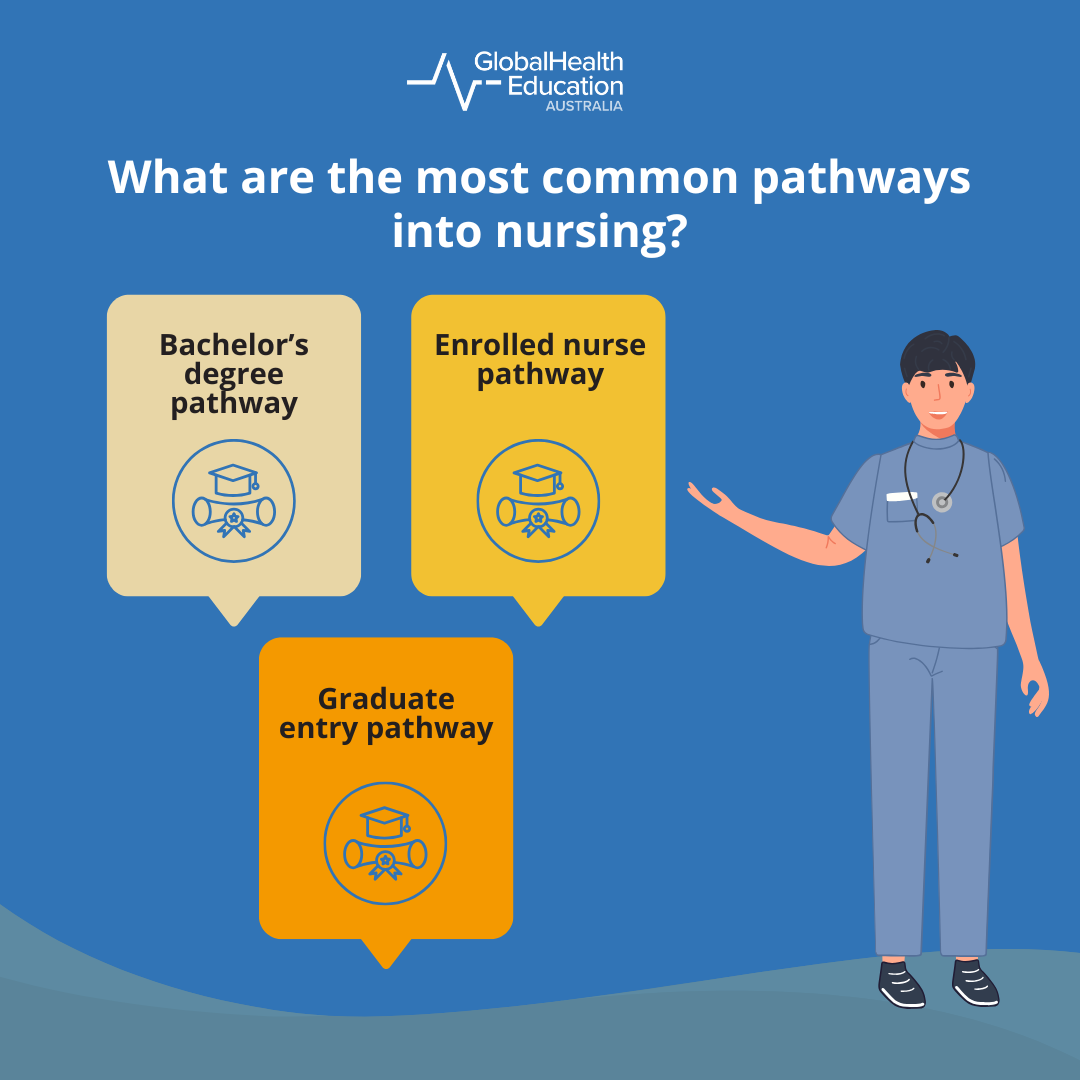
There are many ways to become a registered nurse. This field is open to people both with and without a healthcare background. Understanding your options can help you make an informed decision on what path to choose. There are study options available depending on your current qualification level and how quickly you want to enter the profession.
Here is a breakdown of the typical educational pathways into nursing:
Bachelor’s degree pathway
Completing a Bachelor of Nursing is a common route to becoming a registered nurse. These courses typically take between three and four years full-time and may be ideal for high school graduates or individuals who don’t have a university degree.
A bachelor’s degree in nursing is a comprehensive course that covers all the theoretical and practical aspects of nursing care. It includes a range of core areas of study, such as human biology, pharmacology, health assessment, interpersonal skills and evidence-based care that provide a solid foundation to your nursing practice.
You’ll also complete supervised clinical placements across many settings, such as public and private hospitals, aged care, community healthcare and rural or remote work. Obtaining your nursing qualification through a bachelor’s degree can help give you the tools and confidence to pursue clinical, leadership and educator roles and opens up opportunities to pursue postgraduate study in a field of interest or specialisation. It also meets the NMBA registration standards for nursing practice in Australia.
Enrolled nurse pathway
Enrolled nurses can continue their study journey to become registered nurses (RN) through the EN to RN pathway. Many universities provide an accelerated bachelor’s degree option for enrolled nurses, which recognises their prior studies and experience and builds upon their Diploma of Nursing qualification. These accelerated nursing courses typically take around two years to complete full-time, which is a shorter timeframe than most standard Bachelor of Nursing undergraduate degrees.
Diploma of Nursing courses are offered through TAFE and other approved registered training organisations (RTOs) and take between 18 months and up to two years to complete full time. Enrolled nurses have experience in the field, which may be beneficial to them in the long run when pursuing the additional RN qualification. They have developed important skills and experience working across different healthcare environments, which can help them confidently move into a career as a registered nurse. The accelerated nursing bachelor’s degrees also meet the NMBA requirements to practice as a registered nurse.
Graduate entry pathway
The graduate entry pathway is the quickest route into nursing for degree holders. If you hold a bachelor’s degree in any discipline, you can expedite your nursing qualification through a Master of Nursing (Graduate Entry) program. These courses are designed to condense the necessary theoretical and clinical components of nursing education into a shorter two-year commitment of full-time study.
For example, the University of Canberra Master of Nursing Practice (Graduate Entry) course is available to students with any undergraduate degree completed within the last 10 years who are looking to change careers and become a registered nurse. This two-year course is flexible, offering intensive blocks of theoretical subjects and immersive clinical placements.
A unique feature of this graduate entry program is the learning experience gained via a simulated clinical environment. Here, students have the opportunity to refine their skills through role-play, utilising simulation trainers and with emerging technology such as AI and VR training. You’ll be equipped with the skills and knowledge to be a dynamic, evidence-based practitioner.


Prepare for registered nursing practice through clinical learning, simulation and evidence-based study, with 800 hours of clinical practice across diverse healthcare settings.
Several other Australian universities offer nursing graduate entry programs to help you become a registered nurse in just two years, including:
- Edith Cowan University – Master of Nursing (Graduate Entry)
- Southern Cross University – Master of Nursing
- (Graduate Entry) University of Queensland – Master of Nursing (Graduate Entry)
These postgraduate degrees focus on clinical practice, research and practical learning. You can apply for entry if you have a health-related bachelor’s degree or if your degree is from a different field entirely. Most Master of Nursing (Graduate Entry) courses require the completion of a tertiary-level unit in human biology, anatomy or physiology. Check each course page for the specific entry requirements.
A graduate entry program leverages your existing skills and knowledge, allowing you to focus on your goal of becoming a registered nurse. With a prior degree, you bring demonstrated critical thinking, research and academic writing skills, as well as a wealth of experience from your previous career.
Once you complete a graduate entry program, you'll have the same qualification as someone who has completed a lengthier bachelor’s degree in nursing, allowing you to apply for registration with the NMBA and practice as a registered nurse.
It’s also possible to pursue an accelerated bachelor's degree as an alternative pathway into nursing if you hold a previous health-related degree. In general, undertaking this pathway ensures you can become a registered nurse in two years if completed full time.
What financial support options apply to each nursing pathway?
No matter the study pathway you take into nursing, there is financial support available to make the cost of taking on your studies easier.
Commonwealth support places (CSP)
Most undergraduate degrees, including Bachelor of Nursing degrees, are offered as a CSP, which means the government pays a portion of the tuition fees directly to the tertiary education provider and you pay the remaining student contribution amount.
CSPs are also available for postgraduate courses, but are far more limited than at the undergraduate level. Most government funding is directed toward undergraduate programs, leaving fewer subsidised postgraduate places. Postgraduate CSP availability varies each year and depends on government funding priorities and whether the course aligns with national skills needs or workforce shortages. This often includes nursing and applies to the Master of Nursing Practice (Graduate Entry) at the University of Canberra, which is currently a CSP course.
CSPs are a government subsidy rather than a loan, which means you don’t need to repay the subsidised amount. Enrolling in a CSP course is an ideal way to reduce the overall cost of your tuition and can take some of the financial pressure away from taking on your studies.
Read more about eligibility for CSPs relevant to postgraduate healthcare degrees in our comprehensive guide here.
Higher education loan schemes (HECS-HELP and FEE-HELP)
HECS-HELP and FEE-HELP are loan schemes designed to help students defer their tuition fees, reducing the upfront costs of taking on or returning to tertiary study. These apply to bachelor's degrees and master’s degrees, including Master of Nursing (Graduate Entry) programs.
HECS-HELP is a loan scheme for eligible CSP students that allows them to defer their student contribution amount. This loan is repayable through the tax system once your income reaches a certain threshold, which also means there is no immediate cost to you upon enrolling in your degree.
FEE-HELP is a loan scheme for students who have enrolled in a full-fee paying course at a university and want to defer their tuition costs. This loan covers the full amount of your tuition and is also repayable through the tax system upon a certain threshold. Similar to the HECS-HELP loan arrangement, there is no immediate cost involved when taking on your degree.
To find out more about higher education loan schemes, read our in-depth guide here.
Scholarships
There are various undergraduate and postgraduate nursing scholarships available from universities, government health departments and external organisations in Australia. These may range from supporting rural and remote placements, merit-based academic scholarship and promoting women in the nursing workforce. A scholarship can totally or partially cover the cost of your tuition or you can receive funds to cover study-related costs that are relevant to your degree.
GlobalHealth Education’s Healthcare Education Scholarship supports Aboriginal and Torres Strait Islander students undertaking tertiary studies with a grant of $5,000 to use towards the costs of course fees, study materials and travel. To learn more about the application process, submission deadlines and to find out if you’re eligible, read more here.
Commonwealth Prac Payment
The Commonwealth Prac Payment is a grant from the government paid to eligible Diploma of Nursing, Bachelor of Nursing and Master of Nursing students. This payment is made in instalments to help cover the costs related to undertaking practical placements as part of your nursing course.
Students who are eligible can receive $338.60 per week throughout the duration of their placements, benchmarked to the single Austudy rate on 1 January each year. This payment is designed to help offset the loss of income as a result of completing your placements. It can be used to cover different living costs, such as travel, uniforms, food, accommodation and living expenses.
Other financial support options
If you’re taking the enrolled nurse route to become an EN and later become an RN, you may be eligible for a VET student loan (VSL). These loans cover tuition fees for diploma-level VET courses, inclusive of the Diploma of Nursing.
A VSL is similar to a higher education loan, where the government pays the loan amount to your RTO and you incur a debt that’s repayable through the tax system once your income reaches a certain threshold. VSLs may not cover the total course fees, and as such, you may still need to pay a gap amount. It’s important to check directly with your TAFE or approved RTO for current course prices and your eligibility.
Several Australian states offer fee-free TAFE for nursing, which covers the Diploma of Nursing. While the specific eligibility criteria may vary between regions, in general, tuition fees are covered by the relevant state health department, while study materials are not covered.
How do I apply for these financial support schemes?
Your university or course provider will have all the relevant information and application guidelines specific to your chosen nursing course. For the most up-to-date information, contact them directly to discuss your options and eligibility.
Benefits of pursuing a faster pathway into nursing
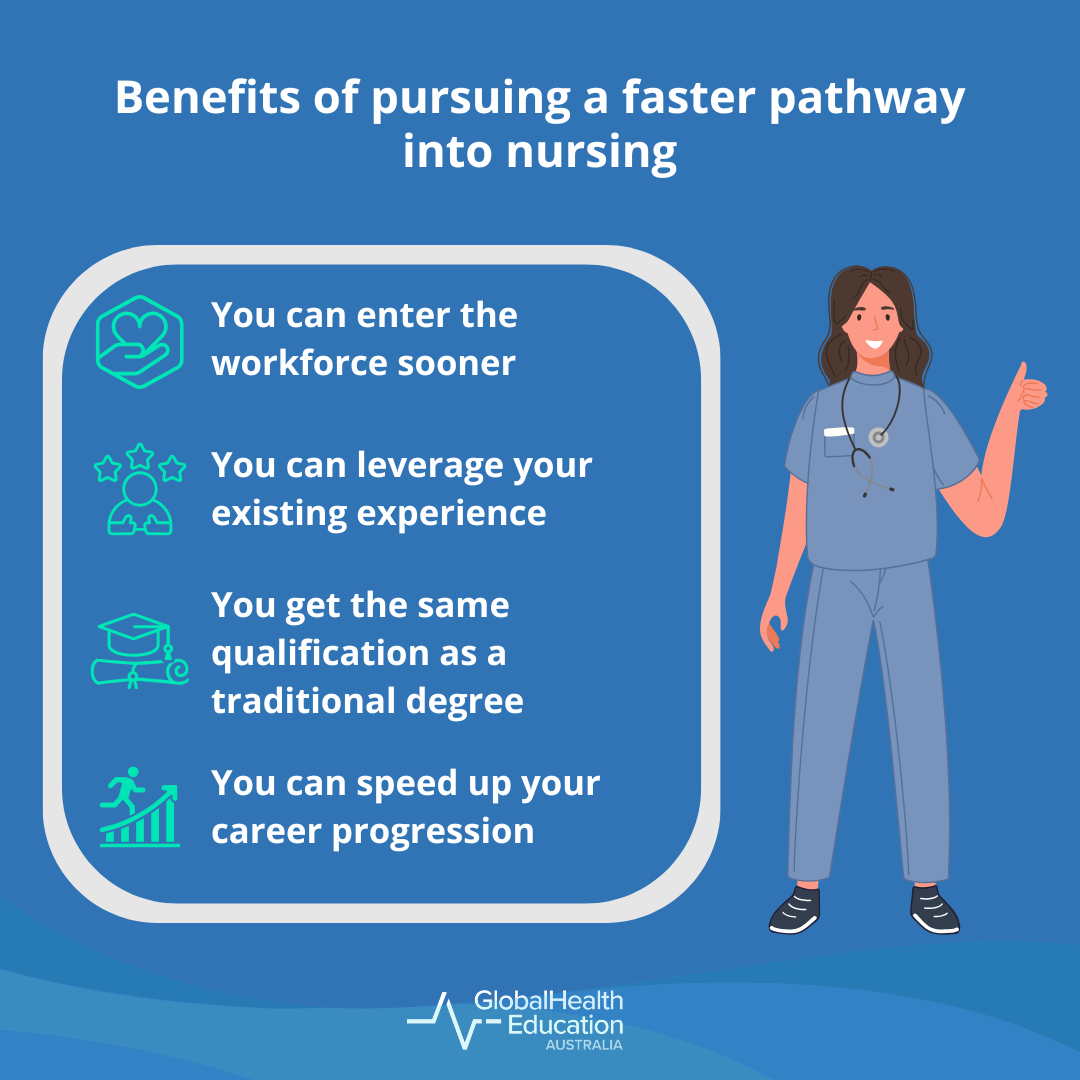
Here are some reasons why opting for a fast-track path into nursing might suit you:
You can enter the workforce sooner
One obvious reason to choose a quicker path into nursing is that you can enter the nursing workforce sooner. You can begin work as a registered nurse a full year earlier than if you were to have completed a three-year bachelor’s degree. Transitioning into the nursing workforce sooner also means you can start making a difference in the lives of patients, which is a rewarding aspect of the job. You can also start earning a nursing salary earlier, helping you to build a financially stable future. Nursing salaries are generally reliable, with registered nurses earning an average of approximately $90,000 annually and opportunities for higher earning potential as you advance your career.
You can leverage your existing experience
If you pursue a graduate-entry course or accelerated degree, you will be able to bring your existing skill set from another field into this sector. Your previous soft skills add value to your future role and can be applied directly to nursing practice. These may include leadership, effective communication, critical thinking, problem-solving, teamwork or adaptability. You may also have a range of demonstrable hard skills, such as data analysis and digital literacy, that will help you feel equipped for an evolving role in healthcare in the future.
During your studies, you may be in a cohort of peers who are mature-age students, healthcare providers or professionals from other disciplines. Each person brings diverse life and career experiences into their virtual and in-person study environment, which helps create a rich and dynamic learning experience for everyone.
You get the same qualification as a traditional degree
Another advantage of completing a fast-track nursing course is that the qualification you earn meets the same professional registration requirements as more traditional, longer nursing degrees. Master of Nursing (Graduate Entry) programs, as well as accelerated options, are specifically developed to align with the NMBA nursing registration standards that are matched to those who become nurses via the bachelor’s degree pathway.
You gain the same credentials, can work within the same scope of practice, are recognised internationally and have the same career opportunities as registered nurses who have taken the traditional route, just in less time. Obtaining a master’s degree may also look good on your resume or CV and position you more favourably for future leadership positions or specialised clinical roles.
You can speed up your career progression
Completing an accelerated degree or a Master of Nursing (Graduate Entry) program means you can gain necessary hands-on clinical experience faster, which can help your career in the long term. You may be an earlier candidate for advanced, senior or leadership roles, such as a clinical nurse educator, clinical nurse specialist or nurse unit manager. You may also choose to pursue further study and move into a nursing specialisation, such as critical care, mental health, paediatric nursing or perioperative nursing. No matter your career goals, a faster study pathway helps you get there by giving you a head start on both experience and professional development.
Tips on choosing which faster nursing pathway is right for you
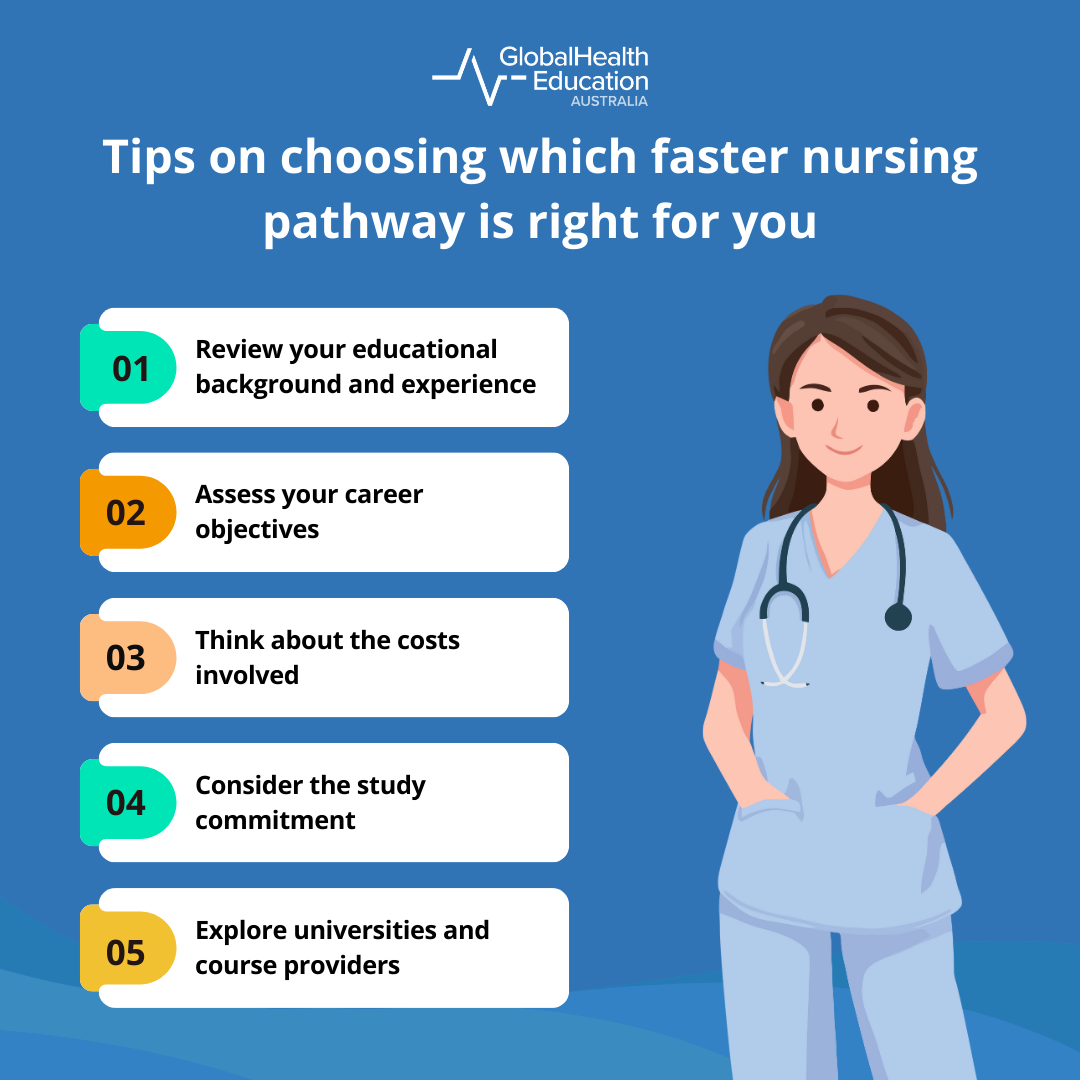
Here are some things to keep in mind when comparing your options and deciding which pathway into nursing you should choose:
-
Review your educational background and experience
A good place to begin when it comes to determining the best path for you is to know your current education status and experience level. This will help you narrow down your options.If you have an undergraduate degree in a healthcare field or other discipline, consider the Master of Nursing (Graduate Entry) pathway to utilise your prior education and career experience. This pathway is designed for career-changers and condenses the core nursing curriculum into a shorter timeframe.
If you are a recent high school leaver or do not have a tertiary degree, a Bachelor of Nursing is one direct path to becoming a registered nurse and might be a more suitable option. If you're looking for a faster entry into the workforce, a Diploma of Nursing to become an EN initially, with the goal of continuing on in your studies to become an RN, might be a good starting point.
-
Assess your career objectives
Begin to think about where you see yourself in the future. Do you want to hone your clinical expertise as a registered nurse, refine your practice and work toward a leadership position? Or do you want to utilise your experience, bring a fresh perspective to nursing and add value to your new career path?A diploma-level or undergraduate qualification is ideal for guiding you into the nursing field as you orient yourself with the role, build important skills and explore various niche areas. As you acquire nursing experience, you’re likely to be well-positioned to pursue senior or specialised roles in a practice area that you enjoy. A postgraduate course can help open doors to more senior or specialised roles.
Entering the nursing workforce at the postgraduate level means you can bring a unique set of skills that allow you to approach patient care with a broader perspective. In the field, you’ll be able to draw on real-world experience that helps you identify novel solutions to problems in clinical settings. Moreover, as you take on your studies, you’ll begin to connect with like-minded peers, mentors and industry experts. These relationships can help build your professional network, which supports career growth and collaborative opportunities in the future.
-
Think about the costs involved
The cost of nursing education can vary significantly between courses and institutions. It can help to do your own research and compare tuition fees and the various financial support options that might be available to you. One way to get started is by exploring our nursing course catalogue.Find out whether the course you’re interested in is a CSP course, look into scholarships and grants and check your eligibility for government-funded loan schemes. Don’t forget to account for the costs associated with studying, independent of your course fees. These may include books, laptops, study materials, travel and other expenses. Rest assured, there are plenty of ways to alleviate the financial strain of taking on further study to make your way into nursing.
-
Consider the study commitment
The fastest way to become a registered nurse depends entirely on your current situation, previous education and future goals. At a minimum, you can expect to commit to two years of full-time study to become qualified as an RN. This applies in general to Master of Nursing (Graduate Entry) programs and accelerated nursing courses. Part-time options may be available, but will extend the duration of the course and therefore take longer to become qualified. It’s important to select a course that aligns with your lifestyle as well as your personal and professional needs. -
Explore universities and course providers
Lastly, it’s vital to research and compare different universities based on their curricula, facilities, graduate output and academic reputation. You may also be interested in the culture and student life at various institutions, which can help give you a positive overall educational experience.Understand whether the course you’re interested in has flexible learning options, such as multiple yearly intakes, online units or a blended teaching model. It can also help to look into the quality and variety of their clinical placement opportunities. Your placements can help you build confidence and are the first exposure to clinical environments that help shape the future nurse you’ll become. Strong partnerships with hospitals and healthcare facilities will provide you with diverse, real-world training.
It’s also worth looking into the support services available at your chosen institution. Having the right support in place can make a big difference to both your success and your overall wellbeing while you study.
Fast-track your nursing career today
There are many ways to become a registered nurse and understanding the course options and pathways can help you determine which direction to take. Nursing is a career that offers immense personal and professional rewards. If you are ready to make the leap, remember, you don't have to take the long road.
You can leverage your existing qualifications through the University of Canberra’s Master of Nursing (Graduate Entry) program, or equivalent, which helps you fast-track your entry into this dynamic field and start your nursing career with confidence.
GlobalHealth Education partners with reputable Australian universities to offer postgraduate healthcare courses in various fields. Explore the extensive range of postgraduate healthcare courses beyond nursing, including health leadership and management, counselling, psychology, public health, social work, mental health and more.
Narrowing down your study options can be difficult, but you don’t have to do it alone. If you’d like personalised advice on what courses would be most suitable to you, book a free professional development strategy call with our Education Consultant, Catriona. She can help remove the overwhelm and clarify your next steps so that you can enter nursing sooner.