In This Article
- What is a qualification allowance?
- How are qualification allowances calculated?
- Who is eligible for a qualification allowance and who isn’t?
- Which postgraduate nursing qualifications are eligible for qualification allowances?
- Overview of nurse qualification allowance rates by state and territory
- Qualification allowance rates by state and territory
- Which state or territory has the highest qualification allowance for registered nurses?
- Which state or territory has the lowest qualification allowance for registered nurses?
- How to claim a qualification allowance (step-by-step)
- Frequently asked questions about qualification allowances
- Boost your income with a postgraduate nursing qualification

Why trust GlobalHealth Education?
-
Our in-house editorial team and healthcare advisors write and review our content.
-
The information in our content provides clarity and insights to help you compare courses.
-
We list postgraduate courses from 25+ respected and reputable institutions in Australia.

While completing a postgraduate nursing qualification can advance your skills and career, it could also come with a financial reward in the form of a qualification allowance. Though it depends on the state or territory you work in and the qualification you’ve completed, a qualification allowance could boost your income by $4,500 or more annually.
In this comprehensive guide, we’ve taken a look at each of the nursing and midwifery public sector enterprise agreements and compiled each state and territory’s qualification allowance rates. We’ve also put together a step-by-step guide to claiming your qualification allowance and answered some frequently asked questions.
What is a qualification allowance?
While the exact definition of a qualification allowance differs between each state and territory, it generally refers to an ongoing payment added to a nurse’s salary for completing a relevant qualification beyond their base nursing qualification. Most commonly referred to as a qualification allowance, the terminology does differ slightly between states and territories, with New South Wales referring to it as a continuing education allowance and Tasmania and Northern Territory referring to it as a postgraduate allowance.
The amount you receive will vary depending on the state or territory you work in, as it is determined by the conditions set out in each jurisdiction’s public sector enterprise agreement. Qualification allowance amounts and conditions also differ between public and private hospitals. For the purposes of this article, we’ll be focusing on the qualification allowances outlined in public sector enterprise agreements.
How are qualification allowances calculated?
How a qualification allowance is calculated differs depending on the state and territory. In Victoria and New South Wales, for example, qualification allowances are fixed tiered amounts based on the qualification you have completed. Whereas in Tasmania, qualification allowances are calculated as a set percentage of your salary.
The table below provides an overview of how qualification allowances are calculated in each state and territory.
| State or territory | Calculation method |
| Victoria | Fixed tiered amount based on qualification |
| New South Wales | Fixed tiered amount based on qualification |
| Tasmania | Set percentage of the employee’s own salary |
| Western Australia | Set percentage of a fixed reference salary point |
| Australian Capital Territory | Set percentage of a fixed reference salary point |
| South Australia | Set percentage of a fixed reference salary point |
| Queensland | Set percentage of a fixed reference salary point |
| Northern Territory | Set percentage of a fixed reference salary point |
Read on to see how these calculation methods determine qualification allowances in each state and territory.
Who is eligible for a qualification allowance and who isn’t?
The eligibility criteria for a qualification allowance differs slightly between states and territories. Typically, however, the following conditions need to be met:
- You need to have completed a qualification that is relevant to your area of work. Relevance is typically assessed based on your current area of practice and whether the qualification assists you in performing your duties
- You are employed on a full-time or part-time basis. Though some states, such as Victoria, also extend the allowance to casual employees on a pro rata basis
There are some circumstances (which can differ between states and territories), where you may not be eligible for a qualification allowance. These include:
- If your qualification is deemed not relevant to your area of work
- If you have not provided evidence within the required timeframe. In New South Wales, for instance, nurses must provide evidence of their qualification to their employer within three months of completing the course or within three months of commencing work in a relevant specialty
- If you’ve completed short intensive courses or individual modules
- If you’ve completed a qualification that is required for registration. In South Australia, for instance, you’re not eligible for a qualification allowance if the qualification you completed is required for registration or enrolment
Which postgraduate nursing qualifications are eligible for qualification allowances?
The types of eligible qualifications vary between states and territories. Typically, however, the following qualifications (provided they are relevant to your area of practice) are eligible for qualification allowances.
Graduate certificate
While most states and territories require a graduate certificate to be awarded by a recognised university, some also accept equivalent qualifications from other providers.
In Victoria, for example, certificates obtained from a training or education facilities provider are also eligible, provided the course is equivalent to a university graduate certificate and the provider has verified that in writing. States such as New South Wales, South Australia and Western Australia also accept certain hospital-based or post-registration hospital certificates.
If you’re looking to pursue a graduate certificate, examples of eligible courses include:
- Graduate Certificate of Mental Health Nursing at Southern Cross University
- Graduate Certificate in Critical Care at the University of Technology Sydney
- Graduate Certificate in Palliative Care at the University of Technology Sydney
- Graduate Certificate in Clinical Nursing at the University of Notre Dame Australia
Graduate diploma
Your graduate diploma must be awarded by a recognised university or other agreed education provider. Examples of eligible graduate diplomas include:
- Graduate Diploma in Mental Health Nursing at Victoria University
- Graduate Diploma of Health (Child and Family Health Nursing) at Federation University
- Graduate Diploma of Advanced Nursing (Perioperative Nursing) at the University of Tasmania
- Graduate Diploma of Nursing (Gerontology) at the University of Southern Queensland
Master’s degree / doctoral degree / PhD
Must be a recognised master’s degree, doctoral degree or PhD that is relevant to your area of nursing, position or role.
Examples of eligible master’s courses include:
- Master of Nursing Majoring in Education at James Cook University
- Master of Advanced Practice (Acute Care Nursing) at Curtin University
- Master of Nursing (Paediatric and Adolescent Nursing) at Queensland University of Technology
- Master of Advanced Nursing Practice (Emergency Nursing) at Griffith University
Some states and territories may also accept a base qualification, also known as an entry-level qualification, which is the minimum educational requirement needed to register as a nurse. In Victoria, for example, nurses who have a double degree or master’s degree as their base qualification are eligible, but only after they’ve gained at least one year of experience in an area where the qualification is relevant.
If you’re thinking of pursuing a postgraduate nursing qualification and are unsure of which nursing degree level to pursue, take our quiz to discover which nursing degree level may suit you best.
Overview of nurse qualification allowance rates by state and territory
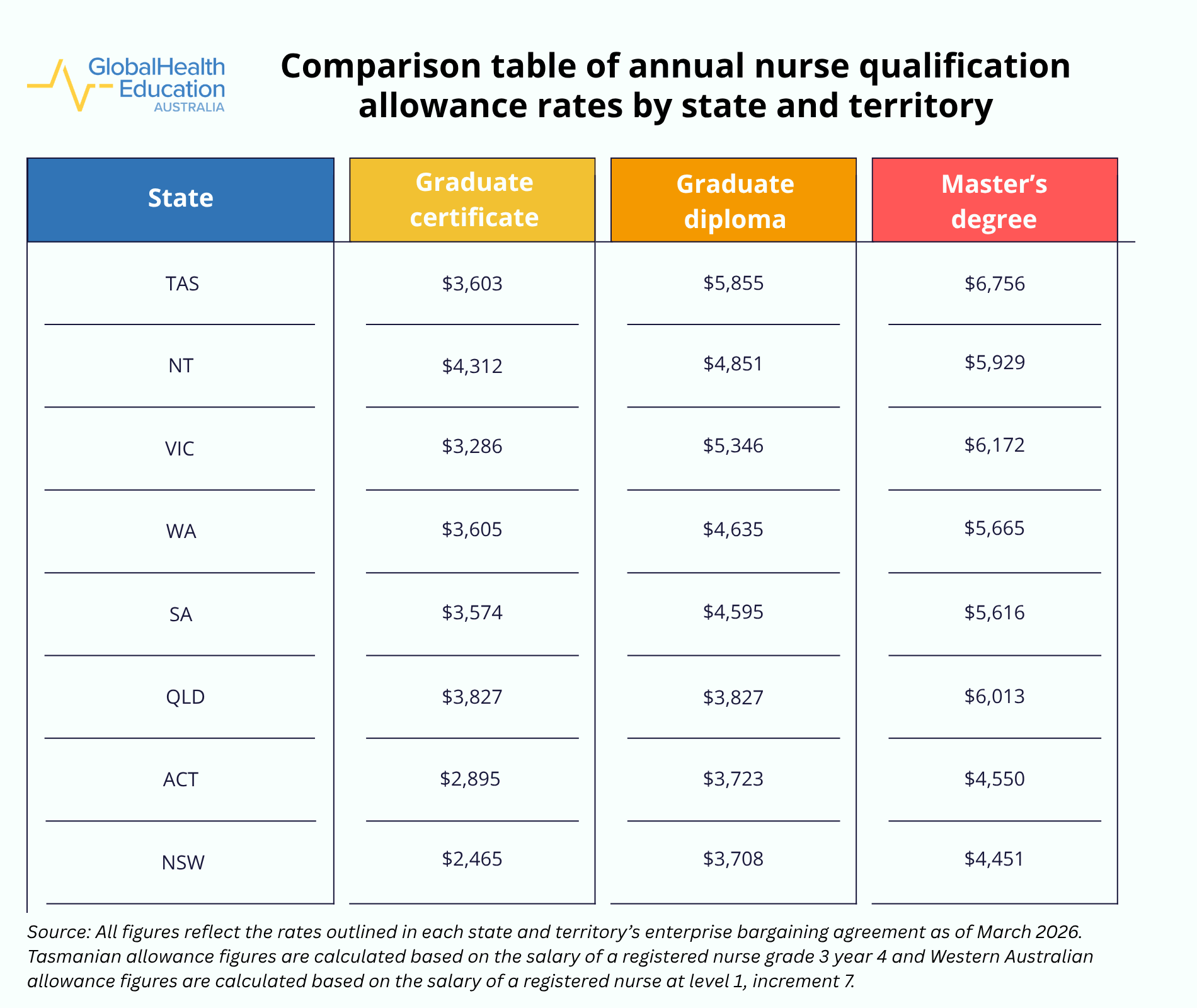
Qualification allowance rates by state and territory
These qualification allowance rates are based on what’s mentioned in each state or territory’s public sector enterprise agreements. If you’re working in the private sector, qualification allowances vary, so you’ll need to consult your workplace’s enterprise agreement for further details.
Disclaimer: While every effort has been made to ensure that qualification allowance rates are accurate and up to date, no guarantee is given, nor responsibility taken, for variations or discrepancies.
Victoria
Qualification allowances in Victoria are fixed tiered amounts based on the qualification completed.
| Qualification | From 24 November 2025 | From 11 May 2026 | From 23 November 2026 | From 1 July 2027 | From 17 April 2028 |
| Certificate IV TAE | $55.40 per week ($2,881 per annum) | $57.10 per week ($2,969 per annum) | $57.70 per week ($3,000 per annum) | $89.10 per week ($4,633 per annum) | $97.50 per week ($5,070 per annum) |
| Enrolled nurse 6-month course | $57 per week ($2,964 per annum) | $58.70 per week ($3,052 per annum) | $59.30 per week ($3,084 per annum) | $91.70 per week ($4,768 per annum) | $100.30 per week ($5,216 per annum) |
| Enrolled nurse 12-month course | $106.80 per week ($5,554 per annum) | $110.00 per week ($5,720 per annum) | $111.20 per week ($5,782 per annum) | $171.80 per week ($8,934 per annum) | $188.00 per week ($9,776 per annum) |
| Graduate certificate | $63.20 per week ($3,286 per annum) | $65.10 per week ($3,385 per annum) | $65.80 per week ($3,422 per annum) | $101.70 per week ($5,288 per annum) | $111.30 per week ($5,788 per annum) |
| Postgraduate diploma or degree | $102.80 per week ($5,346 per annum) | $105.90 per week ($5,507 per annum) | $107.00 per week ($5,564 per annum) | $165.30 per week ($8,596 per annum) | $180.90 per week ($9,407 per annum) |
| Master’s degree | $118.70 per week ($6,172 per annum) | $122.30 per week ($6,360 per annum) | $123.60 per week ($6,427 per annum) | $191 per week ($9,932 per annum) | $209 per week ($10,868 per annum) |
| PhD | $158.20 per week ($8,226 per annum) | $162.90 per week ($8,471 per annum) | $164.60 per week ($8,559 per annum) | $254.30 per week ($13,224 per annum) | $278.30 per week ($14,472 per annum) |
New South Wales
Known as the continuing education allowance, similar to Victoria, the allowance is a fixed tiered amount based on the qualification completed.
| Qualification | As of 1 July 2025 |
| Enrolled nurse certificate 4 | $34.20 per week ($1,778 per annum) |
| Enrolled nurse Advanced Diploma of Nursing | $43 per week ($2,236 per annum) |
| Post registration hospital certificate or postgraduate certificate | $47.40 per week ($2,465 per annum) |
| Postgraduate diploma or degree | $71.30 per week ($3,708 per annum) |
| Master’s degree or doctorate | $85.60 per week ($4,451 per annum) |
Tasmania
Qualification allowances in Tasmania are percentage-based increases that are calculated based on the employee’s salaried incremental point. They are also categorised into three groups – enrolled nurse, registered nurse and nurse practitioner.
For the examples below, we’ve selected a pay point from each nursing category to illustrate what the annual allowance could look like. Salaries are as per what has been published on the Tasmanian Government Department of Health website.
Enrolled nurse grade 2 year 4 ($80,524)
| Qualification | Percentage | Annual allowance |
| Relevant certificate or qualification for a course of six months or an Advanced Diploma of Nursing | 4 per cent | $3,221 |
| Relevant certificate or qualification of 12 months or more | 7.5 per cent | $6,039 |
Registered nurse grade 3 year 4 ($90,081)
| Qualification | Percentage | Annual allowance |
| Graduate certificate | 4 per cent | $3,603 |
| Postgraduate diploma or degree | 6.5 per cent | $5,855 |
| Master’s degree | 7.5 per cent | $6,756 |
| PhD or Doctorate | 10 per cent | $9,008 |
Registered nurse grade 8 level 4 ($154,301)
| Qualification | Percentage | Annual allowance |
| Graduate certificate | 4 per cent | $6,172 |
| Postgraduate diploma or degree | 6.5 per cent | $10,030 |
| Master’s degree | 7.5 per cent | $11,573 |
Western Australia
Western Australia has percentage-based increases that are calculated based on the salary of a registered nurse level 1 increment 8.
| Qualification | Percentage | Annual rate on and from 12 October 2025 | Annual rate on and from 12 October 2026 |
| Level 1 (graduate certificate) | 3.5 per cent | $3,732 | $3,943 |
| Level 2 (graduate diploma) | 4.5 per cent | $4,798 | $5,069 |
| Level 3 (Masters or PhD) | 5.5 per cent | $5,865 | $6,195 |
Australian Capital Territory
The ACT also has percentage-based increases according to study level. Qualification allowances are calculated based on the minimum point of the salary scale of either an enrolled nurse level 1 or registered nurse level 1.
| Enrolled nurse | |||
| Qualification | Percentage | Fortnightly rate from 4 December 2025 | Annual rate from 4 December 2025 |
| An enrolled nurse qualification with a course of study of no less than 6 months or 120 hours | 3.5 per cent | $101.78 | $2,646 |
| Registered nurse | |||
| Qualification | Percentage | Fortnightly rate from 4 December 2025 | Annual rate from 4 December 2025 |
| Honours degree, conversion degree or postgraduate certificate | 3.5 per cent | $111.36 | $2,895 |
| Postgraduate diploma Second degree | 4.5 per cent | $143.18 | $3,723 |
| Master’s degree or doctoral degree | 5.5 per cent | $175.00 | $4,550 |
South Australia
In South Australia, qualification allowances are only applicable for registered nurses level 1 through 4 and enrolled nurses on the diploma or advanced skills salary scale. Qualification allowances are calculated based on level 1 increment 9 for registered nurses and at the maximum increment of the enrolled nurse diploma salary scale for enrolled nurses.
| Enrolled nurse | ||
| Qualification | Percentage | Annual rate from 1 January 2025 |
| Post enrolment courses (no less than 6 months) | 3.5 per cent | $2,619 |
| Registered nurse | ||
| Hospital or graduate certificate | 3.5 per cent | $3,574 |
| Graduate diploma | 4.5 per cent | $4,595 |
| Second degree, master’s degree or PhD | 5.5 per cent | $5,616 |
Queensland
In Queensland, qualification allowances are applicable for nurses grades 5 to 7 and 9 and calculated based on the wage rate of a nurse grade 5 pay point 7. Queensland nurses who are not at the maximum pay point of their classification are also entitled to an accelerated pay point advancement benefit where obtaining a qualification or advanced qualification allows them to advance by one pay point from the date the qualification is accepted by the employer.
From 1 July 2026, enrolled nurses grade 3 to 4 will also receive a qualification allowance, calculated based on the wage rate of a nurse grade 3 pay point 5.
| Enrolled nurse | |||||
| Qualification | Percentage | From 1 July 2026 | From 1 April 2027 | From 1 December 2027 | |
| Second diploma | 3.5 per cent | $2,794 | $2,863 | $2,949 | |
| Advanced diploma or higher | 5.5 per cent | $4,390 | $4,500 | $4,635 | |
| Registered nurse | |||||
| Qualification | Percentage | From 1 April 2025 | From 1 April 2026 | From 1 April 2027 | From 1 December 2027 |
| Graduate certificate, graduate diploma, second bachelor’s | 3.5 per cent | $3,827 | $3,922 | $4,020 | $4,141 |
| Master’s or PhD | 5.5 per cent | $6,013 | $6,164 | $6,318 | $6,507 |
Northern Territory
Qualification allowances in the Northern Territory are also calculated based on specific pay points as stipulated in the table below.
| Enrolled nurse | ||
| Qualification | Allowance | Annual amount |
| Nurse 1 (enrolled nurse), course of study no less than six months or 120 hours | 4 per cent of the 5th pay point of the nurse 1 classification | $3,227 |
| Registered nurse | ||
| Conversion degree or graduate certificate | 4 per cent of the maximum pay point of the nurse 2 classification | $4,312 |
| Graduate diploma | 4.5 per cent of the maximum pay point of the nurse 2 classification | $4,851 |
| Master’s degree or doctorate | 5.5 per cent of the maximum pay point of the nurse 2 classification | $5,929 |
Which state or territory has the highest qualification allowance for registered nurses?
As of March 2026, Tasmania has the highest qualification allowance, with a registered nurse earning $90,081 annually receiving an additional $5,855 for a graduate diploma and $6,756 for a master’s degree, the highest of all states and territories. As Tasmania calculates qualification allowances based on the employee’s own salary rather than a fixed reference point, nurses who earn more will receive a higher allowance.
While Tasmania currently holds the top position, with the Northern Territory in second place and Victoria in third, that is poised to change with Victoria’s qualification allowances increasing by a further 50 per cent from 1 July 2027 and a total of 92 per cent by 2028. To put things in perspective, by 17 April 2028, Victorian registered nurses will receive $10,868 per annum for completing a master’s degree, $4,696 more than what they currently receive in March 2026.
Which state or territory has the lowest qualification allowance for registered nurses?
Currently, New South Wales has the lowest qualification allowance for registered nurses, with nurses receiving $2,465 per annum for a graduate certificate, $3,708 for a postgraduate diploma and $4,451 for a master’s degree. In comparison, Tasmanian nurses receive approximately 46 per cent more for a graduate certificate, 58 per cent more for a postgraduate diploma and 52 per cent more for a master’s degree.
Currently, the NSW Nurses and Midwives’ Association has submitted a special case to the NSW Industrial Relations Commission seeking a pay increase. If approved, this may also result in higher qualification allowance rates for NSW nurses.
How to claim a qualification allowance (step-by-step)
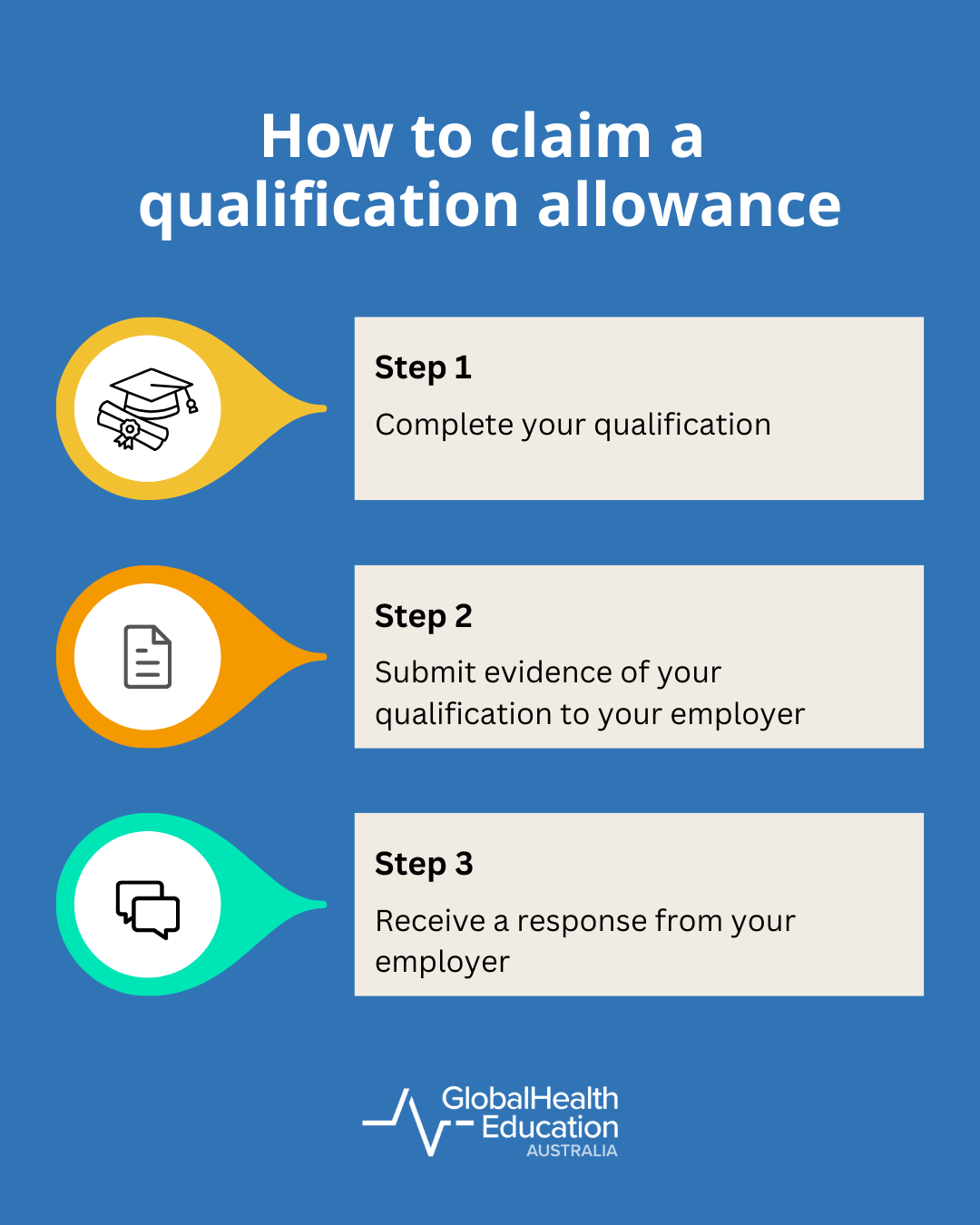
- Completing your qualification
You’ll first need to complete a postgraduate qualification that is relevant to your area of practice. As each state and territory has its own conditions around what does or doesn’t constitute as an eligible qualification, it’s worth checking the corresponding enterprise agreement before proceeding. Submitting evidence of your qualification to your employer
Once you’ve completed your qualification, the next step is to provide your employer with the relevant documentation. This may include your award, certificate or transcript from your education or training provider. The documentation required can differ between states and territories, so it’s best to refer to the enterprise agreement for specifics.Some states and territories also have official forms for this process. In Western Australia, for example, nurses are required to submit an electronic ANF qualification allowance form accompanied by their base qualification certificate or testamur, their postgraduate qualification certificate or testamur and their postgraduate academic transcript.
Receiving a response from your employer
Once you’ve submitted your evidence, your employer will review the documentation and respond accordingly. Timeframes may differ between states and territories, but in Victoria, for example, employees are required to provide a written response within 28 days.If approved
If approved, your documentation will be forwarded to payroll and your qualification allowance will be added to your salary and paid on an ongoing basis, typically fortnightly.If not approved
If your request has been rejected and you wish to challenge the decision, most enterprise agreements outline a formal dispute or appeals process. In the ACT, for instance, nurses can lodge a request for review with the qualifications committee.
Frequently asked questions about qualification allowances
Have further questions about qualification allowances? Here are answers to some of the most commonly asked questions:
Do I get the qualification allowance if I’m part-time or casual?
It depends on the state or territory you work in. Most states and territories only offer qualification allowances to full-time and part-time employees, with part-time employees receiving the allowance on a pro rata basis. Victoria is one of the few states that extends the allowance to casual employees. If you’re unsure whether you’re eligible, it’s best to refer to the enterprise agreement.
Can I claim more than one qualification allowance?
In most cases, no. If you hold multiple qualifications, most enterprise agreements stipulate that you will only receive an allowance for the highest qualification you hold.
How is the qualification allowance paid?
The qualification allowance is typically added to your salary and paid on a fortnightly basis.
Does the course need to be relevant to my role?
Yes, while the specific criteria for what’s relevant varies between states and territories, at a minimum, your qualification will need to be relevant to your area of practice and position. The enterprise agreement will outline what constitutes as relevant in your state or territory.
Is the qualification allowance taxed?
Yes, as the qualification allowance is added to your income, it is considered taxable income in Australia and will be taxed accordingly.
What happens if I’m transferred, promoted or moved to a different position?
This depends on the conditions outlined in your enterprise agreement. In Western Australia, for instance, if you accept a transfer, appointment or promotion within the WA health system, your qualification allowance will cease unless your qualification remains relevant to your new practice, position or role.
In Victoria, on the other hand, if you are relocated by your employer due to reasons such as travelling, relocation or if you’re moved to another ward, unit or department that is not your base ward, you’ll still continue to receive the qualification allowance.
Is the qualification allowance paid during leave?
Yes, your qualification allowance is typically payable during periods of paid leave, though it may come with certain conditions. In Victoria, for instance, the allowance will not be paid for registered nurses on sick leave beyond 21 days in any 12-month period and long service leave. In the Northern Territory, the qualification allowance will not be paid during leave without pay or during periods of leave which have not been authorised.
What if I obtained my qualification overseas?
It depends on the state or territory. In Western Australia, for instance, overseas qualifications may be assessed against the Australian Qualifications Framework (AQF) and may be eligible, provided the qualification is a post-registration clinical qualification equivalent to AQF level 8 or above and accepted by your employer as relevant to your practice, position or role. If you hold an overseas qualification, it’s best to check with your employer or consult with the enterprise agreement for guidance on how it would be assessed.
Boost your income with a postgraduate nursing qualification
Pursuing a postgraduate nursing qualification is one of the most rewarding investments you can make in your nursing career. While you’ll gain a breadth of skills and knowledge and open doors to new career opportunities, you may also boost your income with a qualification allowance.
If you’re keen on getting started, take a look at the extensive range of postgraduate nursing courses available from reputable Australian universities on the GlobalHealth Education catalogue. There are also numerous postgraduate nursing courses that offer a Commonwealth supported place (CSP), allowing you to upskill at a reduced cost.
If you’re unsure of which postgraduate nursing course is the right fit for you, our Education Consultant, Catriona, is here to help. Having guided countless individuals through the process of finding the right qualification for their career goals, Catriona can answer your questions and work with you to put together a practical plan tailored to your needs. If you’re ready to take the next step, book a complimentary professional development strategy call with her today.