In This Article
- What is the hidden curriculum?
- Why is the hidden curriculum important for postgraduate healthcare professionals?
- Hidden curriculum lessons: how your postgraduate course helps shape you as a healthcare professional
- The shadow side of the hidden curriculum in healthcare
- How to integrate the hidden curriculum lessons into your healthcare role
- Expand your skills and yourself with postgraduate study

Why trust GlobalHealth Education?
-
Our in-house editorial team and healthcare advisors write and review our content.
-
The information in our content provides clarity and insights to help you compare courses.
-
We list postgraduate courses from 25+ respected and reputable institutions in Australia.
2026 If you’re thinking of stepping into postgraduate healthcare study, there may be some clear reasons why it’s on your mind.
You may want to deepen your expertise, expand your scope of practice, strengthen your clinical skills or increase your chances of pursuing leadership or advanced roles. Importantly, upon the completion of your course, you’ll have more credibility, additional knowledge and a qualification to showcase your efforts.
However, something else takes shape between the formal course curriculum, assessments and placements. There is a subtle layer of learning that can’t be found in your coursework. This is what’s known as the hidden curriculum, and in postgraduate healthcare study, these lessons manifest in various ways and stay with you long after you graduate.
In this article, you’ll gain an understanding of what the hidden curriculum is and how it affects who you are as a health professional. You’ll learn about some of the positive and other potentially negative aspects of the hidden curriculum that can arise as part of your study journey. You’ll also discover how you can apply these lessons in your healthcare role.
What is the hidden curriculum?
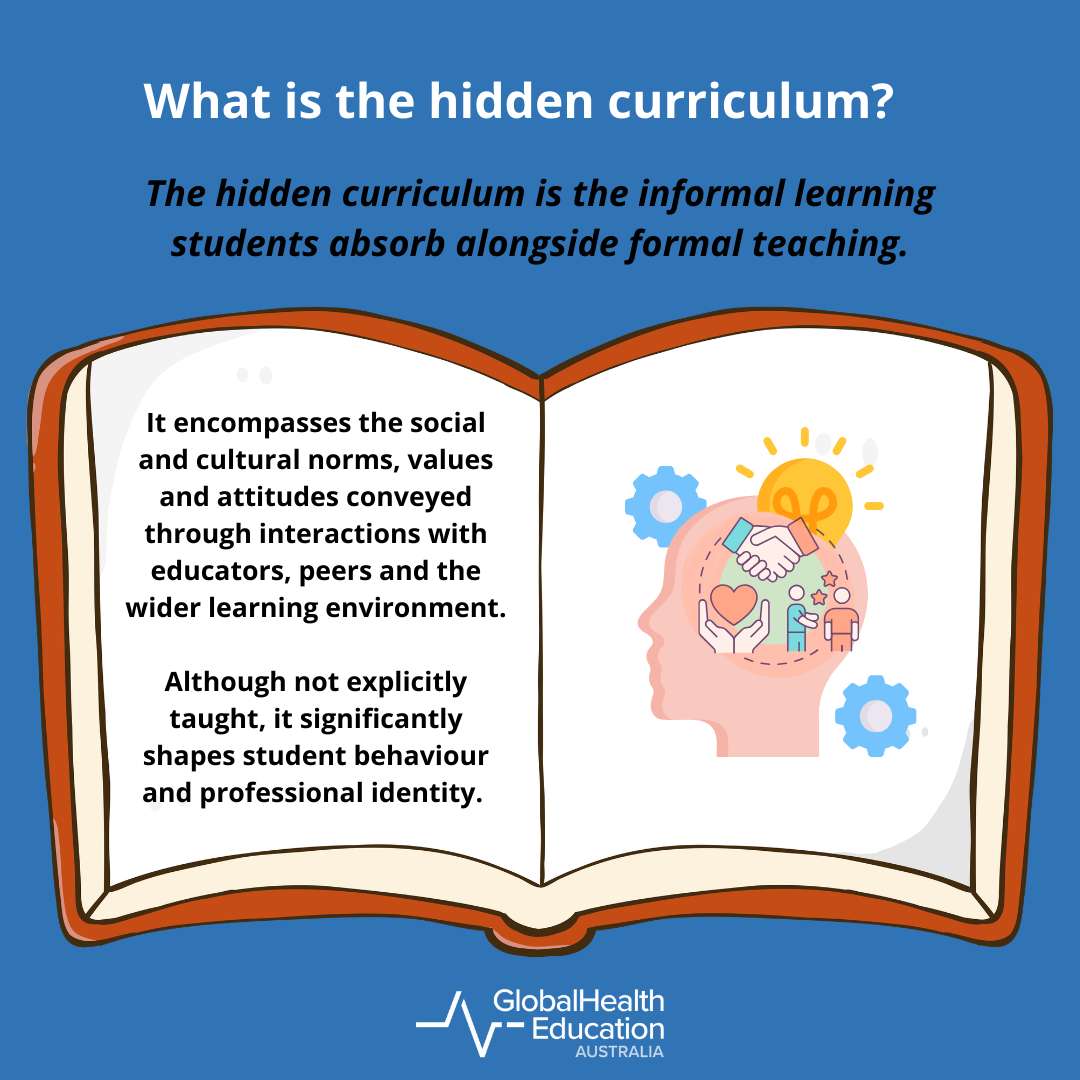
The hidden curriculum refers to the unintentional, informal and often passive lessons students absorb alongside formal education. Through everyday interactions and the learning environment, students pick up values, behaviours, attitudes and social norms. These lessons shape how students think, act and understand their place within systems. The hidden curriculum can sometimes be more influential than the formalised course content.
This phenomenon occurs in all manner of formal education, from primary school through to higher education. The following are examples of the hidden curriculum in action within a university setting:
Time and punctuality: A student observes that arriving late is frowned upon and those who are punctual are seen as more responsible. They learn the importance of time management and reliability without this being formally taught.
Working with authority figures: Students observe that openly questioning tutors and lecturers may sometimes be discouraged, while thoughtful input and respectful contributions are encouraged. They learn how to navigate authority, when to speak up appropriately and how to show respect within hierarchical structures.
Collaboration and competition: In group work, a student sees that those who take initiative, lead discussions and involve other team members are more recognised and often praised by tutors and lecturers. They learn that teamwork involves a combination of participation, leadership and negotiation skills, through the positive reinforcement offered by teachers or academic staff.
The lessons students pick up indirectly will depend on the culture, expectations and social dynamics of their environment, as well as the behaviours and values demonstrated by the people around them.
Why is the hidden curriculum important for postgraduate healthcare professionals?
The hidden curriculum in postgraduate healthcare education is important because it supports the transition from being broadly proficient to becoming a reflective, resilient healthcare professional. It shapes how you communicate, make decisions and behave in clinical environments. The implicit knowledge gained through your studies can be instrumental in shaping how effectively you provide care, work in teams and progress in your career – just as much as the skills gained in your formal coursework.
If you have a healthcare background, you’ve likely moved through the preparatory pangs of imposter syndrome as you found your groove in your role. You’ve no doubt travelled up (or down) some steep learning curves as you’ve applied your skills in your career so far. However messy it has looked up until now, and whether you’ve come from nursing, social work, allied health or another area, you’ve established yourself as a contributing professional in your field.
As you consider the idea of taking on postgraduate study, there’s a part of you that’s ready to challenge yourself, expand your scope and see what’s possible for your future. By the end of your studies, a new version of you will emerge – someone who has gained new soft and hard skills, a broader critical thinking capacity and a stronger, renewed identity to carry into your career.
Hidden curriculum lessons: how your postgraduate course helps shape you as a healthcare professional
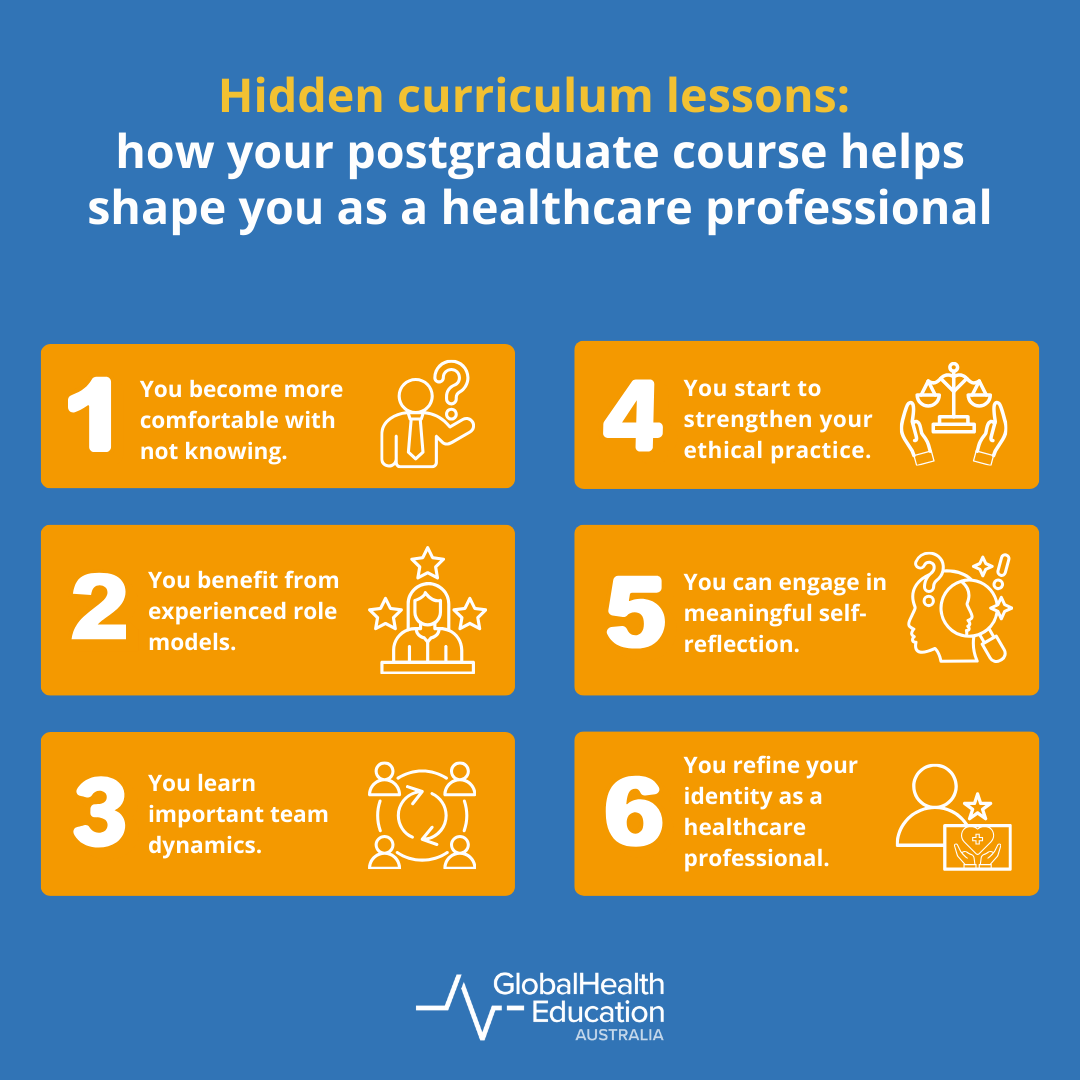
Here are some hidden curriculum examples and valuable lessons you can gain from your postgraduate healthcare studies:
1. You become more comfortable with not knowing
There is often a lot of pressure placed on healthcare professionals to know it all and to have all the answers. Acknowledging that you don’t know everything, and perhaps that’s okay, is one of the unspoken lessons gained through the postgraduate hidden curriculum.
It's also akin to another phenomenon, known as the Dunning-Kruger effect, which highlights that as expertise grows, people realise how much there is to know and become more aware of what they still need to learn. It becomes evident, then, that as a healthcare professional, you realise there’s always something to learn or a skill to master and it’s nearly impossible to be across it all.
This lesson should come as a sigh of relief, as you begin to appreciate that healthcare is always evolving and navigating uncertainty in your career is completely normal. It’s also possible to hold many perspectives at the same time and nuance in your practice will always be important to maintain.
Postgraduate study gives you the opportunity to get more comfortable with not knowing, even and especially as you gain more clinical skills to help you know. It helps you practice critical thinking, ask important and provocative questions and scour the available research. At the end of the day, you come to realise that you have enough tools and experience to make clinical decisions to the best of your ability in the moment that it’s needed.
Example: postgraduate speech pathology studies
Melanie participates in a case-based tutorial discussion focused on a child with language delay, where the lecturer presents a case with overlapping features of developmental language disorder and autism but provides preliminary assessment data only.
As the discussion unfolds, Sarah becomes increasingly uneasy with the lack of a clear diagnostic answer and consequent treatment approach, especially as she sees that her peers propose differing interpretations and ideas for interventions. When Melanie asks her lecturer which clinical diagnosis is correct, the question is redirected back to the group, where each student is encouraged to justify their perspectives and by the end of the discussion, no definitive, single answer is reached.
Although initially frustrating, this experience helps Melanie become more comfortable with uncertainty, shifting her focus from finding the right answer to developing sound clinical reasoning. She can begin to appreciate that working with the information available is an acceptable starting point and there are always subsequent opportunities to gather more information to help determine an appropriate treatment plan and positive outcome.
Importantly, Melanie can begin to see that competence doesn’t have to equal certainty as a clinician. Uncertainty allows clinicians to respond to the client in front of them with curiosity, seek guidance where it’s needed and grow more comfortable with this concept over their career.
Have you considered a career in speech pathology?
If you have a background in health or are coming from another field entirely, there is a range of postgraduate speech pathology courses you can consider to become a speech pathologist.
For example, the University of Queensland’s Master of Speech Pathology Studies is a two-year on-campus degree that equips you with the knowledge and skills to begin a career as a speech pathologist. You’ll undertake a combination of theoretical and practical learning to become competent in addressing challenges in speech, language and swallowing in a variety of demographics.
Many other Australian universities offer postgraduate speech pathology courses, including:
- University of Canberra - Master of Speech Pathology
- Curtin University - Master of Speech Pathology
Discover a master’s degree in speech pathology to launch your career in this dynamic field.
2. You benefit from experienced healthcare role models
Having positive, experienced role models can be immensely influential in supporting your growth and development within healthcare. Many postgraduate healthcare degrees have a practical placement component, while others have simulated learning experiences or work-integrated learning. These practical learning opportunities are common in graduate diplomas and master’s degrees in fields like nursing, social work and counselling and they are where role modelling may occur.
Seeing first-hand how things are done by senior clinicians or healthcare professionals in their respective settings allows you to understand how theory translates into real-world practice. You’ll observe how those with more experience communicate, make decisions, navigate uncertainty and provide care. You also observe compassion, professionalism and high standards of care in action. Rather than being instructed to behave, talk or carry yourself in a particular way, you can begin to emulate the behaviours demonstrated to you in these settings.
Mentors and positive role models also help promote psychological safety, which is an important feature of the learning environment for students. When senior professionals invite questions from students and respond to them respectfully, this helps strengthen interpersonal and rapport-building skills and creates an environment where students feel safe to speak up and contribute actively.
Example: postgraduate social work studies
Sarah is interested in becoming a social worker and is completing a Master of Social Work accredited by the Australian Association of Social Workers. As part of her course requirements, she must complete 1,000 hours of supervised field placements, divided into two practical components. For her first placement, Sarah is assigned to a community-based family support service that works with vulnerable families experiencing housing instability and welfare hardship.
In the initial stages of her placement, she co-facilitates client sessions with her supervisor and observes how sessions are conducted by an experienced social worker. This is a crucial learning phase for Sarah as she can learn important aspects of the role, including how the agency operates, how to conduct a client risk assessment and the necessary documentation requirements. She also witnesses firsthand how to maintain professional boundaries, demonstrate empathy and practice effective communication with clients.
She also participates in case discussions with her supervisor before and after meetings with clients. This is where the supervisor can give direct feedback to support Sarah’s confidence before later on in her placement, where she’ll be assigned more cases independently, under close supervision. Over time, Sarah observes how her supervisor navigates complex cases as well as how to work within an agency to meet the requirements of her role. Learning by example from a positive role model, Sarah integrates her experiences, which help shape how she will eventually provide care for clients in her social work career.
Are you interested in a social work career?
If you have a background in social science, behavioural science, nursing, allied health, education, family law or another relevant area, you may be eligible to complete a postgraduate degree in social work to become qualified for a career in this field.
For example, the University of Canberra’s Master of Social Work (Qualifying) is a flexible course with multiple yearly intakes, allowing you to take on postgraduate study and upskill when it suits you. You’ll gain a globally recognised qualification, complete practical placements and learn from industry experts who can help you become a skilled and compassionate social worker.
Many other Australian universities offer postgraduate social work courses, such as:
- Adelaide University - Master of Social Work
- Edith Cowan University - Master of Social Work (Qualifying)
- Monash University - Master of Social Work
- University of Newcastle - Master of Social Work (Qualifying)
- University of Notre Dame Australia - Master of Social Work (Qualifying)
- University of Tasmania - Master of Social Work (Qualifying)
Explore the courses above to find one that may be ideal for you.
3. You learn important team dynamics
Another important lesson within the hidden curriculum of postgraduate healthcare education is understanding team dynamics and working within a supportive team environment. This lesson becomes clear when put into practice, whether you work in multidisciplinary settings, such as healthcare clinics and hospitals, or in private practice.
As a healthcare professional, rarely do you work in complete solitude. To get optimal results for patients and clients, it’s important to work collaboratively with other specialists, clinicians and healthcare professionals across diverse disciplines. Learning in the real-world context of these environments, such as in clinical placements, can help you develop your interpersonal skills, gain mutual respect and highlight how your expertise is needed in the greater healthcare system. You also gain an appreciation of how decisions are made in real life, as you observe the organisational hierarchy in action.
Being part of a supportive team encourages you as a student to contribute ideas, learn about other disciplines and actively participate in patient or client care. A positive team environment provides an enhanced learning experience in which you feel valued and included, which promotes extra effort and dedication to the role. You’ll take these informal, yet valuable learning experiences with you into your career.
Example: postgraduate midwifery studies
Emily is a healthcare professional enrolled in a postgraduate midwifery program to become a midwife.
As part of her course, she completes clinical placements in a busy metropolitan maternity ward, rotating through antenatal, maternity and postnatal units. During her first weeks on the ward, she is nervous about participating in delivery and birth and works closely with an experienced midwife. She observes how this senior midwife manages multiple patients at once and works alongside obstetricians and other staff to provide high-quality care.
Emily also observes how the entire team on the ward communicates, shares responsibilities and supports each other under pressure. In the context of midwifery, positive and collaborative team dynamics are essential, as emergency situations may arise unexpectedly, requiring midwives to come together to support each other, the birthing mothers and their babies. She witnesses the camaraderie and how senior staff have an unspoken awareness of each other’s needs that occurs beyond formal communication channels. Emily participates in debriefing after stressful shifts, which allows the team to reflect and offer each other emotional support if needed.
While Emily can apply her technical and clinical skills, she also indirectly learns the value of teamwork, mutual support and communication and how these contribute to the provision of safe, patient-centred care. These experiences become deeply embedded in her midwifery practice and she learns the importance of a cohesive and nurturing team culture. These lessons are not explicitly written in her course curriculum, yet they are important in reinforcing her clinical competence and shaping her professional practice as a midwife.
Have you considered a career as a registered midwife?
If you have a background in nursing or healthcare and are interested in becoming a midwife, you might be eligible to complete a postgraduate course in midwifery, such as a Graduate Diploma of Midwifery or Master of Midwifery, to gain entry into this area.
Curtin University’s Master of Midwifery is for professionals with a prior degree from another field outside of nursing and serves as an alternative pathway into midwifery. This course is delivered face-to-face and equips you with the necessary skills to provide care to mothers during pregnancy, labour and birth across diverse healthcare settings.
If you’re a registered midwife, the courses below can help you enhance your knowledge and skill set:
Graduate certificates
- Curtin University - Graduate Certificate in Midwifery Screening Diagnostics and Prescribing
- Notre Dame University - Graduate Certificate in Contemporary Midwifery
- University of Tasmania - Graduate Certificate in Midwifery (Quality and Safety)
Postgraduate midwifery courses are widely available at many other tertiary education providers in Australia. If you’re looking to enter the midwifery field, here are some courses that provide a pathway into this profession:
Graduate diplomas
- James Cook University - Graduate Diploma of Midwifery
- La Trobe University - Graduate Diploma in Midwifery
- University of the Sunshine Coast - Graduate Diploma in Midwifery
Master’s degrees
- Adelaide University - Master of Midwifery (Graduate Entry)
- Edith Cowan University - Master of Midwifery
- University of Newcastle - Master of Midwifery (Graduate Entry)
Browse the courses listed above to find the one that best suits your needs.
4. You start to strengthen your ethical practice
As a healthcare professional, one of the most important things to establish is an ethical framework within which you can build your practice. This is something that is commonly taught during undergraduate healthcare degrees, woven throughout the curriculum and may not always be delivered as a single, standalone subject.
However, in postgraduate study, ethics can be explored more explicitly and in greater depth, with some courses offering dedicated units on professional ethics that encourage you to further strengthen your ethical practice by analysing complex, clinical problems. Postgraduate study that includes ethics units also gives you the opportunity to learn more about the importance of client and patient advocacy and how to build more integrity into your clinical decisions.
Practical placements provide an important learning opportunity to observe how senior clinicians navigate ethical grey areas. It’s also where, as a student, you can practice making ethical decisions that have meaningful implications for patients or clients under guided supervision. Participating in these situations is where you discover what you stand for as a healthcare professional. This hidden lesson helps you refine your value set, which is particularly important in sensitive or complex clinical situations in your future role.
Example: postgraduate counselling studies
James is completing a postgraduate counselling degree to become a counsellor and is undertaking his practical placement in a community service focused on men’s mental health. Through his coursework, he has developed a solid understanding of ethical frameworks, confidentiality, professional boundaries and codes of conduct that he must adhere to in a counselling role.
During a session, James observes his supervisor, who is supporting an older male client struggling with depression and addictive behaviour related to gambling. Before the session, the supervisor introduces James to the client, clarifying James’s role as an observing student and ensuring the client feels comfortable with James’s presence. This reinforces for James the importance of transparency, client agency and clear communication in counselling practice.
Throughout the session, the client speaks openly about feelings of shame surrounding his gambling and how it’s impacting his finances, relationships and work life. James notices how his supervisor balances showing empathy with maintaining professional boundaries. Rather than responding with any judgement over the client’s situation, the supervisor is calm and validates the client’s feelings. The supervisor is supportive and works with the client to develop a holistic plan. This includes strategies to improve his mental wellbeing and the option of working with more healthcare providers to address the underlying causes of his addictive behaviour.
James sees how ethical practice involves collaborative decision-making, appropriate referral and risk management and working with the client’s unique needs. He develops greater confidence in addressing sensitive issues such as addiction and complex mental health conditions. Most importantly, he begins to integrate a client-centred, ethical approach to his practice as he moves through his placements, which will support his future counselling career.
Do you feel called to a career in counselling?
If you hold a prior degree in healthcare or have a background in another field, there is a range of postgraduate counselling courses accredited by the Australian Counselling Association (ACA) and the Psychotherapy and Counselling Federation of Australia (PACFA) to become qualified as a counsellor.
While completing a counselling course accredited by ACA and PACFA is not essential to become a counsellor in Australia, becoming registered with an association signifies to employers and your clients a high professional standard and educational experience that equips you to work in the counselling field.
For example, the Master of Counselling at Edith Cowan University includes the dedicated unit, Ethics and Counselling Practice, which provides an opportunity to evaluate your values, attitudes and biases to better understand how these impact counselling practice. This is a crucial part of the course to help prepare you for placements and professional practice.
Here are some examples of ACA and PACFA-accredited postgraduate counselling courses:
Graduate diplomas
- Torrens University - Graduate Diploma of Counselling
- Western Sydney University - Graduate Diploma in Counselling
- Victoria University - Graduate Diploma in Counselling Theory and Practice
Master’s degrees
- Deakin University - Master of Counselling
- University of Canberra - Master of Counselling
- Murdoch University - Master of Counselling
Take a look at the courses above to discover one that matches your career goals.
5. You can engage in meaningful self-reflection
As you progress through your postgraduate course, you’ll become more reflective about your career. You may examine your values, impact and purpose as a healthcare professional. You’ll also get better at recognising knowledge gaps and identifying potential ways to improve your practice. Most importantly, you start to reflect on why you do what you do.
The net effect of being in environments where you’re working with clients or patients is that you’ll be evaluating your own decisions, emotional responses and limitations as a healthcare professional. You’ll also observe your peers to see how differently they do things. Reflection helps transform mistakes or challenging situations into valuable learning opportunities. This helps build your resilience and boost your capacity to adapt and grow.
Receiving supervisor feedback and engaging in case discussions invites you to think of new ways to solve problems or provide care. This capacity to self-reflect becomes an ongoing practice that you carry forward into your career. It helps develop your professional identity as someone who is self-aware, attuned to others and is motivated by lifelong growth and learning.
Example: postgraduate nursing studies
Catherine is tasked with writing a reflective assignment based on a simulated learning experience involving a nurse-patient interaction. Her initial written submission focused on describing the case, justifying the clinical decisions made, while including some comments about how unsuccessful the patient was with treatment. The patient was from an Aboriginal and Torres Strait Islander background.
The feedback she received from her supervisor challenged her to engage more critically with her own assumptions. Catherine recognised that she had labelled the patient as non-compliant without considering some of the broader social and cultural influences that were impacting them. She also reflected on her own tendency to prioritise efficiency over providing culturally-aware and patient-centred care.
This process of self-reflection can be uncomfortable. It required Catherine to confront her biases and critically reflect on her thinking. She learns that the reflective practice in her postgraduate nursing degree is something that will also support her ongoing professional growth – requiring honesty, self-awareness and a willingness to evolve throughout her career.
Does becoming a nurse sound like your next career move?
If you’re interested in entering the nursing profession by leveraging your existing skills, a graduate entry nursing pathway may be ideal for you.
For example, the University of Canberra’s Master of Nursing Practice (Graduate Entry) is suitable for those with a prior undergraduate from any discipline completed within the last 10 years and provides a pathway to becoming a registered nurse. This course takes two years to complete on campus and includes a combination of theoretical subjects, simulated learning and clinical placements.
Other fast-track entry to nursing programs include:
- Edith Cowan University - Master of Nursing (Graduate Entry)
- Southern Cross University - Master of Nursing (Graduate Entry)
- University of Queensland - Master of Nursing (Graduate Entry)
There is an extensive range of postgraduate nursing courses to explore, including graduate certificates, graduate diplomas and master’s degrees from various Australian universities. Many of these courses are suited to practicing nurses looking to pursue specialised or advanced roles, as well as previously registered nurses looking to gain re-entry to practice.
6. You start to refine your identity as a healthcare professional
Finally, one of the most meaningful hidden lessons of completing a postgraduate course in healthcare is the transformation that occurs with your own professional identity. You’ve acquired new skills that can help improve the quality of care you provide and help advance your career. You’ve also gained a stronger, more grounded and mature sense of who you are as a healthcare professional.
As your confidence grows, so does your ability to use your voice and you begin to view yourself as someone who can contribute meaningfully in your work. Whether this is contributing more thoughtfully in team discussions, taking on greater clinical responsibility, offering your unique perspectives or advocating more clearly for your patients or clients, you see the value you bring to your profession, which can be an enduring reward throughout your career.
This identity formation can also help set you up for senior roles in leadership, management or directorship, opening up opportunities to influence healthcare systems, shape policy or potentially contribute on the global healthcare stage. This hidden lesson highlights that who you are as a professional is just as important as what you know and may be one of the richest gains of postgraduate healthcare study.
Example: postgraduate physiotherapy studies
Toby is completing a postgraduate physiotherapy degree, and in one subject towards the end of his course, he takes part in a group case presentation on chronic low back pain. He noticed a change in how he conducts himself within the group and toward his peers in the class.
In the earlier part of his course, he tended to speak tentatively and frame his ideas as personal opinions. However, through observing his peers, understanding how to back his treatment approaches with evidence and responding to expectations within the course, he started to adopt more confident, evidence-based language. As he presents, he references clinical guidelines, justifies his recommendations with research and engages more assertively in the group discussion.
Toby begins to see himself transitioning beyond being a student into a qualified physiotherapist, who can support his practice with research, engage in meaningful discussions and play a part in the recovery and wellbeing of his clients. His professional identity is emerging, which is directly shaped by the experiences gained through his postgraduate degree.
Have you always wondered about a career in physiotherapy?
If you have an existing qualification in a health science discipline, such as exercise science, human movement, nursing or allied health, you might be eligible to complete a Master of Physiotherapy to become a qualified physiotherapist.
For example, the University of Technology Sydney’s Master of Physiotherapy is a face-to-face course that takes two years to complete full-time. You’ll undertake theoretical and clinical placement subjects, learning from industry experts with units such as Acute Physiotherapy Care, Prevention and Rehabilitation in the Community and Pain Neuroscience and Management. This course is ideally suited to those with a background in public health, exercise and rehabilitation or physiology.
Several other Master of Physiotherapy programs provide pathways into physiotherapy, including:
- La Trobe University - Master of Physiotherapy Practice
- RMIT - Master of Physiotherapy
- Swinburne University of Technology - Master of Physiotherapy
- University of Canberra - Master of Physiotherapy
- University of Queensland - Master of Physiotherapy Studies
- University of Tasmania - Master of Physiotherapy
- Victoria University - Master of Physiotherapy
These courses are all delivered on campus over two years. Explore the options above and find one that suits you.
The shadow side of the hidden curriculum in healthcare
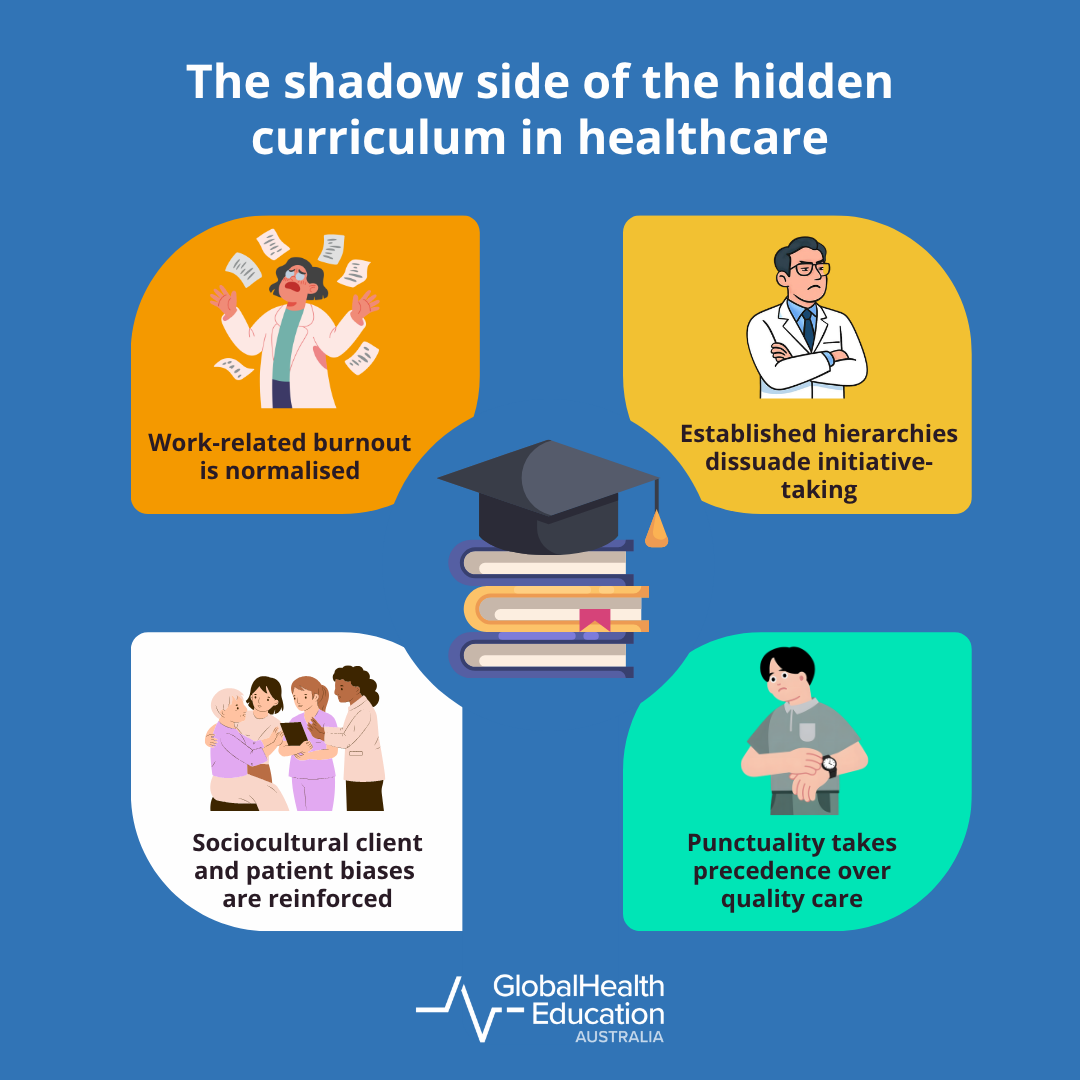
While the hidden curriculum in postgraduate healthcare education offers many benefits, there are also some potential downsides.
You may encounter unspoken norms, attitudes or practices that appear to be at odds with what’s taught in your formal education. These will depend on your profession, your specific role, the biases and beliefs of your educators and the environment in which you complete your practical placements.
Some common implicit learnings to be mindful of in placements and in practice can include:
Work-related burnout is normalised
In large, multidisciplinary healthcare settings such as hospitals, high stress, long hours and emotional exhaustion may be considered unavoidable aspects of the job. The incidence of burnout is seen frequently in nursing and psychology and is also prevalent in other healthcare fields.
Learning environments in which senior professionals miss breaks, work overtime, downplay exhaustion or even celebrate it as a signal of their commitment to the role may influence students’ understanding of what’s normal in the workplace. This is a subtle lesson that teaches students that burnout is expected in their career, which could discourage healthy boundary-setting and set the tone for a potentially unsustainable practice.
When burnout becomes accepted as part of the workplace culture or a central aspect of the role, healthcare professionals may feel pressure to prioritise work over their own wellbeing. This can increase the likelihood of clinical errors, cynical thinking, compassion fatigue and eventual attrition from the field.
Burnout in healthcare is a genuine issue and is something that organisations should strive to address to attract and retain a skilled workforce. Be mindful of this undeclared ‘norm’ as you complete your postgraduate studies. It can help you make a conscious choice about where you work if you know the expectations for your role.
Established hierarchies dissuade initiative-taking
Healthcare environments often operate within clear hierarchical structures designed to maintain safety and accountability. However, what is sometimes modelled in these environments is the idea that authority should not be questioned, even when an open, constructive dialogue could lead to improvements in the workplace. This may lead to situations of poor psychological safety, which affects your confidence and willingness to contribute.
In these situations, it’s important not to internalise the belief that your role is to remain quiet in the face of strong power dynamics. This may become particularly relevant in circumstances you observe to be unsafe or unethical, where patient or client care may be compromised.
When initiative-taking is subtly discouraged by those who hold hierarchical structures in place, opportunities for improvement, advocacy or collaborative problem-solving may be missed. It may also impact your ability to progress in your career if these systems are resistant to constructive challenge or if you simply believe your ideas are not welcome. Becoming aware of these environments and how they can implicitly teach you not to ‘rock the boat’ can help you develop respectful assertiveness in your future healthcare role.
Sociocultural client and patient biases are reinforced
Another aspect of the postgraduate healthcare hidden curriculum is the everyday attitudes and assumptions that shape workplace culture. The way senior professionals and colleagues speak about certain client groups, the language used in case discussions or the expectations placed on different demographics can all subtly communicate what is considered normal.
Without intentional reflection, cultural norms, stereotypes or biases, whether related to gender, age, socioeconomic background or health behaviours, can be absorbed by you as implicit learning without any conscious awareness. Small assumptions can have significant downstream effects, which is why developing cultural competency, strengthening your ethical practice and engaging in your own self-reflection are so important in healthcare practice.
You may observe that certain perspectives held by colleagues appear to be in conflict with your own ethical framework and value system. When the goal is to provide person-centred care, it’s important to be mindful of how these implicit biases can influence how you might communicate with clients or patients, assess risk and provide treatment options. This allows you to provide an inclusive, fair and respectful healthcare service to diverse communities.
Punctuality takes precedence over quality care
Being punctual shows respect for others’ time and is an important aspect of your professional practice. This lesson is established early on in classroom environments, where being organised, planning ahead and working within a structured schedule matters. In a healthcare setting, this supports organisations, such as hospitals or private practices to run smoothly.
However, punctuality can sometimes be modelled in ways that prioritise strict time management rather than allowing for flexibility and clinical judgement. You might observe situations where being on time is valued so highly that it leaves no room to run late or to respond to the complexities of patient and client needs in real-world healthcare settings.
For example, spending extra time with someone who is distressed, in pain or who responds unexpectedly to a particular treatment or intervention may be required on occasion. If you find yourself in environments that prioritise punctuality over person-centred care, you may feel constrained in your capacity to deliver quality care, which can cause undue stress in your role. Navigating this as a student or when newly entering your field can be challenging, yet important, particularly if you’re still working out how to balance being efficient with being empathetic.
How to integrate the hidden curriculum lessons into your healthcare role
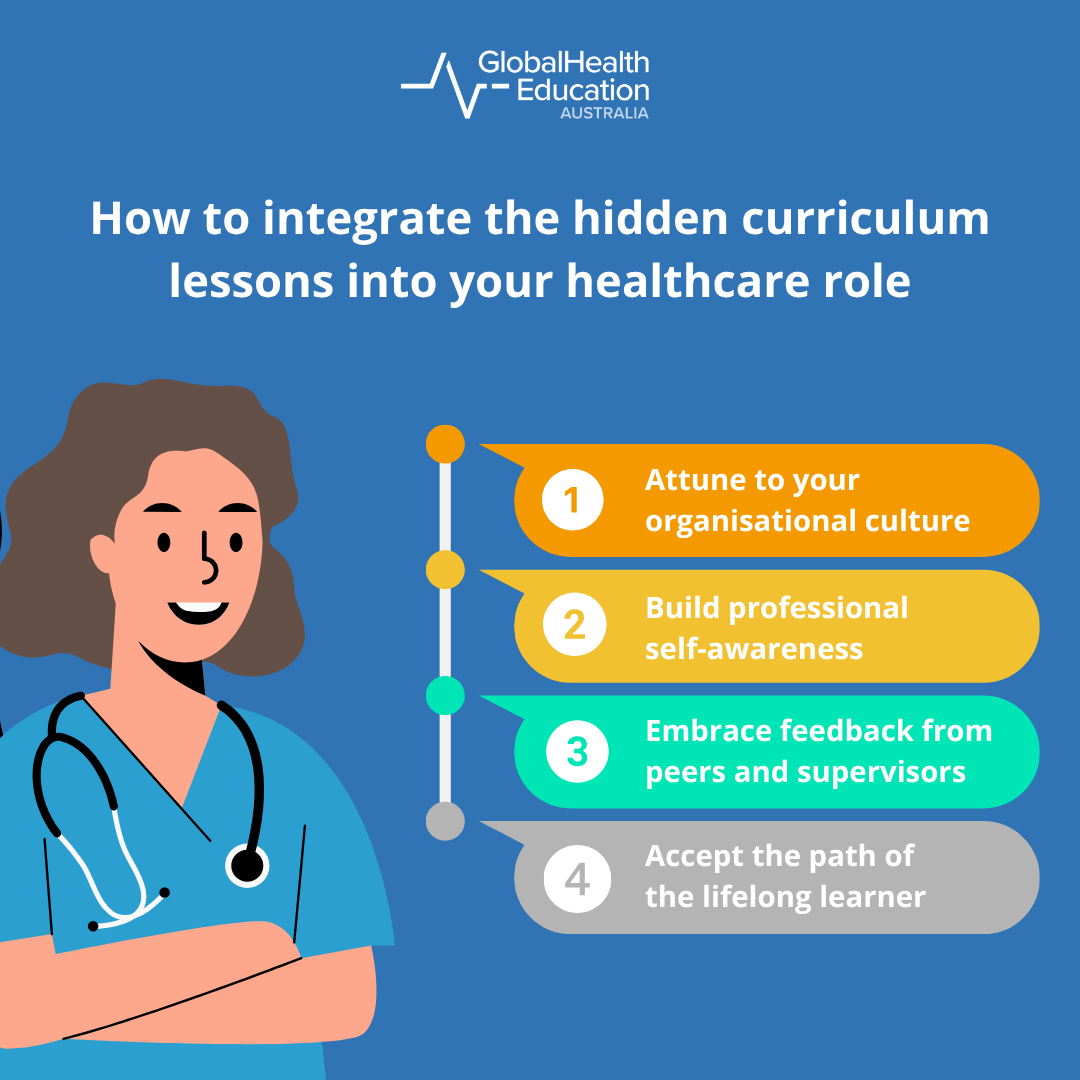
Here are some actionable ways you can apply the lessons learned from the hidden curriculum to your role:
- Attune to your organisational culture: Each healthcare environment has its own hierarchy, norms and preferred ways of working. Getting a sense of the workplace culture can help you navigate complex situations related to effective care delivery and collaborating with your colleagues.
- Build professional self-awareness: Reflect on your own beliefs, values, strengths and weaknesses and how each may impact your practice. Self-awareness also allows you to make more considered decisions under pressure and strengthens your resilience in demanding situations.
- Embrace feedback from peers and supervisors: When you seek out and openly receive guidance from other healthcare professionals, you’ll uncover blind spots in your practice, which become opportunities for improvement. This also helps support positive team dynamics and may open up mentoring opportunities to refine your expertise further.
- Accept the path of the lifelong learner: Adopting a mindset of continuous learning ensures you remain competent, engaged and ahead of the curve in your clinical role. When you approach each day with an eagerness to evolve, every client or patient interaction, team discussion and unexpected challenge becomes an opportunity to grow.
Expand your skills and yourself with postgraduate study
The hidden curriculum is a valuable dimension of postgraduate healthcare education. Through these unspoken lessons, you can grow and discover aspects of yourself that help you level up as a healthcare professional. If you’re ready to be the recipient of the lessons found within the hidden curriculum of postgraduate study, as well as advancing your skill set, explore the extensive range of healthcare courses in the GlobalHealth Education course catalogue.
We showcase healthcare courses from many respected Australian universities, including our partner universities. Take a look at courses across health leadership, psychology, nursing, public health, counselling, social work, mental health and more. There are online and on-campus courses to suit your lifestyle and career.
Postgraduate study opens doors to new opportunities and a new you as a healthcare professional. If you need help selecting a course that best fits your career path, book a free professional development strategy call with Catriona, our Education Consultant. She can offer tailored support to help you make a bold move in your healthcare career.