
Why trust GlobalHealth Education?
-
Our in-house editorial team and healthcare advisors write and review our content.
-
The information in our content provides clarity and insights to help you compare courses.
-
We list postgraduate courses from 25+ respected and reputable institutions in Australia.

Social work is a fulfilling allied health profession in Australia, with strong job growth projected over the next decade. These roles focus on helping individuals, families and communities to overcome hardships and improve their lives.
If you’re interested in becoming a social worker and want to use your existing tertiary qualification or experience to become qualified, completing a Master of Social Work can help you get there. However, understanding what these social work degrees involve, their level of difficulty and whether they align with your goals and interests is an important first step to help you make an informed choice.
This article explores the realities of completing a postgraduate social work degree, including common challenges related to the course content, placements and the financial commitment required to complete your studies. You’ll also see how a Master of Social Work compares to similar postgraduate healthcare degrees to gain a better understanding of whether this rewarding and impactful path is suitable for you.
Is a postgraduate social work degree hard?
Pursuing a Master of Social Work to qualify as a professional in this field is demanding, but for the right person, it can also be deeply meaningful and worthwhile. Several factors play into what makes a postgraduate social work degree challenging, including the theoretical and practical course components, time and study commitment, the interpersonal skills required and the financial investment needed to complete your studies.
When compared with other postgraduate healthcare degrees, a Master of Social Work is often less clinically technical. In saying this, it is just as challenging in terms of the interpersonal and practical skills you need to build in order to support vulnerable people and help improve their holistic needs and wellbeing as a social worker.
Once qualified, you can pursue a career that delivers genuine purpose, as you advocate for people’s basic needs, address systemic social injustice and enhance the wellbeing of diverse populations across various roles and environments.
What are the challenging aspects of a Master of Social Work?
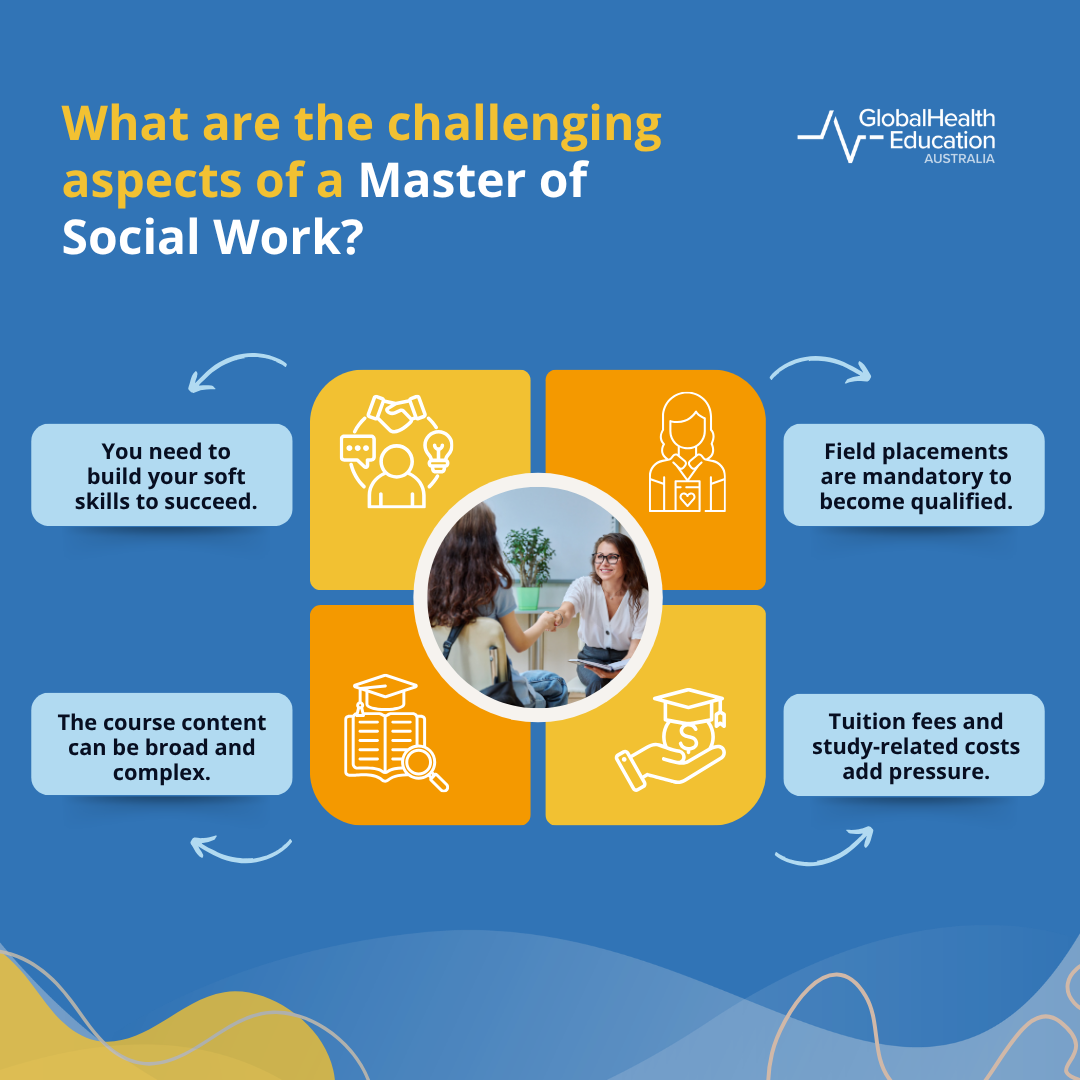
While there are many reasons you should study a Master of Social Work, there are also a few reasons why these courses may be considered challenging.
You need to build your soft skills to succeed
Inherent to these roles are people struggling with complex situations and navigating difficulties such as personal grief, addiction, discrimination, homelessness, mental health challenges and financial hardship. Cultivating emotional resilience is important, as this helps to avoid compassion fatigue and burnout across your social work career. The emotional demands of social work can be difficult, especially if you are empathic or if you have first-hand experience of the challenges that are also impacting your clients.
As a student, opportunities to strengthen your soft skills, including critical thinking and reflection, are available throughout your coursework. For example, the Ethical and Legal Contexts of Social Work Practice unit from the University of Canberra’s Master of Social Work (Qualifying) equips you with the skills to analyse and navigate the complex intersections of law, human rights and professional ethics. You also gain critical reflection skills with respect to how these frameworks shape social work practice and how they affect people on an individual and systemic level.
Similarly, the unit Critical Reflection on Social Work Practice from the University of Notre Dame’s Master of Social Work (Qualifying) can strengthen your understanding of social work theories and allow you to evaluate the best strategies for different people and communities. This helps ensure you provide the most appropriate care in your professional practice.
Units such as these are common across many social work master’s degrees and are designed to help you build an ethical social work practice, along with the self-reflection skills needed to provide appropriate care in a way that sustains you in the long term.
The courses below are listed by qualification level, from lowest to highest.


Develop professional social work knowledge and practice skills across areas including diversity, psychosocial health, ethics, research, policy, trauma and family practice, supported by intensive learning and 1,000 hours of supervised field education.


Prepare for contemporary social work practice through coursework, research and extensive supervised field education across a range of professional settings.
The course content can be broad and complex
Another key factor that contributes to the difficulty of postgraduate social work degrees is the content itself. Master of Social Work programs typically cover a wide range of topics, spanning areas like legal frameworks, human behaviour, mental health and counselling, social justice, leadership, policy and political advocacy and research skills.
Because these themes impact people differently across varying demographics, you’ll also explore how they apply to child and family welfare, rehabilitation, healthcare, women’s health and trauma care. You’ll also gain an understanding of how to provide culturally-responsive care to Aboriginal and Torres Strait Islander peoples and those from diverse cultural backgrounds.
Many Master of Social Work programs cover these learning areas and more, to help you build a comprehensive social work practice that addresses the needs of diverse populations.
For example, the Curtin University Master of Social Work (Qualifying) program includes the unit Social Work Practice with Individuals, Children and Families, which allows you to understand the lived experiences of children and families, provide counselling support and explore the social factors that shape their circumstances.
This course also includes the unit Social Work Understandings and Responses to Violence, Abuse and Trauma, which helps you gain a better understanding of trauma, its negative impacts and how it affects people differently across the lifespan, including gender-based and cultural influencing factors. This unit helps you build a trauma-informed and person-centred practice, where you can provide support that fits your clients’ unique needs.
The Master of Social Work (Professional Qualifying) at James Cook University includes the unit Aboriginal and Torres Strait Islander Skills and Frameworks for Practice. This unit focuses on developing respectful, culturally-aware and responsive practices for graduates to work with Aboriginal and Torres Strait Islander peoples and communities. You’ll gain a deeper awareness of the unique, complex, historical and contemporary inequities experienced by people in these groups and how to advocate for their needs appropriately through knowledge of anti-oppressive frameworks.
The courses below are listed by qualification level, from lowest to highest.


Build the professional knowledge, judgement and practical capability to support individuals, families and communities and contribute to meaningful social change through an AASW-accredited qualification.


Develop expertise in enhancing the lives of others by acquiring critical skills in social work that address the unique and complex challenges faced by individuals, families, groups and communities.
You must complete field placements in order to become a social worker
In Australia, social work courses that lead to entry into the social work field typically include approximately 1,000 hours of mandatory field placements, which are often divided into two blocks of 500 hours each. This requirement also ensures you graduate with the practical experience needed to meet the Australian Association of Social Workers’ minimum practice standards to work as a social worker.
Social work placements provide an immersive, hands-on learning experience where you get to put your theoretical skills into practice in real-world social work settings. You can benefit from practical learning opportunities in hospitals, aged care facilities, schools, child protection agencies, correctional facilities and government organisations, as examples.
Regardless of whether the theoretical components of your course are delivered online or face-to-face, the 1,000 hours of field placements must be completed in person and usually require a full-time commitment during the placement periods. These placement requirements are included in the overall duration of qualifying Master of Social Work degrees, which usually take two years full-time or up to three years part-time to complete.
If you work full-time or have caring responsibilities, fitting mandatory placement hours around your personal and professional life can be particularly challenging. In this way, the commitment involved in completing placements can make this one of the more demanding aspects of a Master of Social Work.
Tuition fees and study-related costs add pressure
There’s also the reality of paying for your master’s degree, which can pose a challenge for students looking to take on further study. The cost of a Master of Social Work can vary between universities and will differ depending on whether the course is offered as a Commonwealth Supported Place (CSP) or a full-fee domestic place.
CSP courses are much less expensive overall, as these courses are heavily subsidised by the government, which means you only need to pay a reduced fee, known as the student contribution amount. CSP courses are available to eligible domestic students and can help alleviate the financial pressure of completing postgraduate social work study.
Comparing the price differences between full-fee and CSP courses can save you thousands of dollars on further study. Explore discounted CSP social work courses to find out how much you could save.
For example, in 2026, the Master of Social Work (Qualifying) at the University of New England is a CSP course with an estimated first-year tuition fee of $9,504, while the University of Wollongong’s CSP Master of Social Work (Qualifying) program has an indicative first-year tuition fee of $19,072.
In contrast, the Master of Social Work (Qualifying) at Edith Cowan University costs approximately $52,000 in total for a domestic full-fee paying place, whereas CQUniversity’s Master of Social Work (Qualifying) costs around $71,520 in total for a domestic full-fee paying place.
Course fees are indicative only, may vary at the time of enrolment and are subject to change. For the most accurate information, confirm with the university regarding the specific course you’re interested in.
The courses below are listed by qualification level, from lowest to highest.


Acquire the skills needed to tackle barriers, inequality and injustices faced by marginalised and disadvantaged groups in Australia's diverse society.

Seamlessly integrates advanced social theory with hands-on, community-engaged practice to empower emerging leaders committed to fostering meaningful social change.


Acquire the knowledge and skills necessary to pursue a career as a professional social work practitioner, capable of working in Australia and abroad. This program includes 1000 hours of supervised fieldwork placements to refine your skills.


Qualify as a professional social worker through flexible online postgraduate study, developing the knowledge, practical skills and field education required for contemporary social work practice.
Besides choosing the option of a CSP course, there are further financial support schemes available to students to help ease the cost of studying and taking on placements.
FEE-HELP is a government loan scheme which allows you to defer your upfront tuition fees. It is available to eligible domestic students enrolled in a postgraduate full-fee paying course. Student contribution amounts for postgraduate CSP courses can be deferred using a HECS-HELP loan. These loan schemes are repayable through the taxation system when you meet the compulsory minimum repayment threshold. For a detailed overview on higher education loan schemes, read our comprehensive guide here.
The time taken away from work to complete your placement hours can create added financial pressure. This can be especially difficult because placements are unpaid and some students may need to reduce working hours or cover the costs associated with completing placements, such as travel or childcare.
The Commonwealth Prac Payment (CPP) is available to eligible social work students undertaking mandatory placements and is designed to alleviate the loss of income as a result of completing these field placements. The current amount students can receive is $338.60 per week throughout their placement, aligned with the single Austudy rate. These funds may be used to cover expenses like travel, living expenses, uniforms and essential items needed to complete your placement.
How hard is social work compared to other healthcare master’s degrees?
Below is a general comparison of typical social work, nursing, counselling and psychology master’s degrees for a balanced take on the potentially challenging aspects across each.
| Feature | Master of Social Work | Master of Nursing | Master of Counselling | Master of Psychology |
|---|---|---|---|---|
| Overall focus | Social justice, human behaviour, community systems, client advocacy, counselling interventions, case management. | Clinical care, patient assessment, triage and treatment, leadership, education, advanced practice. | Therapeutic counselling and communication, mental health support, client wellbeing and resilience-building. | Human behaviour, assessment, mental health diagnosis and therapeutic interventions, research and specialised practice. |
| Theoretical components | Strong emphasis on social theory, ethics, policy and advocacy, critical reflection and human development. | Clinical, advanced and specialised nursing skills, pharmacology, advanced health assessment and treatment. | Counselling models, psychotherapy theories, ethics, human psychological development. | Evidence-based psychotherapy interventions, advanced psychological theory, statistics and research. |
| Practical requirements | 1,000 hours of supervised field placements in community, human services or healthcare settings. | Graduate entry nursing master’s degrees include a minimum of 800 hours of supervised clinical practice in hospital or healthcare settings. | Between 200 and 250 hours of professional field placement under supervision in a variety of healthcare, community and rehabilitative settings. | Many Master of Professional Psychology and Master of Clinical Psychology placement requirements range between 750 to 1,500 hours. |
| Career outcomes | Social worker, child and family support worker, community worker, engagement officer, case manager, policy advisor and accredited social worker in various practice areas. | Registered nurse, advanced and specialised roles in clinical areas and in leadership, including nurse educator, clinical nurse specialist and nurse practitioner. | Counsellor, wellbeing officer and diverse roles in rehabilitation, organisational, relationships and crisis counselling. | Pathways to becoming a registered psychologist, specialised practice areas, research and academia. |
Note: The structure and outcomes of each degree type can vary depending on specialisation and whether the program is an entry-to-practice or advanced practice degree. Many nursing master’s degrees do not typically include dedicated placement units as part of the course content.
Who is a master of social work best suited to?
For many students, the valuable skills, professional growth and learning opportunities gained through the coursework and placements outweigh the challenging aspects of a social work degree. Reflecting on your personal strengths and career aspirations can help you decide if completing a qualifying Master of Social Work program is something you should pursue.
The Master of Social Work degree may be a good fit for professionals who want comprehensive skills to address social injustice, advocate for marginalised populations and enhance the welfare of individuals and communities. It suits those who possess a high level of emotional intelligence, resilience and strong interpersonal skills. A Master of Social Work is ideal for those interested in policy and advocacy work, where your skills and expertise can help improve lives on a systemic level.
It’s also ideal for those looking to grow into compassionate practitioners, capable of providing person-centred support to the most vulnerable members of society. This qualification can open doors to incredibly versatile careers in government, non-profit organisations and private practice.
If you have these attributes and are interested in a career that makes a difference, pursuing a Master of Social Work could be right for you.
Make a rewarding career move into social work
Social work is a growing sector with rewarding career potential across various roles. Despite the inherent challenges that come with completing a Master of Social Work, you’ll gain an important qualification that makes a significant difference on an individual and societal level.
If you’re ready to jump into a fulfilling career that offers strong job security and genuine meaning, explore the social work master’s degrees mentioned throughout this article and click on a course card to get started.
You can also browse the extensive range of social work master’s degrees from reputable Australian universities, including our university partners. Select a course that interests you to find out more.
If you need tailored support choosing the right Master of Social Work program, our Education Consultant, Catriona, is ready to help. Catriona can help you navigate your options so you can make your move into social work. Book a complimentary call with Catriona today to get started.