In This Article
- Part-time vs full-time study: which one is better?
- Part-time study
- Full-time study
- Postgraduate course levels and study loads: how they typically work
- Why do study loads differ between certain healthcare courses?
- Do tuition fees change for full-time vs part-time study?
- Part-time vs full-time study summary
- Deciding between part-time or full-time study
- Advance your healthcare career at a pace that suits you

Why trust GlobalHealth Education?
-
Our in-house editorial team and healthcare advisors write and review our content.
-
The information in our content provides clarity and insights to help you compare courses.
-
We list postgraduate courses from 25+ respected and reputable institutions in Australia.

Returning to study to upskill in a postgraduate course is a big decision that requires careful consideration. You may already be balancing work, personal responsibilities or family commitments, so it’s understandable to be thinking about how studying will fit into your life as well.
Knowing the differences between a part-time and full-time study load can help you explore courses with confidence and choose the option that’s right for you. This article compares these two options, outlines the benefits and challenges of each, explores whether there are cost differences and highlights how postgraduate courses are typically structured. You’ll be able to make an informed decision about part-time vs full-time study to help you advance your healthcare career.
Part-time vs full-time study: which one is better?
Determining the better option between part-time and full-time study will depend on your individual study needs and goals for your career. It also depends on how fast you want to obtain your qualification and what time commitment you can manage.
Part-time study may work well if you’re established in your career and working as a healthcare professional. This option offers the flexibility needed to continue working and build experience in your role, while balancing family or personal commitments. A part-time load is commonly how many postgraduate courses are delivered, allowing you to take on study at a manageable pace to align with your professional and lifestyle needs.
On the other hand, full-time study requires a substantial weekly time commitment, which may impact your working, social and family life. This option may be more ideal if you want to complete your qualification sooner, allowing you to apply your new or advanced skills in your role after you graduate. A full-time load often applies to many graduate entry healthcare courses.
Part-time study
What is part-time study?
Part-time study involves enrolling in an academic workload at a reduced capacity compared to that of full-time study. For Australian universities, study loads are measured by the Equivalent Full-Time Student Load (EFTSL). In general, a part-time load can be defined as anything less than 75 per cent of a standard full-time study load. Some universities calculate their study load based on credit points, with each unit or subject worth a specific number of credit points each. This information is usually available on the university course page or in the handbook relevant to the course.
A part-time study load usually equates to between 10 and 20 hours of study per week, which typically includes coursework, tutorials and individual revision. Depending on the specific course, this could mean a workload of between one and three units per study period. A part-time student is, therefore, someone who completes fewer units than a full-time student during a given academic period, such as a block, trimester, semester or year.
Benefits and challenges of part-time study
Benefits
A clear benefit of part-time study is flexibility. Taking on a reduced study load allows you to continue working in your current role, ensuring a steady income with less interruption to your career.
If your course is directly relevant to your current role, you can immediately apply the theoretical and practical skills gained to your work in real time as you progress through the coursework.
Taking on fewer subjects at once can also help you maintain a better work-life balance and prevent the risk of burning out. This means you can balance your studies with your personal or family responsibilities with less stress overall.
Challenges
Conversely, one of the challenges of part-time study is the longer time it takes to complete the course, compared to enrolling in the same course at a full-time study load. Depending on the program, this difference can add one or more years onto the total time it takes to obtain your qualification.
Another potential drawback is that studying part-time can mean you’re not eligible for certain government support payments, such as Austudy or ABSTUDY. Generally, you need to be studying full-time, among other criteria, to be eligible for these financial assistance schemes.
Who is best suited to part-time study?
Part-time study is well-suited to students for a variety of reasons.
Parents and carers: If you have significant caring responsibilities, you may find the commitment level of a part-time study load more manageable. Taking on your studies in this way can help you further your career with minimal impact on your personal life and family commitments.
Working professionals seeking flexibility: If you’re working in healthcare and want to upskill without quitting your job, you may find that the flexibility of part-time study fits in well with your ongoing role. This option allows you to balance work and study in a sustainable way, while you build skills to help further your career.
Mid-career healthcare professionals: If you’re looking to expand into a more senior, leadership or advanced role, part-time study could be well-suited to you. You can leverage your current role and experience while choosing a course that bridges the gap between where you are now and where you want to go next in your career.
For example, the Master of Nurse Practitioner at Queensland University of Technology is a part-time master’s degree delivered over two years to help you expand your scope of practice to become a nurse practitioner. This course consists of eight units, including Quality Use of Medicines (QUM) and Safe Prescribing and Clinical Therapeutics, which help build advanced skills to support your future role.
Many universities offer nurse practitioner postgraduate degrees that take between two and three years to complete at a part-time study load. This means that you can enrol in a master’s degree that allows you to pursue advanced practice roles, all while continuing to work, build skills and earn a stable income.


Expanded the scope of your nursing practice by enabling independent assessment, diagnosis and treatment of clients while also developing advanced knowledge and skills in your speciality.
The University of Queensland also offers a Master of Nurse Practitioner, which is a two-year, part-time degree delivered online for flexible learning to upskill towards a nurse practitioner position. Through units such as Physical Assessment and Clinical Decision Making for Independent Practice and Advanced Clinical Leadership, you’ll have advanced skills beyond traditional nursing to support patient health and wellbeing across different healthcare settings.


Designed to prepare experienced registered nurses to develop professional skills in advanced and expanded clinical roles.
Full-time study
What is full-time study?
Full-time study can be defined as a study load of 75 per cent or more of a course’s full-time load.
A full-time student is someone who enrols in a course at this study load capacity or higher, and compared to a part-time student's study load, it is a significantly bigger study commitment. The workload is similar to that of a full-time job, with full-time study usually equating to around three to four subjects per academic period, such as for a trimester, semester or year.
Students can expect the workload of full-time study to be between 20 to 40 hours per week. This can include coursework, research and other independent study relevant to the course.
Benefits and challenges of full-time study
Benefits
An obvious benefit to enrolling in a course full-time is that you’ll typically complete your studies sooner, compared to an equivalent part-time course. This means you can enter the workforce earlier or apply your skills more readily in your current role.
Another benefit of full-time study is the eligibility for financial assistance payments, such as Austudy or ABSTUDY. These government support payments typically apply to undergraduate courses. However, many approved master’s by coursework programs also qualify, as long as the course meets the minimum requirement for entry into a profession or the fastest pathway to professional entry.
Students need to maintain a study load of 75 per cent or more to receive these government payments and further details on the complete eligibility criteria can be found on the Services Australia website.
Challenges
A challenging aspect of full-time study is the substantial time commitment required to complete your course. This can make it difficult to maintain full-time employment, potentially resulting in reduced or lost income and added financial stress. As highlighted, exploring the available financial support options while undertaking full-time study can help ease the impact of this loss of income.
The workload and course content at a full-time study load can also be highly demanding, depending on your specific course. Balancing assessments, keeping up with the required coursework and completing practical placements where relevant are all additional challenges to navigate.
It’s important to prioritise self-care and establish an effective time management plan to help you stay organised, maintain a healthy study-life balance and keep on top of your academic commitments as a full-time student.
Who is best suited to full-time study?
Full-time study may be a good choice for some, depending on your personal and professional circumstances.
Time affluent students: If you’re well-organised with fewer external responsibilities and can commit to the rigorous study requirements inherent to a full-time course, then full-time study could be ideal for you.
Scholarship seekers: If you’re eligible for or interested in a scholarship, full-time study might be the right option to consider. The eligibility criteria for many scholarships typically include full-time course enrolment, allowing you to commit to studying and pursue your dream career.
Career changers: If you’re looking to make a career change, focusing on your studies for a set time period can help you pursue a new career path sooner. You can leverage your existing skills and knowledge to transform your career and begin working in a completely new field.
For example, if becoming a speech pathologist interests you, a full-time postgraduate degree in speech pathology can help you achieve your career goals. If you have a bachelor’s degree or postgraduate degree in any discipline with a credit average or higher, you can complete a Master of Speech Pathology at the University of Canberra.
This course is delivered face-to-face and takes two years to complete full-time. You’ll complete units such as Foundations of Communication Science, Speech Disorders Across the Lifespan and Aphasia and Cognitive Communication Disorders. This master’s degree is designed to equip you with deep clinical knowledge and the confidence to help those with speech and swallowing challenges in your new role as a speech pathologist.


Develop the clinical, research and evidence-based skills to assess and manage speech, language, communication and swallowing needs across diverse populations and practice settings.
The Master of Speech Pathology from Curtin University is another two-year, face-to-face master’s degree, offered at a full-time study load. This course is open to those with an existing tertiary qualification, such as a bachelor’s degree or postgraduate degree with a course weighted average of 65 or greater, from any field. You’ll learn about acquired and developmental speech and language disorders, hearing and cognitive disorders and strategies to provide evidence-based interventions for your clients.
Speech pathology is one of the fastest-growing allied health professions, with opportunities to work in a variety of settings, such as public hospitals, private practice and in non-profit organisations.


Build evidence-based assessment and intervention skills across speech, language, fluency, voice, communication and swallowing while completing the clinical education required to enter speech pathology practice.
Postgraduate course levels and study loads: how they typically work
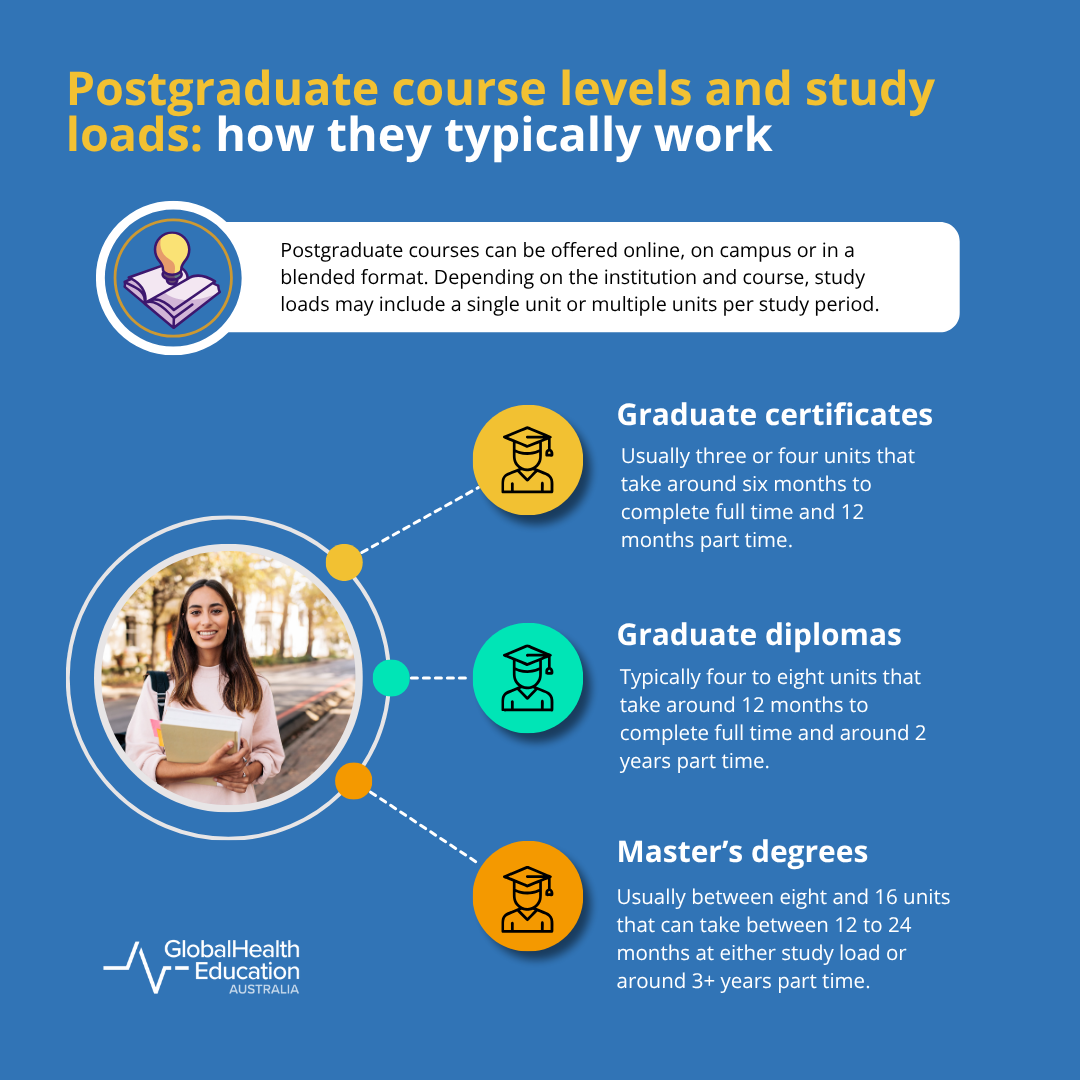
Universities offer varying full-time and part-time study options across each postgraduate course level. Below is a general guide to the typical study load and course duration for graduate certificates, graduate diplomas and master’s degrees:
Study loads for postgraduate courses
Graduate certificates
Provide an introduction to a specific healthcare discipline or skill set, usually consisting of three or four subjects. These courses typically take six months to complete full time or 12 months or longer part time.
Graduate diplomas
Are more in-depth and expand on foundational knowledge, usually consisting of between four and eight subjects. These courses typically take up to 12 months to complete full time or approximately 2 years part time.
If you’re weighing up whether to study a graduate certificate or graduate diploma, you can find more detailed information here.
Master's degrees
Deliver a comprehensive qualification, usually consisting of between eight and 16 subjects. These courses equip you with advanced clinical or specialised skills and knowledge, sometimes including a major research project or clinical placements. A master's degree generally takes between 12 and 24 months to complete at either study load or around 3 years or longer at a part-time study load.
Flexible delivery modes
Whether you’re taking on your studies at a full-time or part-time study load, there are various study modes available that provide flexible learning, catering to different learning styles and student needs.
Traditional on-campus study provides in-person learning opportunities and access to lecturers and peers in class environments. Online learning has become an integral part of many postgraduate course levels. This learning mode provides on-demand access to lectures, tutorials and virtual collaboration with fellow students through the university’s learning management system. Choosing to study online or on campus depends on your personal preferences and professional needs.
Many courses offer a blended learning model that includes a combination of both online and on-campus study. This gives students greater flexibility while still providing opportunities for in-person learning, networking opportunities and face-to-face support where needed.
Some universities have also adapted to offer more frequent intake periods throughout the year, moving beyond the traditional semester model within an academic calendar. Institutions such as James Cook University, Southern Cross University and Victoria University have postgraduate courses that allow students to study one unit at a time over a shorter time period. Depending on the course, these study blocks usually take between four and seven weeks before students move on to the next unit.
If a course includes practical or field placements, students need to complete these in person as part of the course requirements, regardless of whether the rest of the course is delivered online, on campus, full time or part time.
Why do study loads differ between certain healthcare courses?
Full-time only options
In tertiary education, some courses are offered exclusively as full-time programs, while others are offered exclusively as part-time programs and others have the flexibility to be offered as either. Whether a healthcare course is offered full time, part time or both often depends on the purpose and structure of the program.
Courses that lead to professional entry into a specific field are more likely to be offered at a full-time study load only. This can be due to the way universities structure practical placement subjects, as well as requirements set by accreditation and registration bodies, which may require placements and coursework to be completed in a specific sequence or within a set timeframe.
This may include undergraduate, graduate entry or re-entry to practice degrees in areas such as nursing and allied health, where supervised training in healthcare settings takes place, commonly in an immersive, full-time environment. Starting and finishing a course in this way, where each subject builds on the knowledge and skills gained in the previous subjects, helps ensure graduates can consolidate their learning and meet the professional requirements needed to practise in their field.
For example, re-entry to nursing programs, such as the Graduate Certificate in Nursing (Re-entry) from the Australian College of Nursing, provides previously registered nurses a pathway to return to clinical practice in 12 weeks at a full-time study load. This course helps nurses refresh and rebuild their clinical knowledge and professional skills through face-to-face theoretical learning and supervised placements. Competency standards are aligned with the Nursing and Midwifery Board of Australia’s accreditation standards, ensuring nurses can safely return to practice.

Build on the knowledge and skills gained from your Bachelor of Nursing degree. This program is designed to facilitate the development of registered nurses.
To gain entry into the occupational therapy field, the University of Canberra offers a Master of Occupational Therapy, which is accredited by Occupational Therapy Australia and the World Federation of Occupational Therapists, giving you a qualification with the opportunity to practice locally and abroad. This degree takes two years to complete at a full-time study load and is available to those with a prior bachelor’s degree in any field, including healthcare. As this degree is an entry-to-practice qualification, it is delivered in a structured and progressive format, with work-integrated-learning components, building competency over a specified timeframe.

Develop the knowledge and professional skills to support people’s participation in everyday life through occupational therapy, combining evidence-based study with 1,000 hours of practical education across diverse settings.
Part-time and flexible options
In contrast, courses aimed at existing healthcare professionals are commonly available in both full-time and part-time formats. Postgraduate courses oftenhave this flexibility, where students can choose a course and consider the study load that suits them.
It is also common for certain healthcare courses to be offered at a part-time study load only. Universities recognise that many healthcare providers are looking for professional development opportunities to advance their careers or gain specialised skills and may already be employed in the healthcare sector. Therefore, these courses are intentionally designed to provide flexibility through reduced study loads, making it easier for professionals to balance work and study together.
For example, the Master of Nursing Majoring in Advanced Practice from James Cook University is designed for registered nurses looking to deepen their clinical expertise and move into advanced practice roles. This master’s degree is delivered part-time over two years, giving nurses greater flexibility while continuing to work and fit their studies around their busy lifestyle.


Enhance your skills in this 100% online advanced practice major, which includes four specialized units designed to equip you with the necessary skills to deliver advanced patient care.
Similarly, the Master of Business Administration (Health Services Management) from Southern Cross University is aimed at professionals with a previous bachelor’s degree or at least five years of professional managerial experience who want to strengthen their leadership and business management capabilities in a healthcare context. The course is delivered in a part-time format and is specifically designed for busy professionals, allowing students to integrate study with full-time work and other responsibilities.


Designed for busy professionals and delivered 100% online, this course will help enhance your business management expertise.
Each university will differ in its course offerings and study loads, so it's helpful to check directly with the institution for up-to-date information regarding the specific details of your course.
Do tuition fees change for full-time vs part-time study?
The good news is that your study load typically doesn’t impact the total cost of your degree.
In higher education, course fees are calculated per unit, with each unit carrying a specific credit point value and a corresponding cost. So, the total tuition cost remains the same for a course, whether you’ve enrolled as a part-time or full-time student.
As a full-time student, your debt will accumulate faster because you are enrolled in more units per semester or academic period. Fortunately, there are many avenues to explore that can help you manage the cost of taking on postgraduate study at either study load.
For example, you may be eligible for a Commonwealth support place (CSP). A CSP is a government-subsidised university place, where the Australian Government pays for a portion of your course fees, reducing your overall tuition fees and leaving you to pay a student contribution amount.
CSP courses can drastically reduce the total cost of your postgraduate healthcare degree. Explore heavily discounted course options in fields like counselling, psychology, mental health, social work, healthcare leadership and management, nursing and public health.
If you are enrolled in a full-fee paying place (non-CSP course) or need assistance covering your student contribution amount, you may be eligible for FEE-HELP financial support. FEE-HELP allows eligible students to defer tuition fees and repay them through the tax system once their income reaches a certain threshold, which updates annually. Choosing this financial support option means there’s no upfront cost to you when you enrol, which means you can focus on your studies without added financial stress.
Whether it’s full-time or part-time study you choose, there are financial support options to ease the cost and help you achieve your career goals.
Part-time vs full-time study summary
Reviewing the overall differences between part-time and full-time study can help uncover which option best fits your needs.
| Factor | Part-time study | Full-time study |
|---|---|---|
| Study load and weekly commitment | Usually less than 75 per cent of a full-time study load, often involving 1 to 3 units per study period. Part-time students usually need to commit to between 10 to 20 hours per week of study. | Usually 75 per cent or more of a full-time study load, often involving 3 to 4 units per study period. Full-time students usually need to commit to between 30 to 40 hours per week of study. |
| Typical duration per course level | Graduate certificates: 6 to 12+ months Graduate diplomas: around 2 years Master’s degrees: 3+ years | Graduate certificate: between 6 to 12 months Graduate diplomas: up to 12 months Master’s degrees: 1 to 2 years |
| Work-life balance and flexibility | Easier to maintain a healthier balance between work, study and personal responsibilities. Part-time study offers greater flexibility and reduced overall workload. | Can be more demanding and may require sacrificing work, social activities or personal time. Full-time study is less flexible with more intensive workloads and study schedules. |
| Impact on employment and income | Gives students the option to continue working full-time or part-time while studying. Helps maintain a steady income and career continuity. | May require reducing work hours or stepping away from employment temporarily to focus solely on completing the required coursework. |
| Career and development opportunities | Enables professionals to upskill gradually while continuing to build industry experience. Courses may provide pathways to leadership, advanced practice and specialised skills. Course content may be directly applicable to their current role in real time. | Allows professionals to qualify sooner and potentially transition into new roles faster. Courses may provide pathways to professional-entry, re-entry to practice and can include field placements. Immersion in study may accelerate skill development and career transition. |
| Eligibility for government support payments | Part-time students do not qualify for support payments such as Austudy or ABSTUDY. | Full-time students are more likely to meet eligibility requirements for Austudy or ABSTUDY. |
| Tuition fees | Total course cost is usually the same overall, but fees may be spread over a longer period. | Total course cost is usually the same overall, but fees may accumulate faster due to higher unit load. |
| CSP and FEE-HELP eligibility | Eligible for CSP or FEE-HELP if enrolled in an approved course and unit-load requirements are met. | Eligible for CSP or FEE-HELP if enrolled in an approved course. |
Deciding between part-time or full-time study
To help gain some clarity on which study load you should consider, here are some questions to reflect on:
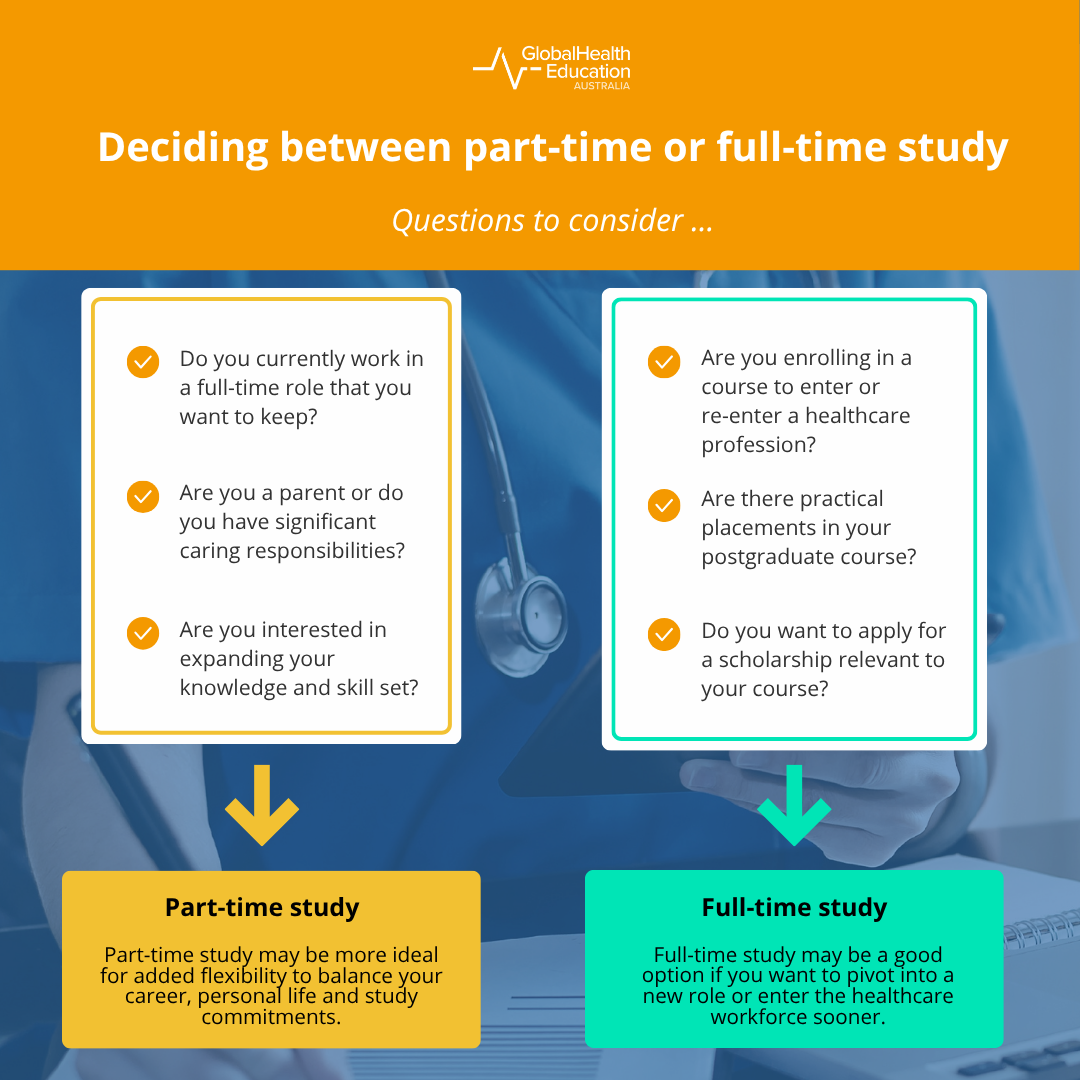
Choosing whether you want to study part time or full time depends on your personal and professional needs. You should consider how quickly you want to finish your studies and what type of time commitment you can realistically make. Depending on the course level or qualification you’re interested in, your options between either study load type may also be limited, so it’s important to do your research before enrolling.
Advance your healthcare career at a pace that suits you
Besides deciding what you want to study, choosing between a part-time or full-time study load is an important decision and one that can shape your educational journey. While full-time study can often qualify you sooner, part-time study can be more manageable, giving you a flexible option that fits in with your life. Take the time to do your research and consider what works best for you.
Whether you’re looking for a part-time or full-time course, GlobalHealth Education lists various options to suit your needs. You’ll find an extensive range of courses in different healthcare fields, including health leadership, psychology, nursing, public health, counselling, social work, mental health and more.
If you’re still weighing up which way to go, Catriona, our Education Consultant, can help. Book a complimentary career strategy call today for personalised advice on which study load option could be right for you.