In This Article
- Respect in leadership: how can nurse leaders achieve it?
- Approachability and authority: why they both matter in nurse leadership
- Striking a balance: building leadership skills that encompass both qualities
- Practical tips for nurses in leadership on earning respect
- Become an effective and well-respected nurse leader

Why trust GlobalHealth Education?
-
Our in-house editorial team and healthcare advisors write and review our content.
-
The information in our content provides clarity and insights to help you compare courses.
-
We list postgraduate courses from 25+ respected and reputable institutions in Australia.
When you step into senior nursing management and leadership positions, you become responsible for setting a standard of professionalism, accountability and safety. You need to be able to earn the respect of other nurses and members within your team. This often builds over time through consistency and by demonstrating that you are clearly in charge, while remaining aware of your team’s emotional and operational needs.
Exemplifying two key qualities – authority and approachability – can be an important part of your strategy to help you earn respect in your leadership role. In this article, we explore why these two qualities are necessary for you to cultivate and how you can strike the right balance by acquiring advanced skills through postgraduate study.
Respect in leadership: how can nurse leaders achieve it?
Gaining respect as a nurse leader can be achieved through consistency, psychological safety, upholding high professional standards and adopting a continual learning mindset. This combination of clinical competence, empathy and integrity together creates a balanced framework that is both authoritative and approachable, with postgraduate study playing a key role in strengthening these qualities.
Approachability and authority: why they both matter in nurse leadership
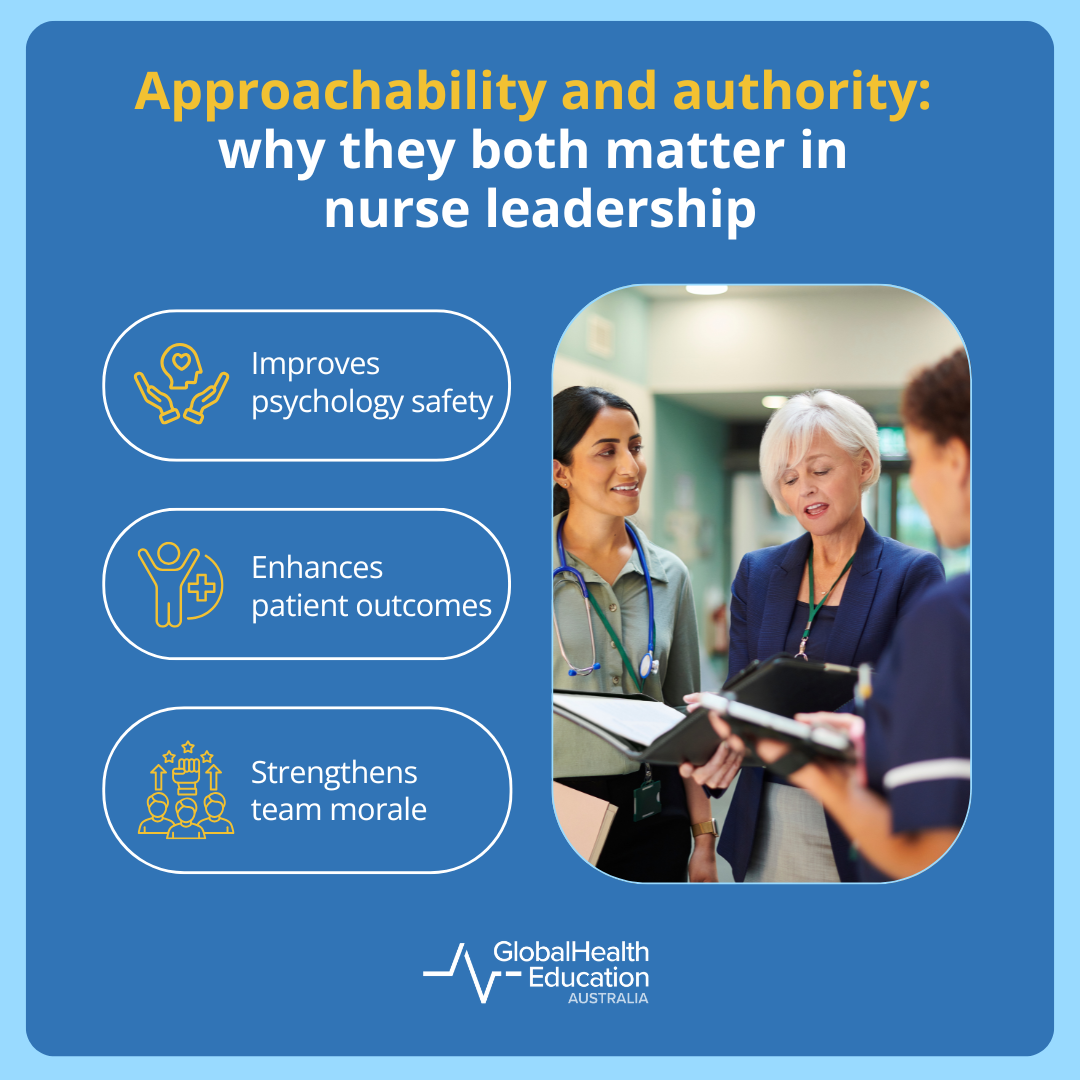
The convergence of these qualities helps create a foundation of trust and respect, where clinical standards are met, complex situations are managed responsibly and staff feel safe to speak up, collaborate and perform at their best.
Here’s how these qualities contribute to respectful leadership and their benefits in a nursing context:
Improves psychological safety
When a nurse leader demonstrates approachability by fostering psychological safety, team members are more likely to speak up, share their concerns and advocate for their own needs in the workplace. Staff feel safe knowing that they will be listened to and treated with dignity, rather than discriminated against or humiliated.
Meanwhile, a nurse leader's authority is essential in ensuring that clear behavioural standards are upheld. Taking a firm stance against negative workplace behaviour and instead promoting greater inclusivity helps model expected behaviours from your team.
Being both approachable and authoritative creates a safe and inclusive workplace where staff feel supported to contribute meaningfully. They also trust that their concerns will be taken seriously, that leaders will act with integrity and follow through with necessary action when needed.
Enhances patient outcomes
An approachable yet authoritative leadership style can contribute to improved patient outcomes by strengthening communication within clinical teams.
Following on from the theme of psychological safety, when nurses feel safe and supported to speak up, they will more readily escalate concerns or question potential clinical errors. Effective communication in nursing is important, as it promotes better continuity of care, reduces the risk of missed information and can mitigate adverse patient events.
A nurse leader with a well-defined sense of authority is someone who can take charge and maintain a vision of how things should be. They hold themselves and others to a high standard and value measurable outcomes rooted in an evidence-based practice. This results in a provision of patient care that’s safer, more responsive and comprehensive overall, which paves the way for earning more respect in your role.
Strengthens team morale
More structure, stability and trust in the workplace and within team environments can be readily cultivated with the help of a leader possessing these two qualities.
A nurse leader who is goal-oriented can empower team members to perform at their best. This can help staff feel confident about what’s required of them and how their work contributes to broader team and organisational goals.
When nurses understand the “why” behind decisions and can see strong, steady leadership in play, it reduces uncertainty and builds a sense of confidence and camaraderie. Nurse leaders who embody both qualities value shared decision-making, where their authority guides processes and individuals can still take ownership and pride in the work they do. Overall, stronger morale can help reduce stress and burnout, improve teamwork and help create a more positive and cohesive workplace.
Striking a balance: building leadership skills that encompass both qualities
There are many leadership styles that are well-suited to healthcare contexts, as well as a range of qualities that make a good nurse leader.
However, whether you're a nurse unit manager, clinical nurse consultant, director of nursing or in another nurse leadership role, postgraduate study can help you strengthen the skills needed to be a respected leader.
Master of Healthcare Leadership at Southern Cross University
The Master of Healthcare Leadership at Southern Cross University is an online master’s degree for registered nurses and broader professionals with a minimum of one year of full-time and current work experience in a health-related field. This course takes approximately two years to complete at a part-time study load and has multiple yearly intakes for flexible enrolment, ready when it suits you.
This course is ideal for nurses who want to step into nurse management, clinical leadership in nursing or similar nurse leadership roles and develops skills relevant to a balance of both approachable and authoritative qualities. Units such as Social and Emotional Competence in Health Care and Leading Change in Healthcare can support your communication skills and teamwork capabilities. You’ll develop the tools to improve systems, patient safety and transform healthcare as a goal-driven leader.
You can choose from a range of elective units, with Organisational Behaviour and The Positive Leader posing unique opportunities to explore and enhance your leadership style, while understanding the interplay between people, processes and organisations.
This master’s degree sets nurse leaders up for success, as they build trust, gain respect and demonstrate their competency as contemporary healthcare leaders.


Delivered 100% online, this course is suitable for people from a broad range of backgrounds and is designed to give you a range of skills you can take with you into the future.
Master of Nursing (Leadership and Management in Health) at the University of Southern Queensland
The University of Southern Queensland’s Master of Nursing (Leadership and Management in Health) is ideal for nurses and other health professionals who want to strengthen their leadership and management capabilities. This master’s degree is a three-year, online course delivered at a part-time study load. It’s suitable for registered nurses moving into leadership, service management and coordination-based roles.
This course includes units especially aimed at developing both an approachable and authoritative leadership practice. Examples of these units include Management in Health Care Practice, which supports nurse leaders in their ability to provide quality care, uphold professional standards and build human resource management skills.
The unit Leading Successful Teams supports greater inclusivity and collaboration of team members across different workplace contexts. The unit Harnessing Human Capabilities for the Future of Work equips leaders with the advanced interpersonal skills needed to work in modern, multigenerational and culturally diverse work environments. This includes building emotional intelligence, conflict resolution, adaptability and resilience capabilities.
Altogether, the specialised units in this master’s degree help nurse leaders become more effective and approachable in their leadership style. They’ll have the tools to drive systemic change, optimise the human potential of those they lead and ensure the next generation of creative problem-solvers are well supported in their roles to achieve organisational goals.


Build expert knowledge and understand the legal, ethical and social justice approaches to clinical leadership in healthcare settings.
UTas Master of Advanced Nursing (Leadership in Practice)
The University of Tasmania’s Master of Advanced Nursing (Leadership in Practice) is also delivered online at a part-time study load over three years. This master’s degree is designed for registered nurses with a completed graduate diploma and a minimum of six months of full-time practice experience.
The specialised units in this degree are Leadership in Practice, Exploring Leadership, The Enabled Leader and Leading Sustainable Practice Change in Healthcare. These units are intentionally focused on building intuitive, capable and respected nurse leaders.
Leadership in Practice and Exploring Leadership helps nurses critically evaluate their own leadership style and effectiveness through understanding leadership models and building self-awareness. The Enabled Leader unit helps nurses better understand themselves as competent leaders, with the skills to encourage leadership qualities in others. Leading Sustainable Practice Change in Healthcare is a project unit where nurses can put their theory into practice to address improvements in healthcare service or quality.
Overall, this course helps nurses learn how to become more authoritative and approachable in their leadership roles. They’ll develop themselves to become motivational and evidence-based leaders, with strong relational skills, able to make tough decisions and galvanise teams to achieve shared goals.


Empowers students with advanced leadership, strategic decision-making and management skills, enabling them to drive innovation, influence policy and lead multidisciplinary teams in delivering high-quality healthcare services.
Practical tips for nurses in leadership on earning respect
Here are some ways nurses can reflect on their leadership skills and identify areas for improvement so they can become respected leaders.
Reveal your authenticity
Admitting mistakes and showing your human side are important for nurse leaders to gain respect amongst their team. This helps show your authenticity and limitations, providing opportunities to learn and adapt in your role.
Practice active listening
Active listening is another important interpersonal skill that nurse leaders should demonstrate.
This skill matters because it improves the quality of communication, beyond what’s being said. It involves paying attention to an individual’s tone, body language and non-verbal cues and helps the listener effectively demonstrate their attention and presence. Practising this in nursing settings can help strengthen relationships, as it builds trust and helps people feel truly heard.
Demonstrate empathy and be curious
As a skill, the cultivation of empathy requires leaders to look beyond the immediate clinical task at hand to understand the human experience of their staff. It also helps strengthen morale, while promoting a positive work culture and wellbeing in healthcare environments.
Empathy extends to understanding the operational pressures staff face; a good leader acknowledges these burdens and actively steps in to help when the ward is overwhelmed. This becomes particularly important in situations of high pressure or if they feel that aspects of their role or immediate work are becoming tenuous or unsafe.
Remain open and available to your team
An unapproachable or unavailable leader can risk losing touch with their team and the organisation’s needs.
Being accessible also means being physically present as much as possible and maintaining an open-door policy for clinical concerns. It means reassuring the team that while you’re in a management or leadership role, you're not disconnected from the realities of the ward, unit or clinical care.
Remaining available for discussions can also give team members some important insight into the challenges inherent to nurse leadership.
Continue learning and growing
Adopting a growth-mindset and pursuing advanced skills in leadership can help you feel more confident and capable as a leader.
This works well for nurses who can combine postgraduate study in conjunction with the role they’re currently in. The skills and knowledge gained through continued learning can be applied directly to everyday clinical practice, allowing nurses to immediately strengthen their leadership and decision-making abilities in the workplace. Completing postgraduate study can also support career advancement into other areas or specialisations.
Become an effective and well-respected nurse leader
Mastering the balance between authority and approachability takes time in your leadership role.
As you develop more confidence, take on greater responsibility and help create supportive team environments, you’ll become a capable and well-respected nurse leader with expanded career potential. Explore the courses mentioned throughout this article if you’re ready to build advanced skills in your leadership role. Click on a course card to discover more.
You can also browse the extensive range of postgraduate nursing and healthcare leadership courses to find a flexible option to suit your professional needs. GlobalHealth Education also lists courses in several other healthcare fields, such as counselling, mental health, psychology, social work, public health and more.
Our Education and Careers Consultant, Catriona, is ready to help. She can provide guidance on choosing the right course and personalised strategies to help you move your career forward. Book a call with Catriona today to get started.