In This Article

Why trust GlobalHealth Education?
-
Our in-house editorial team and healthcare advisors write and review our content.
-
The information in our content provides clarity and insights to help you compare courses.
-
We list postgraduate courses from 25+ respected and reputable institutions in Australia.
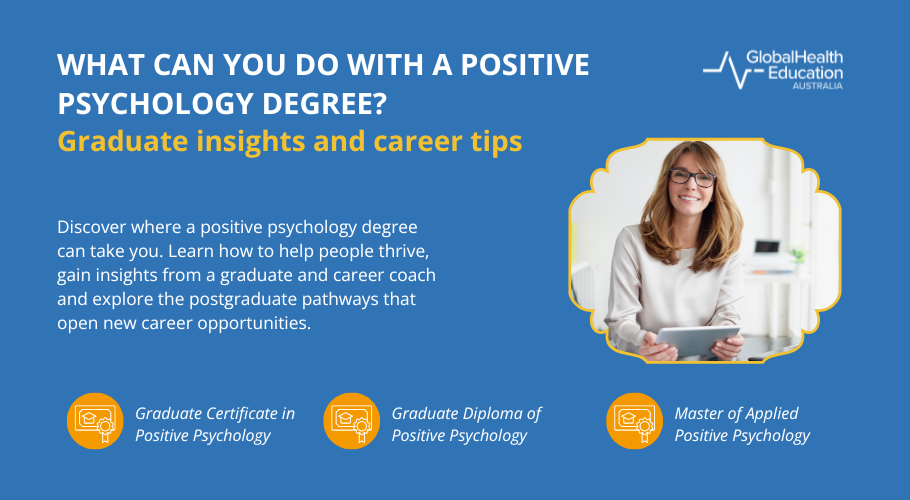
Around 1 in 5 Australians experienced a mental health disorder in the past 12 months, emphasising the continued need for skilled professionals who are able to support people with their mental wellbeing. When people’s mental health and wellbeing are supported, they are more likely to feel happier, more connected and valued in their everyday lives and communities.
Whether you’re a part of the existing mental health workforce, are a broader health professional or have a background in another field, a postgraduate degree in positive psychology provides valuable skills to help support the wellbeing of individuals and groups and can help people live more fulfilling lives.
This article explores what you can do with a positive psychology degree, featuring insights from a graduate and successful career coach, for a deeper understanding of how these skills apply across diverse sectors such as business, consulting, education and healthcare.. You’ll also learn about the differences between positive psychology and traditional psychology concepts and what postgraduate courses are available to help you boost your career.
What is positive psychology?
Positive psychology is a branch of psychology that focuses on the aspects of life that help people thrive, enjoy more satisfaction, engagement, positive relationships and feel a sense of accomplishment. It encompasses the strengths, behaviours and holistic conditions that lead to better wellbeing, resilience and meaning.
Positive psychology uses an evidence-based framework to help people navigate difficulty more effectively. In this way, strategies for improvement shift from a mental illness to a mental wellness approach.
Originally derived from the work of psychologist, Dr Martin Seligman, the positive psychology field has grown significantly over the past three decades. Today, practitioners and professionals from various fields can use positive psychology to design interventions that help individuals, organisations and communities thrive.
The primary framework of positive psychology is in the PERMA model, which is a wellbeing approach that outlines five core elements that are essential to human happiness and wellbeing. Here is a breakdown of what this model entails:
P – Positive emotions: cultivating joy, optimism, gratitude and contentment while maintaining a hopeful outlook on life.
E – Engagement: experiencing being deeply absorbed and in a flow-state while immersed in an activity that matches your skills, passions and interests.
R – Relationships: fostering supportive, meaningful and positive social or loving connections with others to promote a sense of worth.
M – Meaning: having purpose and direction, which can involve serving something larger than yourself, such as religion, spirituality or a meaningful cause.
A – Accomplishment: pursuing and achieving goals, experiencing competence and mastery and taking pride in what you do.
Some strategies used in positive psychology that can help promote better wellbeing through the above principles include mindfulness and optimism exercises, setting meaningful goals and adopting a gratitude practice.
What can you do with a positive psychology degree?
A degree in positive psychology can help you support the wellbeing of individuals and communities alike, with valuable skills that can be used in a variety of settings.
As the curriculum across many of these courses focuses on optimising human behaviour, relationships and promoting wellbeing, the skills gained are useful in roles such as human resources, government agencies, education, coaching, business, marketing, consulting and legal professions. Positive psychology can be used to build more cohesive teams, promote individual resilience, highlight personal and professional strengths, create supportive workplaces and improve employee wellbeing.
For healthcare professionals such as registered nurses and allied health providers, using positive psychology interventions can help improve patient outcomes in various ways. They may use strategies to help foster a positive life outlook, strengthen social connections and support individuals with goal-setting to address their holistic health needs and support overall wellbeing.
In administrative roles, healthcare managers and leaders can leverage positive psychology skills to support staff wellbeing, improve morale and foster more positive and sustainable workplace cultures. A positive psychology qualification gives you the freedom to integrate evidence-based wellbeing practices into your specific role in a way that suits you and your career.
Postgraduate positive psychology courses
There are several postgraduate pathways available to professionals interested in building their expertise in positive psychology.
Graduate Certificate in Positive Psychology at CQUniversity
Course overview
The CQUniversity Graduate Certificate in Positive Psychology introduces students to the historical, developmental and practical application of positive psychology principles. This course comprises four units and is delivered online over six months at a full-time study load and can also be undertaken part time.
Who is this course for?
This course is an ideal entry point for professionals looking to build foundational skills in coaching for positive change, whether it’s for individual or group facilitation in a range of contexts and settings. It suits those with a background in healthcare, education, coaching, consulting and community service.
To gain entry into this course, you must meet the English language proficiency requirements and possess one of the following:
- A completed bachelor’s degree or higher
- A completed AQF diploma and two years of relevant employment experience
- Five years of relevant employment experience
What skills do I gain from this course?
- Understanding the nature of wellbeing, resilience and human flourishing
- Designing and implementing positive psychology interventions in coaching, healthcare or organisational settings
- Supporting individuals and groups by building strategies for engagement, goal-setting and holistic wellbeing

Learn to design evidence-based positive psychology interventions through flexible online study, building the knowledge and skills to promote wellbeing, resilience and positive change across diverse settings.
Graduate Diploma of Positive Psychology at CQUniversity
Course overview
The Graduate Diploma of Positive Psychology from CQUniversity is a more in-depth course compared to the graduate certificate, equipping students with fundamental skills and knowledge of the positive psychology model. This course comprises eight core units, which take around 12 months to complete full-time, with a part-time option available for added flexibility.
Who is this course for?
Similar to the graduate certificate, this course is aimed at professionals with backgrounds in education, consulting, community service, coaching and healthcare. It is suited to those interested in developing a wellbeing-focused practice or offering relevant to their specific role. Graduates will be equipped to work collaboratively with people from various demographics and cultural backgrounds in both local and global contexts to cultivate greater resilience, strength-awareness and performance.
To gain entry into this course, you must meet the English language proficiency requirements and possess one of the following:
- A completed bachelor’s degree or higher
- A completed AQF diploma and two years of relevant employment experience
- Five years of relevant employment experience
What skills do I gain from this course?
- Understanding interdisciplinary and cross-cultural approaches to wellbeing
- Designing and implementing positive psychology interventions for individuals
- Evaluating the importance of sleep, nutrition, exercise, social support, fun and creativity on wellbeing outcomes
- Facilitating groups and applying advanced coaching to promote positive change
- Developing wellbeing initiatives across local and global contexts
- Critically evaluating research to support an evidence-based professional practice
Master of Applied Positive Psychology at CQUniversity
Course overview
The Master of Applied Positive Psychology from CQUniversity is designed to give professionals from various backgrounds with thorough knowledge and advanced skills to help improve the mental, emotional and physical wellbeing of individuals and populations. This course comprises 10 units, which usually takes two years to complete full-time. Students can enrol in this course either at a full-time or part-time study load.
This course blends concepts from positive psychology with coaching psychology, health promotion, positive education, counselling, asset-based community development, eco-psychology and social innovation. You’ll graduate with a unique and comprehensive qualification that’s been developed in consultation with industry experts from the South Australian Health and Medical Research Institute Wellbeing and Resilience Centre.
Who is this course for?
This master’s degree prepares graduates for senior leadership and advanced roles in healthcare, corporate wellbeing, education and more, using comprehensive positive psychology skills to create positive change. It’s ideal for those interested in managerial, coaching, training or counselling and may be well-suited to social workers, counsellors, nurses and broader allied health professionals.
To gain entry into this course, you must meet the English language proficiency requirements and hold a bachelor’s degree or higher equivalent qualification.
What skills do I gain from this course?
- Applying positive psychology principles in practice
- Enhancing wellbeing and resilience across individuals and communities
- Facilitating positive change for individuals, groups and organisations
- Developing group facilitation and advanced coaching skills
- Using interdisciplinary and cross-cultural approaches to wellbeing
- Supporting strengths-based practice across diverse age groups and environments
- Evaluating the effectiveness of wellbeing programs and interventions
- Applying research methods and reviewing literature on positive psychology to build an evidence-based practice
- Designing and undertaking supervised research projects in applied positive psychology

Build advanced knowledge of positive psychology through an evidence-based online master's degree that prepares you to design, implement and evaluate wellbeing initiatives and applied research across professional and community settings.
Master of Applied Positive Psychology at the University of Melbourne
Course overview
The University of Melbourne's Master of Applied Positive Psychology is another postgraduate option for those interested in advanced theoretical and highly practical positive psychology skills. This course explores current evidence-based approaches to the science of wellbeing that can be applied in both personal and professional settings.
The coursework provides a strong foundation of the history of positive psychology, with innovative perspectives from industry leaders. This master’s degree is delivered face to face and takes around 12 months to complete full time, with a part-time study option also available to students. There are six core units as part of this course, plus a capstone unit where students will design a project grounded in the science of positive psychology or wellbeing science, within the context of their choice. This provides a unique learning opportunity, where students can tailor the research component of their degree to match their professional goals.
Who is this course for?
This positive psychology master’s degree is for professionals seeking a versatile qualification that can be used to support roles in education, human resources and consultancy. It suits sole practitioners, entrepreneurs, team leaders and coaches as well as healthcare professionals from various disciplines. Graduates will have the skills to build an ethical and professional practice through experiential, allied and research-informed learning approaches.
To be considered for entry into this master's degree, you must meet the English language proficiency requirements and possess one of the following:
- A bachelor’s honours degree or equivalent in a cognate area
- A three-year undergraduate qualification in a directly related discipline and at least two years of documented relevant work experience
- A three-year undergraduate qualification and at least 50 credit points or equivalent of graduate study in a cognate area
Disciplines directly related to this course include (but may not be limited to) business, economics, education, management, medicine, political science, public health, psychology and sociology. Relevant work experience may include consultancy, entrepreneurial, educational, health-related, human-resources or law professional roles.
What skills do I gain from this course?
- Understanding the conceptual and theoretical foundations of positive psychology
- Applying wellbeing science in professional and personal contexts
- Synthesising wellbeing frameworks from different disciplines
- Designing strategies to enhance health, wellbeing and optimal functioning
- Applying positive psychology in organisations, education and community settings
- Understanding systems-informed approaches to change
- Reflecting on strengths, weaknesses and ethical professional practice
- Understanding sustained behaviour change
- Supporting positive leadership in workplaces
- Critically reviewing wellbeing science and research

Gain a scientific understanding of how humans flourish and how communities and institutions can be strengthened through positive psychology.
How does positive psychology differ from traditional psychology?
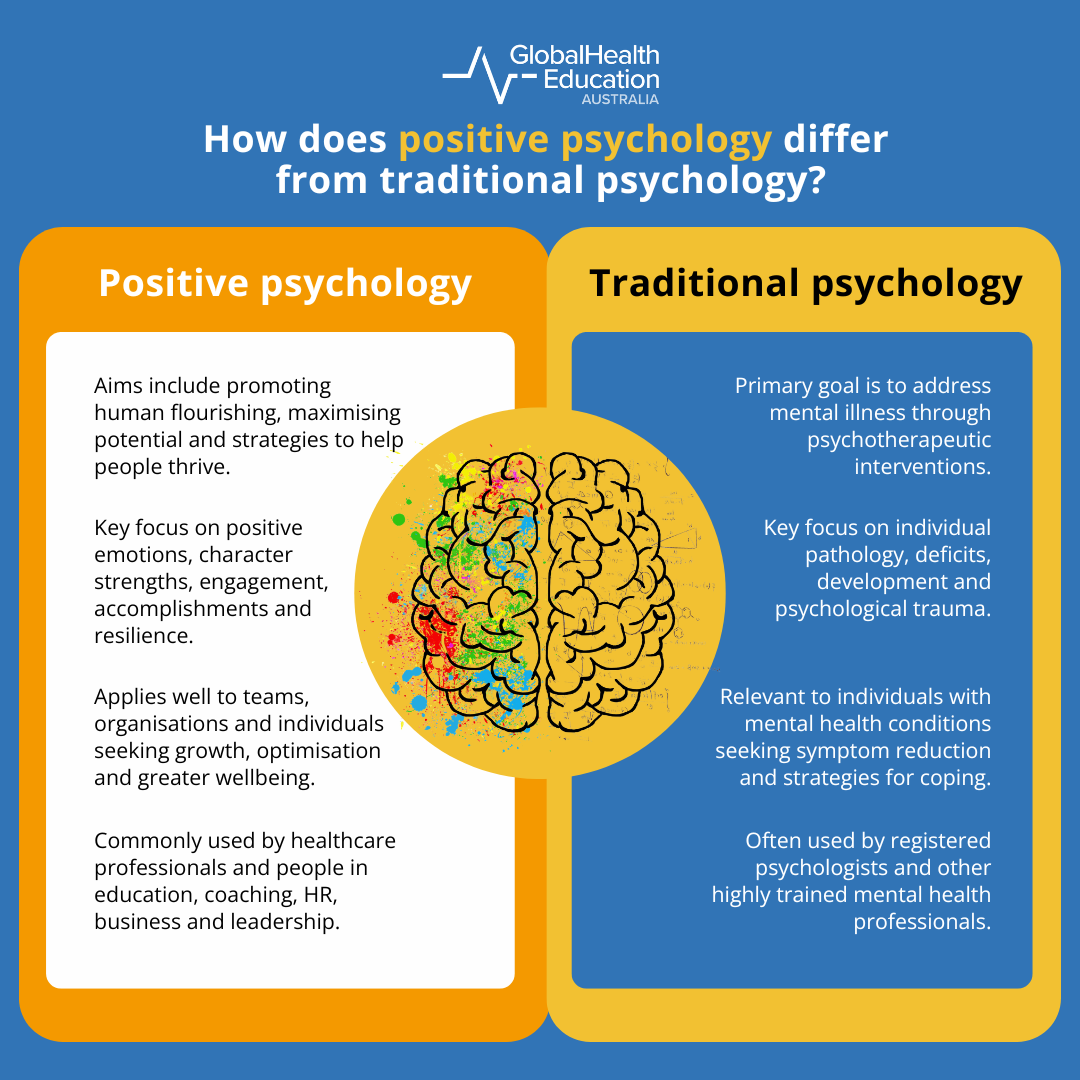
The differences between positive psychology and traditional psychology frameworks primarily lie in the treatment focus and approach.
Positive psychology focuses on wellbeing, human strengths, resilience and the factors that help individuals and communities thrive. This model does not ignore the presence of mental health problems – instead, it explores how people can lead fulfilling lives even when experiencing challenges.
In contrast, traditional psychological frameworks typically concentrate on diagnosing and treating mental illness, such as anxiety, depression and trauma, while reducing psychological distress and their associated symptoms. In many cases, professionals who use traditional psychology interventions in their role are highly trained mental health professionals, such as registered psychologists, accredited mental health social workers or counsellors.
Positive psychology is not a replacement for traditional clinical psychology. Instead, it could be considered as a complementary approach that expands a practitioner's toolkit.
Career insights from a postgraduate positive psychology graduate
To provide a real-world perspective on studying positive psychology, we spoke with Catriona, an Education Consultant at GlobalHealth Education and career coach who completed a Graduate Diploma of Positive Psychology through CQUniversity.
Catriona first discovered positive psychology during her undergraduate degree. She felt drawn to the idea of focusing on what is "right" with people, which aligned with her interest in ethics and helping people get the most out of life. Catriona now attributes her career trajectory to her initial exploration of positive psychology principles.
“Until I came across positive psychology, I never knew what I wanted to be when I “grew up”, so to speak. I had many interests, but that “ah-ha” moment only came after discovering positive psychology. That’s when I knew I wanted to be a coach and it’s led me here – helping, supporting and guiding people to draw on their strengths in order to align their careers with who they truly are and what they truly want to be, both now and into the future.”
Throughout the course, Catriona found the coaching units particularly engaging, as they directly aligned with her professional aspirations of career development coaching. While she found the mandatory research methods and statistics unit challenging, the overall authentic and highly applicable nature of the assessments kept her motivated.
Reflecting on the key skills she’s acquired through her studies, Catriona says skills in active listening, motivational interviewing and her ability to evaluate and use evidence-based interventions have been some important learning areas that she uses in her role.
She also says that understanding people’s character strengths is now an essential component of how she works with people in her coaching business. “Once we understand what we naturally do well and how to use our strengths intentionally, everything begins to shift.”
While she acknowledges that her positive psychology training is highly relevant to her coaching practice, on a personal level, she says these skills have deepened her patience and understanding as a parent and has also had a profound impact on her worldview.
“Honestly, this [course] has affected every aspect of my life. From personal to professional relationships, how I see myself and the rest of the world, to how wellbeing can best be supported across the lifespan – and so much more.”
Catriona says that those in people-focused roles where optimising the human experience becomes important would be well-suited to completing a positive psychology degree. “If you work with or deal with human beings at all, positive psychology is for you.”
She says managers, HR professionals, teachers, professors, sports coaches, mental health providers, nurses, doctors and managers, as well as those in organisational development, would find the content throughout these courses highly relevant. A postgraduate degree in positive psychology can broaden your career opportunities and equip you with the skills to promote wellbeing across diverse settings.
Catriona, our Education Consultant, is ready to help you choose the right positive psychology course to match your needs. She can provide personalised career advice and offer further insights from her own study experience. Book a complimentary call today to get started.
Develop your skills with a positive psychology degree
A positive psychology degree can provide you with evidence-based expertise to build resilience, enhance wellbeing, and create positive outcomes across healthcare, education, HR and other human-centred fields.
Whether you are in a managerial, team-based or clinical role, your positive psychology skills can support better wellbeing, resilience and outcomes. Explore the postgraduate positive psychology degrees mentioned throughout this article and find one that aligns with your goals.