In This Article

Why trust GlobalHealth Education?
-
Our in-house editorial team and healthcare advisors write and review our content.
-
The information in our content provides clarity and insights to help you compare courses.
-
We list postgraduate courses from 25+ respected and reputable institutions in Australia.
Balancing the demands of work and study as a healthcare professional might seem like a daunting task. The good news is, there are flexible courses designed to help you upskill that fit around your personal and professional life. From online and hybrid learning options to courses that have multiple intakes per year, there are some unique features that make these courses flexible.
Read on to discover a range of graduate certificates, graduate diplomas and master's degrees in a variety of healthcare areas that offer genuine flexibility and help make the process of taking on further study easier. You’ll also learn why flexibility matters as a healthcare professional and what to prioritise when choosing a postgraduate course.
Why flexible courses are ideal for healthcare professionals
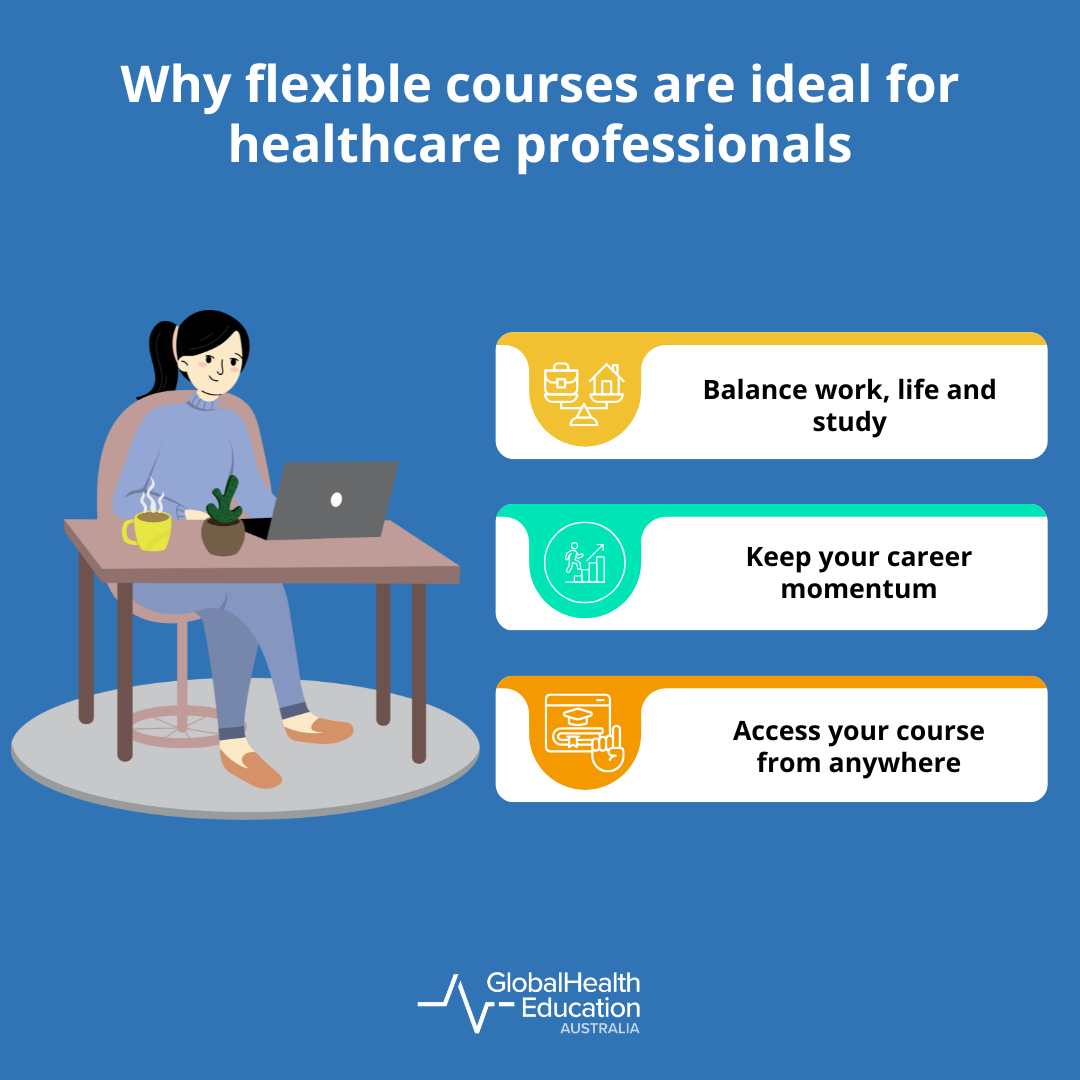
Flexible postgraduate courses have become a mainstay option to help advance your career in healthcare. Here are a few key reasons why flexible courses have become more popular and indeed necessary for the busy, working healthcare professional.
Seamlessly balance work, life and study
These postgraduate courses offer a pathway to gain an advanced qualification without stepping back from your current role. You might be a nurse working busy hospital shifts or a mental health practitioner committed to working face-to-face with clients. You may not always have the flexibility with work to attend in-person lectures or travel to a university campus.
Choosing a course that delivers maximal flexibility to fit around your family responsibilities and hobbies is also increasingly important to postgraduate students. You may be at a point in your life where you’ve been in the workforce for some time or have started a family and have financial responsibilities to uphold. It’s important to find an option that caters to your needs and come up with a plan to help it succeed.
Flexible courses, particularly those delivered completely online, allow you to access course materials, participate in discussions and complete assessments at times that suit you – whether that be after work, early in the morning or on weekends. This autonomy reduces the stress of managing your already busy schedule and ensures that your education complements, rather than disrupts, your professional and personal life.
Keep your career momentum
The idea of postgraduate study is to advance your career, open doors to new roles and ultimately give you more opportunities to shape your future in a way that suits you. The momentum you gain in certain roles as you navigate systems, hone your clinical knowledge and network with peers all help to build your skill set, expertise and authority in your chosen field.
If upskilling requires you to take a step back and pause your career, you may not consider the study commitment worth it. Taking a break from the workforce to complete your studies can mean a pause in salary and creates a gap in your CV. In response to this, universities and tertiary education providers have needed to adapt to the needs of students. Nowadays, they deliver study options that add more value, are adaptable and without the complication.
Taking on a flexible postgraduate course while continuing to work also gives you the chance to apply what you learn in real time. As you acquire new skills in an advanced or specialised field, you can demonstrate these competencies in your current workplace immediately. Doing this also signals to your employer that you’re taking a proactive approach to your professional development, helping them to see the long-term gain in having an expert practitioner who can contribute meaningfully.
Access your course from anywhere in Australia
Australia’s medical, nursing, social care, allied health and aged care sectors fall into the health and social care industry, which makes up over 2 million employed professionals nationally. It is the largest employing industry in the country and shows consistent annual growth trends across many fields. These professionals are spread across many parts of the country, and while a majority live and work in major cities, many also come from or relocate to smaller towns.
Historically, the pursuit of postgraduate education may have been limited to those who could move to a capital city or take a long journey to attend their course in person. The advent of flexible courses, particularly those with frequent intakes or an online or blended learning model, has revolutionised access to education, including postgraduate study. Flexible courses have helped remove the barrier to high-quality tertiary education. There’s no longer a need for a lengthy commute to a distinguished university or to uproot your entire life to pursue your broader professional ambitions and passions.
You can now study with leading universities and gain the same accredited qualifications as your metropolitan counterparts without the financial and personal cost of relocation. This is particularly vital for closing the skills gap in rural healthcare and gives those who are passionate about providing care in under-resourced areas the opportunity to support the community, build valuable expertise and potentially seek future roles further afield.
What to look for in a flexible postgraduate healthcare course
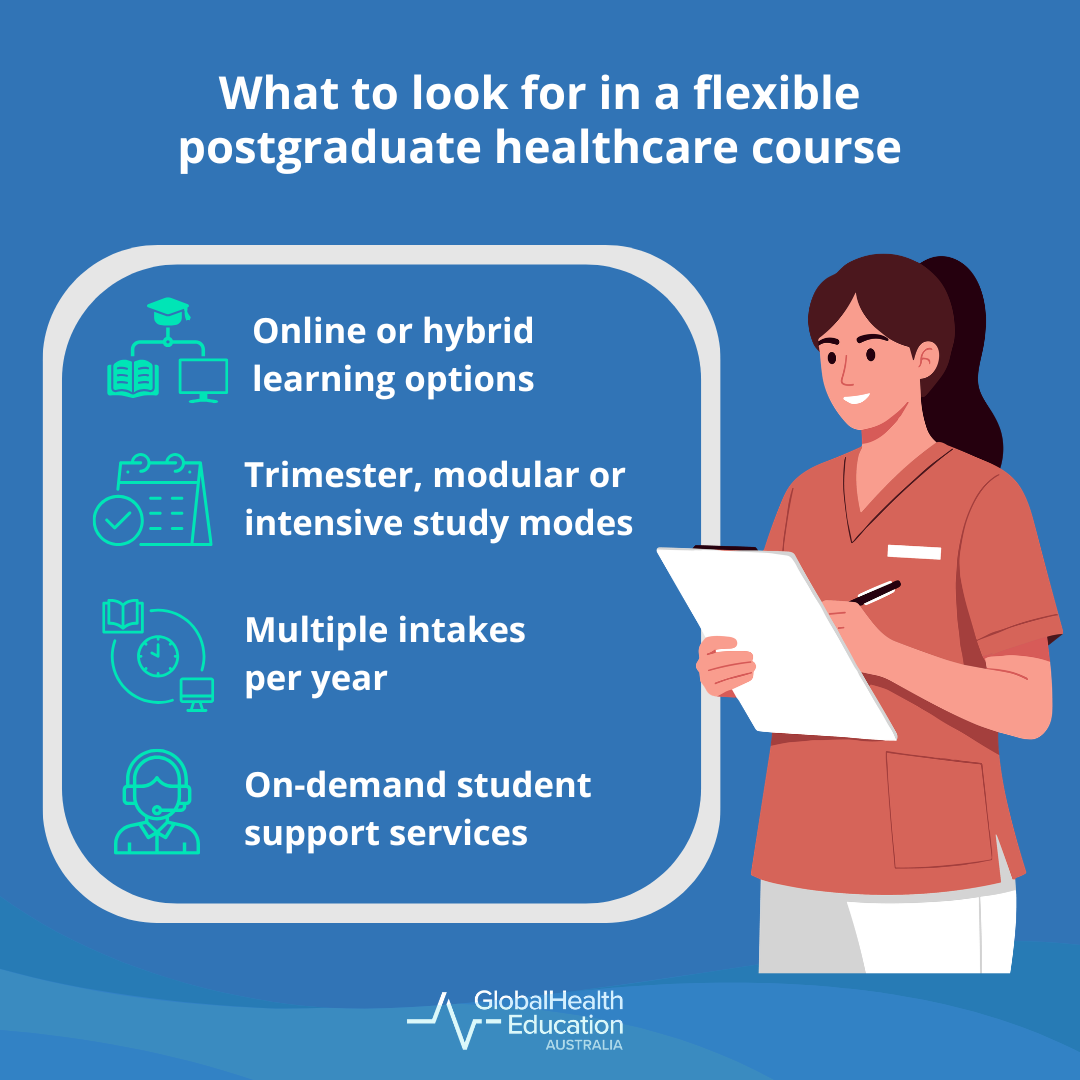
When evaluating your options, it helps to understand some of the features that make a course flexible to find one that suits your needs. Here are some things to look for in a flexible postgraduate healthcare course:
Online or hybrid learning options
By now, you get the picture that an online course lets you study from anywhere and in your own time. Look for programs that offer dedicated online units and learning resources that are interactive and accessible 24/7. While some courses may have a clinical practicum component that requires you to attend a placement, hospital or other healthcare setting in person, engaging in the rest of your course online ensures maximum flexibility suitable for most lifestyles. Many courses offer a blended or hybrid model, which means they contain a combination of online and on-campus units in a structured format, giving you some flexibility with how you study.
Some universities offer even greater flexibility, catering to ongoing student needs with options like ‘StudyFlex’, available at universities such as James Cook University and La Trobe University. These courses are designed to be interchangeable, meaning you choose as you take on each unit whether you want to study on campus or online. Your course ends up being tailored entirely to suit your needs, as and when they change throughout the duration of your studies. Ultimately, having flexible delivery modes gives you the freedom to choose what fits your schedule best.
Trimester, modular or intensive study modes
Rigid study timeframes are becoming less common in the wake of flexible course options. Traditionally, universities operate on a semester-based calendar, with two semesters per year, each typically lasting around 12 to 14 weeks of teaching, followed by assessment periods. While this model may be suitable for full-time or undergraduate students, it can be challenging for working healthcare professionals to commit to overly long study periods. In light of this, many universities have adopted a trimester model, which divides the academic year into three shorter teaching periods. Trimesters provide greater flexibility, allow you to spread or accelerate your study and create more opportunities to balance work, life and study efficiently.
A unique example of an innovative approach to flexible learning is Victoria University’s Block Model, which is specifically designed to support busy professionals, including those working in healthcare. Under this model, you undertake one unit at a time in intensive blocks that usually last four weeks. This way of learning can be a more manageable option that’s less overwhelming than juggling multiple units simultaneously. This modular format at VU, as well as other flexible options at different universities, can help you complete your studies faster, supporting your career growth.
Multiple intakes per year
Many courses have February or July intake dates, while others may have only one per year. Waiting around for an early or mid-year intake to begin your studies sometimes doesn’t align with your life or your work. This means that if you’re not ready to enrol by one particular deadline, you need to wait another six or 12 months to try again.
In contrast, postgraduate courses with multiple yearly start dates let you begin when it suits you. Universities that offer flexible options may have up to six intakes a year. For example, universities such as Southern Cross University, Edith Cowan University and the University of Technology Sydney frequently have courses with several intake options throughout the year. Multiple yearly intakes give you the freedom to reassess more often throughout the year to determine your readiness to take on study, without any extra pressure added to the rest of your life.
On-demand student support services
In the context of online learning, where you’re accessing your resources from home or away from on-campus services, it’s important you choose a university that has strong student support. Flexible learning can often mean you’re studying more independently, managing your own schedule and engaging with content at times that suit your work and personal commitments. When you choose to study may be outside of standard business hours.
Without easy access to helpful resources, student services or academic staff, your flexible course may suddenly feel quite inflexible and stuck. It’s essential to know you have help available so you can stay connected and continue your learning journey. Courses that offer strong on-demand support, such as chatbots, troubleshooting forums or technical assistance with real experts, help ensure you’re not alone and you can stay on track with your studies.
9 postgraduate healthcare courses offering the most flexibility
Here are several flexible postgraduate healthcare study options to consider that suit a range of needs and goals:
Flexible graduate certificates
Graduate Certificate in Healthcare Leadership - Southern Cross University
Who is this course for?
This course is designed for those with a health-related bachelor’s degree, including nurses and allied health professionals. It could suit those who are ready to step into management and leadership roles and use their passion for making an impact in diverse healthcare settings.
What skills do you gain?
- Leadership strategies for managing multidisciplinary teams
- Ability to drive organisational change
- Enhanced problem-solving and decision-making skills
- Management capabilities for navigating complex healthcare contexts
What are the unique and flexible features of this course?
- 100 per cent online
- Complete your studies part-time in 8 months
- Six intake dates per year
- Up to a 20-hour per week study commitment
- Learn through quizzes, presentations and videos, without exams
- Anyone with a bachelor’s degree in a health-related field can apply

Delivered online and designed to build your knowledge to meet leadership challenges in multidisciplinary and complex healthcare delivery.
Graduate Certificate of Mental Wellbeing - Edith Cowan University
Who is this course for?
This course is ideal for professionals across various sectors who want to improve mental health outcomes for themselves or within their workplace. It’s aimed at those with a bachelor’s degree or prior relevant professional experience who may be seeking broader knowledge of mental health and wellbeing practices. It provides a shorter qualification and the opportunity to assess whether a mental health career might be a suitable future career path.
What skills do you gain?
- Practical approaches to promoting individual and community mental wellbeing
- A deeper understanding of key mental health concepts and frameworks
- Cultural competency skills to help support diverse groups
- Counselling knowledge to apply to the self and others
What are the unique and flexible features of this course?
- 100 per cent online
- Study one unit at a time over a seven-week study period
- Complete your studies part-time in 6 months
- Six intake dates per year
- Anyone with a bachelor’s degree from any field can apply
- Provides a seamless pathway to further study with ECU’s Master of Mental Health for a career focused on the mental health sector


Develop essential skills and knowledge to improve mental health outcomes in communities, workplaces and therapeutic settings.
Graduate Certificate of Nursing Majoring in Advanced Practice - James Cook University
Who is this course for?
This flexible nursing degree is for registered nurses or midwives interested in deepening their expertise to move into advanced practice and leadership roles, such as clinical nurse specialist, clinical nurse consultant and nurse unit manager. Graduates will acquire advanced clinical capabilities to deliver high-quality care in a range of healthcare settings.
What skills do you gain?
- Pharmacological knowledge to support the safe, effective and ethical use of medicines in clinical practice
- Capacity to understand, evaluate and contribute to clinical governance frameworks within healthcare organisations
- Competence in conducting comprehensive health assessments across diverse patient populations
- Professional communication skills to collaborate effectively within both multidisciplinary teams and patient care contexts
What are the unique and flexible features of this course?
- 100 per cent online
- Study one unit at a time over a seven-week study period
- Complete your studies part-time in 8 months
- Six intake dates per year
- Besides the advanced practice specialisation, you can also choose a leadership and management pathway to customise your career


Acquire specialized knowledge and skills in your selected area of nursing.
Flexible graduate diplomas
Graduate Diploma in Ageing, Wellbeing and Sustainability - Western Sydney University
Who is this course for?
This graduate diploma is aimed at professionals of any background, not limited to healthcare. It offers an opportunity to expand your professional scope to work in the aged care sector with a focus on individual and community wellbeing, policy or planning. It may be ideal for those interested in developing a systems-level thinking approach to challenges and solutions relevant to an ageing population.
What skills do you gain?
- Comprehensive understanding of ageing, wellbeing and sustainability across healthcare and within social, diverse cultural and policy contexts
- Ability to analyse and respond to complex ageing-related challenges using evidence-based and ethical frameworks
- Skills to ensure the continuous improvement of quality and safety in aged-care and community settings
- Confidence in critical thinking, research literacy and policy awareness to inform professional practice
What are the unique and flexible features of this course?
- 100 per cent online
- Complete your studies full-time in 12 months (can also be studied part-time)
- Two intakes per year Anyone with a bachelor’s degree from any field can apply
- A nested qualification that provides a direct pathway to the master’s degree and an early exit option with the related graduate certificate


Take a role in transforming a society that recognises older people as active contributors to the betterment of themselves and their communities.
Graduate Diploma of Psychology (Bridging) - James Cook University
Who is this course for?
This unique bridging course affords professionals from any field other than psychology the opportunity to transition into the psychology profession. Knowledge gained from this course may be beneficial to existing roles, including human resources, education and counselling. As an Australian Psychology Accreditation Council (APAC)-accredited course, this program provides an important stepping stone to becoming a registered psychologist in Australia.
What skills do you gain?
- Enhanced understanding of psychological concepts across the lifespan
- Ability to integrate and apply major theories and historical perspectives in psychology
- Critical evaluation skills in research methodology, data interpretation and ethical decision-making in psychology
- Capacity to design, evaluate and deliver initiatives that promote mental health, resilience and wellbeing
What are the unique and flexible features of this course?
- 100 per cent online
- Study one unit at a time over a seven-week study period
- Complete your studies part-time in 20 months
- Six intake dates per year
- Up to a 20-hour per week study commitment In-demand, applicable skills to strengthen person-centred careers
- APAC-accredited course
- Presents a direct pathway upon further training to become a registered psychologist

Get APAC-accredited training, study entirely online and start your journey toward psychology registration.
Graduate Diploma in Rural and Remote Nursing Practice - La Trobe University
Who is this course for?
This course is for registered nurses interested in expanding their skills and expertise for roles in rural nursing practice. It's ideal for those passionate about rural and remote area nursing with a drive to deliver person-centred and culturally-aware care to under-resourced or isolated communities.
What skills do you gain?
- Advanced understanding of rural and remote health care practices, including cultural competency and telehealth integration
- Clinical expertise in urgent care, advanced life support and palliative care
- Ability to demonstrate effective communication within communities and geographically dispersed multidisciplinary teams
- Leadership capabilities for advanced practice roles in rural settings, supporting career progression and development
What are the unique and flexible features of this course?
- 100 per cent online
- Complete your studies full-time in 12 months (can also be studied part-time)
- Four intakes per year Develop the requisite core skills to work in rural and remote settings, as identified by the Council of Remote Area Nurses of Australia (CRANA)
- Presents a direct pathway to pursue the Master of Nurse Practitioner for advanced clinical assessment skills and enhanced scope of practice


Learn the latest in evidence-based nursing care so you can make an impact.
Flexible master’s degrees
Master of Business Administration (Health) - University of Technology Sydney
Who is this course for?
This MBA with a health specialisation is ideal for early or mid-career professionals with a bachelor’s degree plus relevant work experience who are interested in moving into the healthcare field. It may be suitable for professionals seeking leadership or executive roles and the ability to integrate their knowledge of business, finance and healthcare to inspire innovation and improvement.
What skills do you gain?
- Leadership and management skills to help inspire change, drive organisational strategy and guide healthcare teams
- Ability to deliver sound financial and business decisions using economic and data-driven insights
- Expertise in healthcare systems to improve service delivery and outcomes
- Strong problem-solving skills to address complex challenges in the healthcare sector
- Cultural competency skills to connect and collaborate with diverse teams and stakeholders
What are the unique and flexible features of this course?
- 100 per cent online
- Complete your studies part-time in two years (minimum)
- Up to a 20-hour per week study commitment
- Six intakes per year
- Anyone with a UTS-approved bachelor’s degree plus four years full-time, or equivalent relevant work experience can apply


100% online and delivered by the UTS AACSB accredited Business School, this course is designed to prepare leaders with the commercial understanding and business acumen needed to ethically innovate and enable a sustainable future.
Master of Public Health - University of Melbourne
Who is this course for?
This master’s degree is for professionals with a public health background or those with an undergraduate degree in any field, plus relevant experience in a health-related setting. It is also open to Ahpra-registered professionals, including nurses and allied health professionals. It is well-suited to those looking to excel in the public health sector to promote the needs of populations at a national or international level. Graduates can pursue positions in health promotion and epidemiology, influencing public health policy and research.
What skills do you gain?
- An integrated understanding of the social, economic and environmental factors that impact population health
- Ability to use statistical evidence to assess the cost-effectiveness and relevance of health programs
- Leadership and strategic management skills to influence change, inspire teams and promote health equity
- Skills to plan, design and oversee research projects for policy development in a range of public health areas
What are the unique and flexible features of this course?
- 100 per cent online
- Complete your studies part-time in 18 months
- Six intakes per year
- Study one subject per eight-week teaching period for optimal focus and learning
- Course structured for students to take breaks and learn at a pace that suits them
- Customisable to meet your career goals, with six core subjects and your choice of four electives from eight available within the public health stream

Learn from leaders in public health at Australia's #1 University.
Master of Nursing (Nursing Informatics Leadership) - Victoria University
Who is this course for?
This course is aimed at registered nurses who are interested in a leadership role that encompasses knowledge of digital healthcare and informatics to guide innovation in a variety of healthcare settings. The advanced skills from this master’s degree can open doors to many roles, including clinical research nurse, clinical nurse consultant, director of nursing and nursing informatics manager.
What skills do you gain?
- Advanced knowledge of healthcare informatics knowledge and digital tools to enhance clinical decision-making and service delivery
- Cultural competency skills that support evidence-based approaches to improve outcomes in diverse populations
- Leadership capabilities to help promote the safety and quality of healthcare initiatives in complex environments
- Skills in critical research and study design to drive advancements in specialist clinical areas
- Ability to advance nursing knowledge and practice through research, evaluation and professional development programs
What are the unique and flexible features of this course?
- 100 per cent online
- Complete your studies part-time in two years
- Five intakes per year
- No exams required and seven-day student support
- One unit at a time ‘block model’ learning for better flexibility, focus and work-study-life balance


Combine nursing expertise with digital health leadership to improve clinical systems, workflows, patient safety and technology-enabled care.
Tips for choosing the right flexible course to suit you
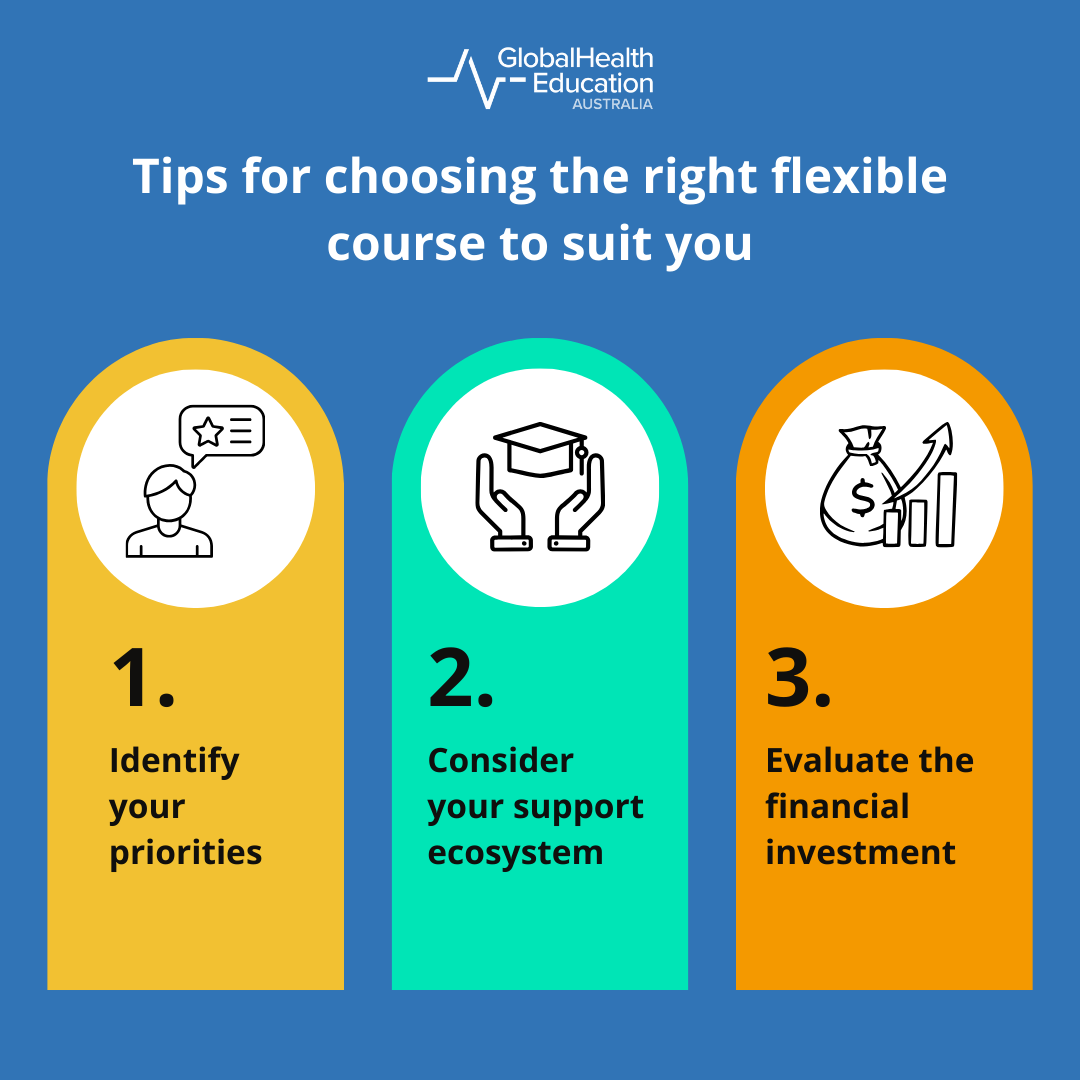
Narrowing down your choices requires taking a strategic approach to consider your study needs, career goals and the investment of postgraduate study.
Identify your priorities
A good place to start is by asking yourself what the term ‘flexibility’ means to you. Determine if that means finishing your course as fast as possible, which might mean choosing a course with an intake date in the near future.
Or, if you’re unsure if you’ll be able to fully commit to a master’s degree, that might mean you should consider a study option with a nested degree so you can exit with a graduate certificate or graduate diploma.
Perhaps you simply need the course to be accessible where and when you need it, which would make an online course an ideal option for you. Getting clear on your specific needs can help you choose a course that offers the most flexibility to suit your life today and as it evolves.
Consider your support ecosystem
As mentioned, when choosing a flexible course, it’s important to consider the support systems and student services available. This can make a significant difference to your overall learning experience, level of engagement and motivation to complete your course. This is especially true for flexible online courses where your interaction is solely virtual with student peers, support and staff.
Look for universities that have a well-resourced student hub and resources, including career guidance, IT support, networking opportunities and study workshops. Knowing that these support systems are in place can give you a sense of connection and belonging, helping you feel part of a larger learning community while you confidently pursue your career goals.
Evaluate the financial investment
Postgraduate study is an investment in your future earning potential, but the immediate costs involved are something to consider carefully. Some postgraduate courses offer limited Commonwealth Supported Places (CSPs), which are a government subsidy that can help reduce the overall cost of your tuition fees.
You may also be eligible for FEE-HELP, which allows you to defer your course fees so there’s no upfront cost upon enrolment or during your studies. Finally, many universities offer a variety of scholarships, including those specifically for nurses, which can cover all or part of your tuition fees. In some cases, scholarships may also be applied to study materials, travel or accommodation. For the most accurate information, refer to your university provider’s scholarship or fees page and enquire directly regarding how to apply.
If you identify as an Aboriginal or Torres Strait Islander person and are undertaking undergraduate or postgraduate study, you may be eligible for the GlobalHealth Education Healthcare Education Scholarship. The recipient of this scholarship will receive $5,000 towards study-related costs, inclusive of course fees, study materials and travel costs.
Take the next step with a flexible healthcare course
Choosing to take on postgraduate study is an important decision to make. Flexible courses have changed the game, making it easier than ever to upskill and advance your healthcare career. You can make an empowered choice and study on the terms that suit you. Whether you want to lead a team, pivot into psychology or pursue a rewarding role in public health, there is a flexible course designed to fit your roster and your lifestyle.
GlobalHealth Education showcases healthcare courses from various respected Australian universities in many fields. You can explore courses in counselling, mental health, nursing, psychology, social work, public health and more. Beyond these fields, there are also several specialised and niche healthcare courses in areas such as allied health, forensic nursing and genetic counselling, to name a few. Find a course and enquire today for more information.
Our Education Consultant, Catriona, is ready and waiting to help you. For personalised career guidance, book a complimentary call today. Catriona can help you map out a study plan that aligns with your lifestyle and professional needs.